Is My Prayer Valid If My Gaze Drifts and Intrusive Images Come?
Answered by Shaykh Faraz Rabbani
Question
Is my prayer valid if my eyes were fixed forward instead of on the place of prostration? And is it valid if images of women came to my mind, and to clear them, I blinked hard or squeezed my eyebrows?
Answer
In the Name of Allah, the Merciful and Compassionate.
Be at ease — your prayer is valid on both counts.
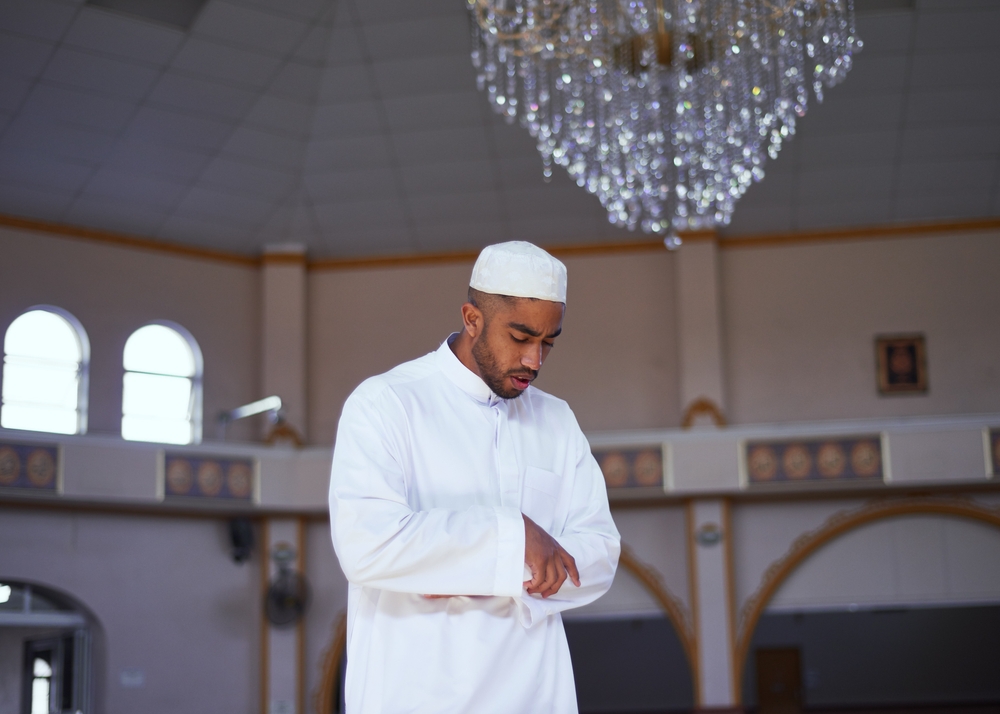
Looking forward rather than at the place of prostration does not invalidate the prayer. Fixing the gaze on the place of prostration is a recommended manner (adab) of prayer, not a condition of its validity.
The Etiquette of Gaze Direction in Prayer
Imam Shurunbulali (Allah have mercy on him) writes that among the etiquette of prayer is “the worshipper looking at the place of his prostration while standing, at the backs of his feet while bowing, at the tip of his nose while prostrating, and at his lap while sitting.” [Shurunbulali, Maraqi al-Falah]
The purpose, he explains, is to guard the gaze from whatever would distract one from humble presence (khushu), mindful of the Prophet’s words (Allah bless him and give him peace): “Worship Allah as though you see Him, for though you do not see Him, He surely sees you” [Bukhari; Muslim]. So if your eyes were forward, simply return to the recommended gaze; nothing is owed.
Dealing with Unwanted Thoughts
As for the intrusive images, thoughts, and images that come unbidden, they are not held against you, and they do not break the prayer, so long as you do not invite them or dwell on them.
Allah Most High praises “those who in their prayer are humbled in devotion” [Quran 23:1-2], and that humility is built by gently returning to the prayer each time the mind wanders — not by waging war on the thoughts. Blinking, or lightly contracting the brow to refocus, is a small and excusable movement; it does not invalidate the prayer.
Presence Is Built by Returning, Not by Fighting
The soul of prayer is the heart’s presence before Allah, and that presence is reclaimed by turning back, calmly and repeatedly. Do not be alarmed by what passes through the mind; bring your attention back to the One before whom you stand, and let that be your quiet work in every prayer.
And Allah knows best.
[Shaykh] Faraz Rabbani
Related
- How Do I Deal with Unwanted Thoughts and Memories That Distract Me during My Prayer?
- How Do I Stop Thinking Negative Things in My Prayer?
- Will Three Consecutive Movements Break One’s Prayer?
Shaykh Faraz Rabbani is a recognized specialist scholar in the Islamic sciences, having studied under leading scholars from around the world. He is the Founder and Executive Director of SeekersGuidance.
Shaykh Faraz stands as a distinguished figure in Islamic scholarship. His journey in seeking knowledge is marked by dedication and depth. He spent ten years studying under some of the most revered scholars of our times. His initial studies took place in Damascus. He then continued in Amman, Jordan.
In Damascus, he was privileged to learn from the late Shaykh Adib al-Kallas. Shaykh Adib al-Kallas was renowned as the foremost theologian of his time. Shaykh Faraz also studied under Shaykh Hassan al-Hindi in Damascus. Shaykh Hassan is recognized as one of the leading Hanafi jurists of our era.
Upon completing his studies, Shaykh Faraz returned to Canada in 2007. His return marked a new chapter in his service to the community. He founded SeekersGuidance. The organization reflects his commitment to spreading Islamic knowledge. It aims to be reliable, relevant, inspiring, and accessible. This mission addresses both online and on-the-ground needs.
Shaykh Faraz is also an accomplished author. His notable work includes “Absolute Essentials of Islam: Faith, Prayer, and the Path of Salvation According to the Hanafi School,” published by White Thread Press in 2004, which is a significant contribution to Islamic literature.
His influence extends beyond his immediate community. Since 2011, Shaykh Faraz has been recognized as one of the 500 most influential Muslims. This recognition comes from the Royal Islamic Strategic Studies Center. It underscores his impact on the global Islamic discourse.
Shaykh Faraz Rabbani’s life and work embody a profound commitment to Islamic scholarship. His teachings continue to enlighten and guide seekers of knowledge worldwide.
