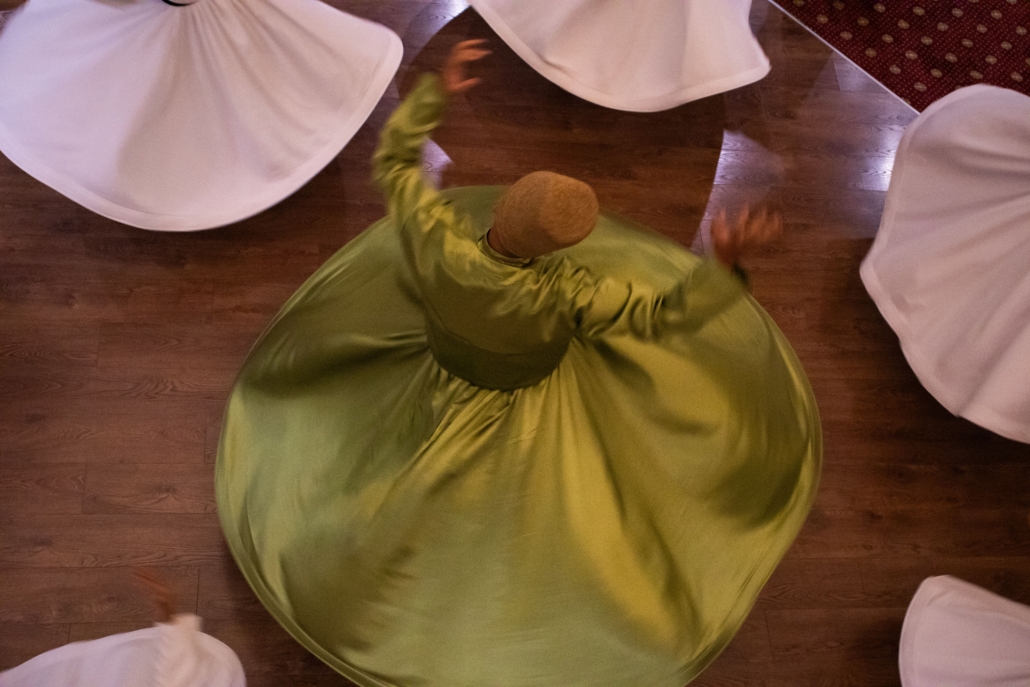
May I Attend and Watch a Whirling Dervish Sema in Konya?
Hanafi Fiqh
Answered by Shaykh Faraz Rabbani
Question
I am visiting the Turkish city of Konya soon, in sha’ Allah. Konya is known for whirling dervish (Sema) performances by practitioners of the Mevlevi order. Is it permissible to attend and observe such a performance?
Answer
In the Name of Allah, the Merciful and Compassionate.
Wa alaykum al-salam wa rahmatullahi wa barakatuh.
This is a matter on which the scholars differed. Many later Hanafi scholars, including Imam Abd al-Ghani al-Nablusi, permitted the Mevlevi samaʿ as a form of remembrance when performed in accordance with its conditions. Based on that view, you may attend and watch respectfully. Go as a guest at a gathering of remembrance, not as a spectator at a show.
Those Who Permitted It
Imam Abd al-Ghani al-Nablusi of Damascus, a leading Hanafi jurist and Sufi, wrote a treatise defending the Mevlevi way, The Pearl Necklaces on the Path of the Mevlevi Masters (al-Uqud al-Luʾluʾiyya fi Tariq al-Sada al-Mawlawiyya). He saw it as remembrance with its proper conditions, not as entertainment.
Shaykh Nuh Keller notes that the Hanafi Imam Khayr al-Din al-Ramli wrote an extensive fatwa in support of the gathering of dhikr with movement in his al-Fatawa al-Khayriyya, and that Imam Nablusi, whom Ibn Abidin always cites as “my master” (Sayyidi), wrote a book in favor of the hadra. [Keller, Sea Without Shore]
Ibn Abidin, the final reference for fatwa in the school, condemns gatherings of dancing, musical modes, and corrupt company. Then he exempts the sincere and upright: “We have no dispute with the truthful among our masters, the Sufis, those free of every base trait.” He relates that Imam Junayd was told of people who were moved in ecstasy and swayed, and he said, “Leave them with Allah.” [Ibn Abidin, Shifa al-Alil]
The Stricter View
Other Hanafis were firm against it. Imam Birgivi and his commentator Khadimi reject swaying or “dancing” in dhikr. [Khadimi, al-Bariqa al-Mahmudiyya] This view deserves respect. It guards the sacred law from being turned into a spectacle.
The Question of the Ney
The Sema is accompanied by the reed flute (ney) and drum. Most jurists prohibit wind and string instruments. Some Sufi scholars permitted them in samaʿ for those whose hearts are wholly turned to Allah.
The Hanafi mufti of Damascus, Abd al-Rahman al-Imadi, was asked about instruments and gave a balanced answer: “Those whose truthfulness cannot be questioned forbade it, and those whose spiritual state cannot be denied permitted it. Whoever finds in his heart some light of gnosis may go forward. Otherwise, stopping at the limits the sacred law has set is safer.” [Muradi, Silk al-Durar; also quoted by Ibn Abidin, Radd al-Muhtar]
Shaykh Nuh Keller is clear on this point. He records that fatwas permitting instruments in sessions of dhikr were adopted by the Mevlevis, and he judges that “the argument behind such fatwas is unconvincing not only because the shari’a should apply to all Muslims equally, but also and most importantly because we cannot establish beyond a reasonable doubt that ‘distracting from Allah’ is the only reason for music’s prohibition.” [Keller, Sea Without Shore]
So if you attend, do not seek out the music for its own sake. Keep your attention on the remembrance of Allah.
Practical Counsel
One. Choose a sincere setting, such as a sema held in a lodge or mosque, opened with a recitation of the Quran and closed with prayer.
Two. Avoid venues where the Sema is mere entertainment: restaurants, hotel shows, places with alcohol or free mixing.
Three. Dress modestly and sit with adab, as you would at a dhikr gathering.
Four. Remember Allah in your heart throughout. Allah Most High says, “Those who believe and whose hearts are at utter peace with the revealed Remindance of Allah: Verily by the remembrance of Allah do hearts find peace.” [Quran 13:28; Keller, The Quran Beheld]
Five. Visit Mawlana Rumi, send salam on the Prophet (Allah bless him and give him peace), and ask Allah for what the dervishes turn toward: presence with Allah Most High.
The principle: a “samaʿ” of sincere remembrance, with its conditions kept, is permitted in the view of many later Hanafi scholars, and the caution of others is a reason for adab, not alarm. Go with a remembering heart, and Konya may give you more than a performance.
May Allah open your heart to His remembrance.
And Allah knows best.
Faraz Rabbani
Related Answers
One. Is Group Dhikr With Swaying Permissible? — Rhythmic dhikr with poetry, permitted by major Hanafi authorities.
Two. The Hadra: Is the Group Dhikr With Singing and Swaying Permitted?— The hadra and the Hanafi scholars who permitted it.
Three. Listening to Islamic Songs with Musical Instruments — The ruling on instruments and the conditions some scholars set.
Four. Is the Duff or Any Other Instrument (to Accompany Dhikr and Nasheed) Allowed in the Masjid? — The duff in dhikr and its limits.
النصوص · Source-Texts
[ابن عابدين، شفاء العليل]
«(ولا كلام) لنا مع الصدق من ساداتنا الصوفية، المبرئين عن كل خصلة ردية، (فقد) سئل امام الطائفتين سيدنا الجنيد ان اقواما يتواجدون ويتمايلون، فقال دعوهم مع الله» ·
[الخادمي، بريقة محمودية]
«وَحِينَ اسْتَفْتَى مِنْ شَيْخِ الْأَخْلَافِ جوي زاده أَفْتَى أَنَّ الرَّقْصَ وَالدَّوَرَانَ حَرَامٌ فِي الْمَذَاهِبِ الْأَرْبَعَةِ» ·
[المرادي، سلك الدرر]
«قد حرمه من لا يعترض عليه لصدق مقاله وأباحه من لا ينكر عليه لقوة حاله فمن وجد في قلبه شيئاً من نور المعرفة فليتقدم وإلا فالوقوف عندما حده الشرع الشريف أسلم» ·
Shaykh Faraz Rabbani is a recognized specialist scholar in the Islamic sciences, having studied under leading scholars from around the world. He is the Founder and Executive Director of SeekersGuidance.Shaykh Faraz stands as a distinguished figure in Islamic scholarship. His journey in seeking knowledge is marked by dedication and depth. He spent ten years studying under some of the most revered scholars of our times. His initial studies took place in Damascus. He then continued in Amman, Jordan. In Damascus, he was privileged to learn from the late Shaykh Adib al-Kallas. Shaykh Adib al-Kallas was renowned as the foremost theologian of his time. Shaykh Faraz also studied under Shaykh Hassan al-Hindi in Damascus. Shaykh Hassan is recognized as one of the leading Hanafi jurists of our era. Upon completing his studies, Shaykh Faraz returned to Canada in 2007. His return marked a new chapter in his service to the community. He founded SeekersGuidance. The organization reflects his commitment to spreading Islamic knowledge. It aims to be reliable, relevant, inspiring, and accessible. This mission addresses both online and on-the-ground needs. Shaykh Faraz is also an accomplished author. His notable work includes “Absolute Essentials of Islam: Faith, Prayer, and the Path of Salvation According to the Hanafi School.” This book, published by White Thread Press in 2004, is a significant contribution to Islamic literature. His influence extends beyond his immediate community. Since 2011, Shaykh Faraz has been recognized as one of the 500 most influential Muslims. This recognition comes from the Royal Islamic Strategic Studies Center. It underscores his impact on the global Islamic discourse. Shaykh Faraz Rabbani’s life and work embody a profound commitment to Islamic scholarship. His teachings continue to enlighten and guide seekers of knowledge worldwide.
