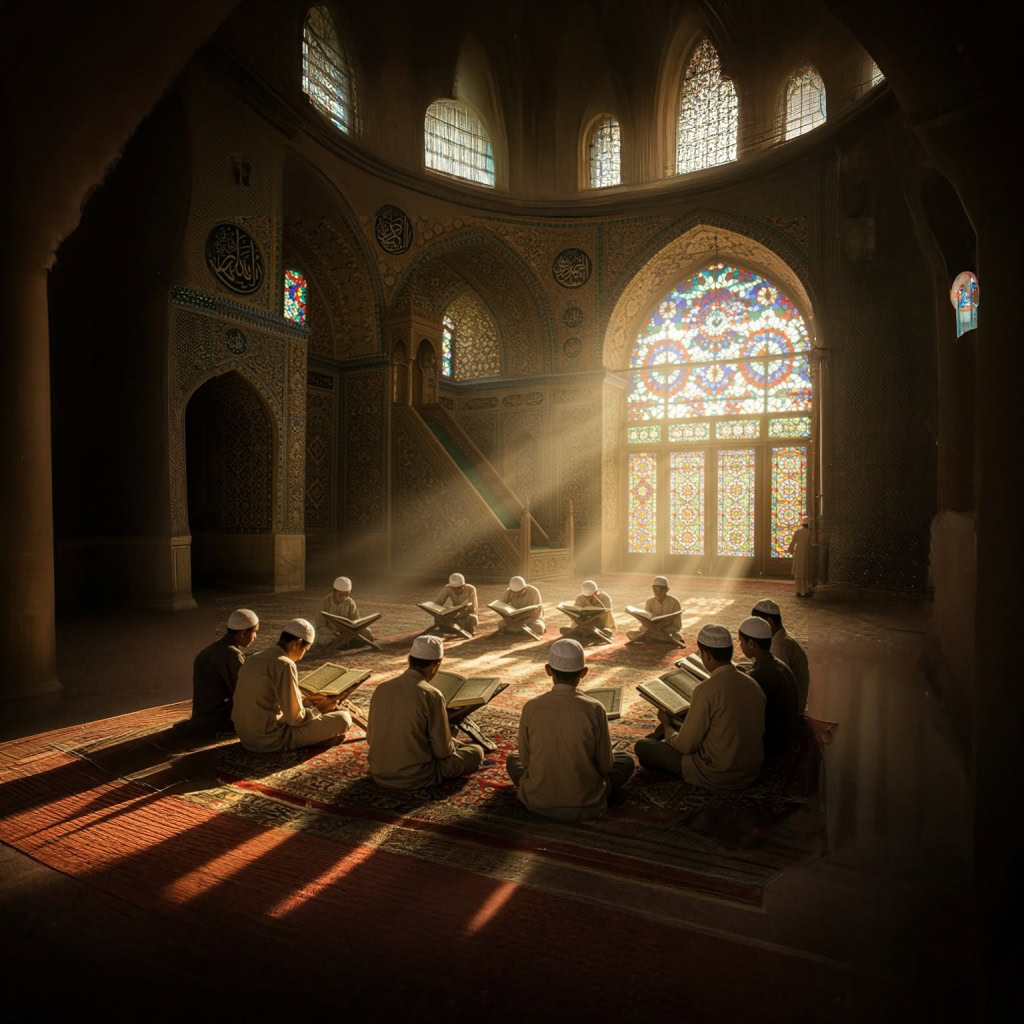
Strengthening the Umma: The Path to Raising Knowledgeable and Influential Youth by Shaykh Hassan Al-Hindi
The following is from a SeekersGuidance seminar including vitally important advice for building the student of knowledge by Shaykh Hassan al-Hindi.
This article presents Shaykh Hassan al-Hindi’s essential guidance on strengthening Islamic education through institutional work. At a time when youth face powerful temptations and doubts, he argues that individual efforts alone cannot meet today’s challenges. What the Umma needs are structured institutions that unite sound knowledge, spiritual refinement, and leadership training.
The Importance of Institutional Work in Contemporary Da’wa
In the field of Da’wa, sincere and coordinated effort is essential. While individual contributions remain valuable, the challenges of our time require a broader, more organized approach. Cooperation between individuals is necessary, but cooperation between institutions is even more critical.
When each person succeeds, the community benefits; and when each institution thrives, the entire Umma moves forward. We strive for the success of each one of us, because the success of each one of us is a success for all of us.
Individual work, such as a teacher nurturing students, guiding them, and caring for their development, is undoubtedly important. However, individual initiatives often remain temporary. A shaykh may pass away, relocate, or become unable to continue, and with him the work may fade.
Institutional work, in contrast, endures. When individual efforts grow into structured institutions rooted in clear vision, sound methodology, and effective administration, the work continues even if leadership changes.
The institution preserves the message, the method, and the mission. This long-term sustainability is urgently needed in today’s religious and Da’wa landscape.
Building Supportive Environments
A central responsibility of these institutions is to cultivate healthy, nurturing environments for children, youth, and students of knowledge. A righteous environment shapes beliefs, character, and conduct more powerfully than any single lesson.
Therefore, institutions must offer settings where young people can grow spiritually, intellectually, and morally. Spaces that provide the knowledge, mentorship, and social context needed to develop strong Muslim identities.
Navigating Contemporary Challenges
We live in an era marked by unprecedented exposure and openness: digital media, global communication, and widespread cultural influence. This openness cannot be avoided, nor should our youth be isolated from it.
Instead, we must equip them with the tools to engage these platforms responsibly, contributing positively rather than being overwhelmed by them.
Today, we find that the enemies of Islam are fighting against each other for the sake of desires. They are opening up to our youth all kinds of desires that they desire, and perhaps they have made it easy, simple, and affordable for any young man to drown in the sea of desires without any burden. Likewise, the fire of suspicions that flow today in our minds, in our beliefs, and in the matters of our lives.
These two forces, desires and doubts, represent the major trials of our time. We cannot simply shut them out. Instead, we must prepare our youth with knowledge, spiritual resilience, and strong moral foundations so they are not swept away by these influences.
Given these challenges, it is neither realistic nor desirable to isolate our children from society. They must live in the world as it is, with all its complexities, while maintaining the virtues of faith, character, and Islamic understanding.
This demands creative, thoughtful, and strategic Da’wa work: initiatives that address the unique dangers and pressures of contemporary life. We must learn to use contemporary tools to defend and spread Islam, and to build generations capable of navigating these tools wisely.
Our mission is to raise youth with intellectual clarity, emotional maturity, and behavioral strength. Achieving this requires innovative institutional efforts that respond effectively to the risks facing today’s Muslim society.
Building a Comprehensive Educational Vision
Education has always been important, but in our present age it has become an absolute necessity, one that cannot be ignored or postponed. When we speak about education today, we do not mean an education limited to the religious or spiritual dimension alone. Instead, we seek an education that is comprehensive, broad, and deep, embracing every aspect of life.
The goal is to integrate all dimensions, spiritual and physical, religious and worldly, so that our youth may achieve success in every sphere. We want them to possess personal strength in their religious commitments as well as in their worldly performance. We want them to be effective, influential, and capable of leadership in the fields of reform, construction, and education.
If we fail to produce such well-rounded figures, our youth will be ill-equipped to face the trials, challenges, and fluctuations of today’s world. For this reason, there is a pressing need to build environments that nurture our youth comprehensively, environments where education is structured rather than chaotic.
Chaos in education leads nowhere. If we aim to produce upright Islamic youth, we must set goals, and more importantly, we must align our methods with those goals. Wishing alone is not enough; success requires the means to achieve these aims.
True educational development must be translated into knowledge, training, intellect, morals, social behavior, and life skills. We do not want a young person who is devout in his relationship with Allah yet harmful in his relationship with people.
Nor do we want one who worships diligently but neglects his duties to parents, relatives, and neighbors. We do not want youth who excel in religious matters but fail in worldly affairs, or who preach one thing while behaving in contradiction to their own teachings.
Thus, we emphasize the necessity of a comprehensive curriculum, a curriculum that builds foundations for education, reform, strength, and resilience in the face of today’s conditions. We must nourish the intellectual capacities of our youth, cultivate their awareness, nurture their emotional and spiritual hearts, purify their souls, and refine their behavior. We must instill good character, for the Prophet (Allah bless him and give him peace) said: “I have been sent to perfect good morals.”
But this mission cannot be accomplished by individuals alone. It requires coordinated effort within the family environment and within our Da’wa and educational institutions.
A young person cannot be formed by academic instruction alone. He may learn a book or memorize a lesson, but intellectual, behavioral, and moral training must follow to shape a complete personality, one upright in his relationship with Allah and with His creation.
One of our challenges today is the contradiction many children encounter: they hear moral advice in theory, but witness opposite behavior in practice, whether at home or in society. This disconnect creates confusion and undermines their development. When theory and reality harmonize, however, the educational structure becomes stronger, more complete, more effective, and more likely to bear fruit.
Therefore, we aim to raise children who succeed in religion, succeed in worldly life, and emerge as influential leaders in the fields of reform. We do not seek youth who possess knowledge and piety but lack leadership, influence, and the ability to uplift society and call others to Allah. Instead, we seek youth who dedicate themselves day and night to strengthening what is between them and their Lord.
If such a young person is studying, he excels and innovates. If he engages with people, he works with diligence and sincerity. If he takes on responsibility, he becomes a caller to Allah.
In understanding, he is deep and far-sighted; in leadership and influence, he follows the path of the Prophet (Allah bless him and give him peace), who built an entire society within a few years.
Today, we often speak of Islam as an idea, but our aim should not be for Islam to remain a sound heard but not seen. We strive for an Islam that is lived, embodied, and reflected in the character and excellence of our youth.
Nurturing Exemplary Youth
We do not want a youth who is negligent in his worship or absent from meaningful roles in worldly life. Nor do we desire one who rectifies his relationship with Allah while harming his relationship with people. Likewise, we do not seek a young person driven only by emotional enthusiasm, lacking firm knowledge, sound thought, and deep awareness.
What we want is a youth who tastes the words of Allah, who follows the Prophet’s guidance: “Say, this is my way; I call to Allah upon insight.” We want a generation that calls to Allah with insight and wisdom, grounded in knowledge, clear understanding, and thoughtful engagement.
Such youth must be equipped with strong intellectual foundations and refined methods in da‘wa, capable of addressing their immediate circles and the broader society with clarity and purpose. This requires building institutions that unite education with nurturing and that follow a broad, comprehensive methodology rather than limited, fragmented instruction.
We need educational environments that expand horizons, deepen understanding, and reject the culture of shortcuts, summaries, and “fast-food” knowledge. Our goal is to develop true students of knowledge today who will become scholars of Allah tomorrow: individuals who combine depth of knowledge, clarity of thought, and purity of character.
For this to happen, our institutions must possess clear goals. Any factory is valued by its output; likewise, every Islamic institution must clearly define the model of the graduate it seeks to produce.
Once the goal is defined, the curriculum must connect organically to that goal. These objectives must be well understood by administrators, teachers, students, and the wider community so that our institutional identity becomes clear: Who are we? What do we want? How do we work?
Brothers, supporting such institutions is a communal obligation. We must encourage our youth to join them, explain their mission to the public, highlight their importance, and help others appreciate the blessing they represent. Each one of us must communicate this message to our families, students, and communities so that our youth recognize the value of structured learning and guided cultivation.
A special responsibility falls upon the elite among our youth, those distinguished by intellect, understanding, strong circumstances, or psychological resilience. Too often, this elite is directed exclusively toward worldly fields, even by some well-intentioned advocates, as if building the worldly realm were our only concern.
Yes, we must contribute to worldly knowledge and professions, but a portion of the elite must be guided toward the service of Islam, toward scholarship, teaching, and leadership in religious and educational institutions.
These elite youth are the hope of the Umma. When Allah grants a young person a capable mind, strength of character, and supportive circumstances, these are not only blessings—they are responsibilities.
Today, we must tell our children to come to the noble goals, to come to the correct curricula, to come to the clear principles, and to come to the good environment that will help you with that.
This is where institutions like SeekersGuidance come in: institutions that provide sound knowledge, a healthy environment, qualified teachers, and clear methodology. They nurture the students of today into the scholars and leaders of tomorrow, preparing them to serve the Umma with insight, wisdom, and steadfastness.
It is our responsibility to guide our children toward these noble paths, and it is their responsibility to respond with commitment and sincerity.
I ask Allah Almighty to help us fulfill our duties toward the education and upbringing of our youth.
I ask Allah to enable the elite among our children to seize these opportunities, to grow in knowledge and wisdom, and to become callers to Allah with insight, mercy, and firmness upon the truth, never compromising principles, yet never causing harm or division.
May Allah accept our efforts, illuminate our paths, and make our youth the pride of this Umma.
Shaykh Hassan al-Hindi was born in 1966. He lost his eyesight before reaching the age of nine. He began his formal religious studies with several shaykhs in private sessions, then continued them at the al-Fath Islamic Institute in 1982, After graduating in 1988,he was then appointed as an instructor of Aqida at the institute upon the recommendation of Shaykh Abd al-Razzaq al-Halabi (may Allah have mercy on him). He then pursued university studies in the Faculty of Shari‘a at the University of Damascus, and later enrolled in al-Imam al-Awza‘i College for postgraduate studies.
The Shaykh received knowledge from an honorable group of the scholars of Damascus, such as Shaykh Abd al-Rahman al-Shaghuri, Shaykh Muhammad Adib al-Kallas, and Shaykh Muhammad Sa‘id Ramadan al-Buti (may Allah have mercy on them).
Summarized and Edited by Muhammad Yaseen Kippie
