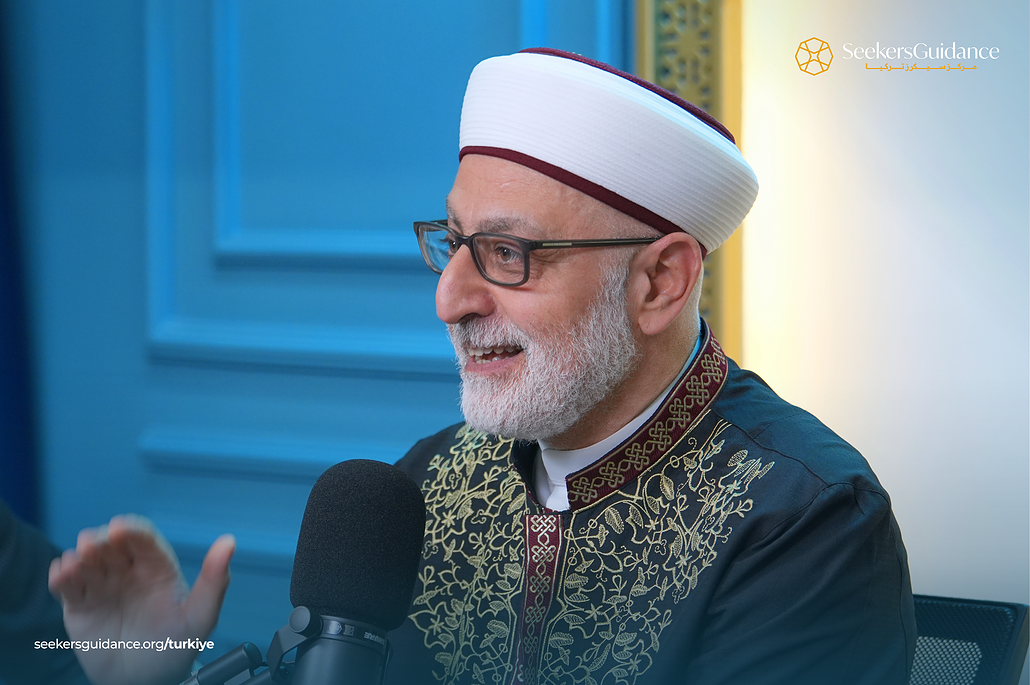
As I Knew Him: Shaykh Adib Kallas and the Light of Damascus by Shaykh Dr Bassem Itani
The following article is based on the SeekersGuidance seminar about the life and legacy of Shaykh Adib Kallas.
Introduction: The Limits of Knowing a Personality
The subject of this session is about Shaykh Adib Kallas, as I know him, and the light of Damascus as well. Knowing a person, or a personality, cannot be fully known or understood by a human being. Not even a person himself can understand himself.
The subject is to analyze a personality, like the personality of Shaykh Adib, who is one of the greatest scholars. As a student, my testimony may be hurtful, because I will speak about my shaykh in a very positive way.
Understanding a Scholar Through His Effects
I will talk about the personality in terms of its effects. There are many effects that shape a person: environmental effects, social effects, family effects, parents, mothers, brothers, the environment in which one lives, teachers, schools, and even genetics.
If we want to know how Shaykh Adib Kallas was formed, this is difficult. Therefore, I will speak about my shaykh through real testimonies, what I personally saw.
I will not mention how he began, how he died, or his illness—may Allah be pleased with him. I will speak about the period between 1985 and 1992. Seven years.
Testimony and Prophetic Criterion (Mi‘yar)
What is the benefit of telling stories about scholars? How much do such stories influence students? And how did this influence society and people?
When a funeral passed by, the Companions praised it. The Prophet (Allah bless him and give him peace) said, “It was obligatory.” Another funeral passed by, and they spoke badly of it. He again said, “It was obligatory.”
They asked, “O Messenger of Allah, what was obligatory?” He said, “The first—you praised it well, so Paradise became obligatory for it. The second—you spoke badly of it, so the Fire became obligatory for it.”
These many testimonies are glad tidings for the people of Paradise. The Messenger of Allah said, “You are the witnesses of Allah on His earth.”
Journey to Damascus (1985)
I went to Damascus seeking scholars. I had graduated from the Azhar Institute in Beirut and moved—by the direction of Shaykh Salah al-Din Fakhri, may Allah have mercy on him—to study in Damascus.
He told me to go to Shaykh Adib and Shaykh ‘Abd al-Razzaq. The year 1985 was a difficult time due to security. There were no public house lessons.
They told me the shaykh was in Jami‘ al-Ward in the Saruja market. I entered after Maghrib and found him reading Bada’i‘ al-Sana’i‘. I was twenty years old.
My mind could not digest the book, but I sat and listened.
The First Invitation: “Come to My House”
After several weeks, as we were leaving the mosque, he said to me, “Come. My son, come to my house—and do not tell anyone.” This was the first key to studying with the shaykh. The lesson was forbidden in the mosque. In the house, there was no one except me.
For seven years, I spent more than 1,500 hours with the shaykh, about five hours a week. All of it was for the sake of Allah, in his house. Without compensation.

Teaching as Foundation-Building
The shaykh emphasized teaching because it is extremely important. He simplified knowledge to elevate the student.
“But be rabbaniyin because of what you teach of the Book and because of what you study.” [Quran, 3:79]
He focused on building runways before flight. Without foundations, there is no takeoff.
The School of Examples
The most beautiful school I have seen is the school of examples. Doctrine is complex. Examples make understanding possible.
Allah Himself sets examples in the Quran so that minds and souls move together.
This is a rare skill among teachers.
Breaking the Ego
The shaykh constantly broke his ego—before students, people, scholars, and in sermons.
Whether one student came or one hundred, his intention never changed.
Ethics of Disagreement
He criticized ideas, not people. He gave evidence without naming individuals.
This is scholarly ethics—disagreeing without personal hostility. His fear of Allah was palpable.
He once said: “If you enter Paradise and do not find me, ask for my intercession. Intercede for me.”
These words still affect us thirty years later because they came from a true state with Allah.
Knowledge Over Social Convention
When his brother passed away, he taught as usual that morning.
He instructed scholars not to attend the funeral if it conflicted with lessons. Knowledge came first.
Intellectual Precision
For a year, he reflected deeply on the fate of those unreached by da‘wa, holding a careful Maturidi position.
He distinguished between what is decisively known and what is not—and refused speculation.
Humility in Teaching
When students missed recording a lecture, he repeated it fully and apologized.
He lived humility; he did not merely speak of it.
Venerating the Sharia
Some issues he refused to answer out of reverence.

He said, “This is the Word of Allah, and it requires manners and veneration.”
Serving Students
At the age of seventy-seven, he served tea himself and said:
“I am like the doorman. My duty is only to open the door.”
He patiently encouraged a Kurdish student with a heavy accent, memorized his poem, copied it, and distributed it—purely to uplift him.
When electricity went out, he sat on the floor at seventy-eight years old, brought a bulb, and insisted on finishing the book.
When done, he said:
“What do we read next?”
Humility in a Gathering
When Shaykh ‘Abd al-Razzaq was teaching in the Umayyad Mosque, Shaykh Adib entered, refused a chair, sat at the back, and said:
“The student of knowledge must break his knees.”
When people rushed to greet him afterward, he said:
“No. The essence is there. Shaykh ‘Abd al-Razzaq is there.”
Shaykh Dr. Bassem Hussayn Itani was born in Beirut, Lebanon, in 1965. He earned his Ph.D. in Islamic Studies in 2005. Among his mentors were Shaykh Muhammad Taha Sukkar, Shaykh Adib al-Kallas, Shaykh Mulla Abdul ‘Alim al-Zinki, Shaykh Abdul Rahman al-Shaghouri, Shaykh Abdul Razzaq al-Halabi, Shaykh Dr. Mustafa Dib al-Bugha, Shaykh Dr. Wahba al-Zuhayli, Dr. Muhammad al-Zuhayli, and others, may Allah have mercy on them all.
Shaykh Itani has a rich background in both academic and administrative fields. He has held significant positions in many governmental and non-governmental institutions in Lebanon and abroad. This includes his role as a member of the Academic Committee at SeekersGuidance and a senior teacher with the free online global seminary.
From 2020 to 2021, he served as the Dean of the College of Da‘wa – University for Islamic Studies (Lebanon) – Postgraduate Studies. He was the Director of Dar Iqra for Islamic Sciences from 1998 to 2018. Shaykh Itani is a well-versed teacher in several academic subjects, including Fiqh, Usul, Aqida, and Tafsir. He has supervised and examined numerous Master’s and Doctoral theses at various universities and colleges in Lebanon.
His contributions to Islamic sciences are also evident in his writings and research. His notable works include “The Relied-upon Statements of Imam Zufar in the Hanafi School,” “Collective Ijtihad: The Sublimity of Thought in the 21st Century,” and “Custom and its Impact in Islamic Jurisprudence.” Shaykh Itani has actively participated in numerous scientific conferences and seminars, both in Lebanon and internationally. He is linguistically adept, excelling in Arabic, proficient in French, and comfortably conversant in English.
Summarized by Mir Omran Ali Khan
