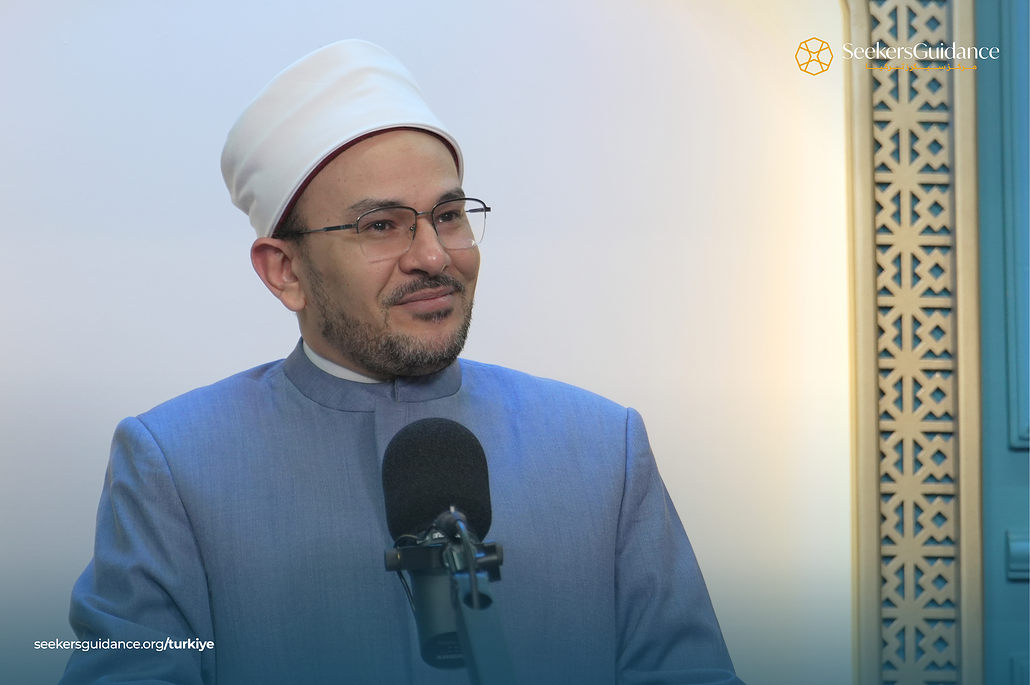
Historical Foundations of Islamic Jurisprudence by Dr Salah al-Shami
The following is from a SeekersGuidance seminar exploring Islamic Jurisprudence in its development and application in the past and present.
Distinguishing Between the History of Jurisprudence and Its Substantive Issues
An important starting point is to clarify that our topic concerns the history of jurisprudence and matters connected to this history. This distinction must be clear to every student of knowledge: speaking about the history of a science is one matter, while discussing its actual issues is another.
This distinction applies across all Islamic sciences, Quranic interpretation, Hadith, jurisprudence, legal theory, theology, logic, language, and others. We must differentiate between speaking about a science as a set of issues and speaking about it as a historical development. Unfortunately, many students blur this line, leading to confusion and disordered study.
If the student distinguishes between historical matters and substantive issues, and understands the weight of each, he is able to progress soundly on the path of knowledge. This resembles what scholars mention in Hadith studies regarding the difference between narration and understanding.
When these categories are confused, a student may occupy himself excessively with narrations yet fail to gain firm understanding. His efforts become diluted, and the foundations of knowledge remain weak.
For this reason, the early scholars advised students regarding narration and understanding. A well-known statement attributed to Imam Faqih Qadi Abdullah ibn Shubruma (Allah have mercy on him) is: “The less you narrate, the more you understand.”
In other words, over-collecting narrations often reduces comprehension. Scholars therefore said, “Multiplication leads to dilution.” This does not deny the importance of narration, but it affirms that a student’s primary focus, roughly eighty percent, should be on jurisprudential understanding, while historical and ancillary matters may comprise the remaining twenty percent.
Similarly, if one occupies himself with narration alone, he is spending his effort on the twenty percent rather than the essential eighty percent. Organizing this hierarchy in the mind is key. We must not mix between the history of knowledge and its substantive issues.
What Scholars Discuss in the History of Knowledge
When speaking about the history of a science, scholars discuss its conception, purpose, stages, sources, and virtue. They examine where the science came from and who established it. These discussions are sometimes called “principles of the science,” “introductions,” or “foundations.”
Such discussions are important because they shape the student’s intellectual formation and give him a correct conceptual grounding before he enters the subject. As scholars said: “Judgment follows conception.” Proper understanding must precede engagement.
Therefore, we speak of historical foundations so that the student stands on firm ground. These foundations illuminate the path of seeking knowledge. Islamic jurisprudence, majestic and essential as it is, is a discipline that serves other sciences and is served by them. Knowledge is interdependent.
The Interconnected Nature of Islamic Sciences
Scholars have long emphasized that the Islamic sciences are interconnected. Many great scholars, including Qarafi, Ibn Jawzi, Ghazali, Najm al-Din al-Tufi, and others, stress this reality. Ghazali beautifully said: “Knowledge is interlinked; parts of it depend on others.”
The meaning is that a student cannot master a field without learning the sciences that support it. A jurist needs knowledge of the verses of rulings, their generality and specificity, their restrictions, their abrogation. He needs Hadiths of rulings, legal theory, Hadith methodology, language, and even logic. Each of these serves his understanding. And just as jurisprudence depends on other sciences, it also serves them.
Thus, a student should not imagine that specializing in Hadith means he does not need jurisprudence, or that a jurist can dispense with Hadith.
Because this point is often misunderstood, many lose the ability to excel. Excellence arises from recognizing the interconnection between sciences. A person who imagines that he can master a field in isolation is deluded.
Shams al-Din Ibn al-Jazari (Allah have mercy on him) noted that it is improper to speak authoritatively about an issue if it pertains to another science unless one is knowledgeable about that other science. This was clear to the earlier scholars.
A powerful example illustrating this interconnection is what Professor Adel Sulayman Jamal (Allah have mercy on him), a student of the great scholar Mahmoud Shaker, related. While editing poetic texts, he encountered a word he could not decipher from a manuscript. When he consulted Mahmoud Shaker, the latter did not simply tell him the word.
Instead, he said, “If you had read the Book of Hajj in Imam Shafi‘i’s al-Umm, you would understand this word.” Professor Adel read the Book of Hajj, and only then did the meaning become clear. Even in the study of poetry, he needed jurisprudence, interpretation, and Hadith.
This demonstrates that specialization does not free a student from other sciences. True scholars often said: “Learn broadly, then specialize. When you specialize, you will realize that you must return to the other sciences.”
Jurisprudence Between Past and Present
Understanding jurisprudence across its historical stages is essential to understanding its role today. Allah Most High pointed to fiqh in His Book, and the Messenger of Allah (Allah bless him and give him peace) judged by revelation and taught his Companions accordingly.
The earliest works on the Prophet’s judgments include Aqdiyat Rasul Allah by Ibn Abi Shaybah (d. 235 AH), even though the complete work did not survive, and later works by Ibn at-Tallā’ and others. Within foundational books such as Imam Malik’s Muwatta’, Imam Shafi‘i’s al-Umm, Sahih Muslim, and Sunan Abu Dawud, entire chapters are titled “Book of Judgments” (Kitab al-Aqdiyah), containing examples of the Prophet’s judgments.
Scholars also discussed whether the Prophet (Allah bless him and give him peace) exercised ijtihad. Many affirmed this through rational and textual evidences: if leading scholars from the Umma performed ijtihad, it is inconceivable that the Prophet (Allah bless him and give him peace) did not. Revelation corrected his ijtihad when needed.
The Companions also practiced ijtihad during and after his life. Mu‘adh ibn Jabal’s famous Hadith demonstrates this: he judged by the Book of Allah, then by the Sunna, then by ijtihad.
Although the Companions numbered over one hundred thousand, only a fraction narrated Hadith, and an even smaller group were jurists. This teaches that not every student becomes a narrator or a mufti. True authority in knowledge is rare.

The Flourishing and Stability of Jurisprudence
Across generations, from the schools of Kufa and Madina to the eras of Abu Hanifa, Malik, Shafi‘i, and Ahmad, knowledge was transmitted and developed. Scholars sometimes describe earlier periods as “flourishing” and later ones as “declining.” This terminology is misleading.
There is no era of decline in Islamic jurisprudence. Strength and weakness exist within each era. Scholars like Zabidi, Imam Sabban, and others of the 11th and 12th centuries produced monumental works. These centuries cannot be dismissed as “decline.”
Sometimes political narratives cause later eras to be labelled as weak so that new powers appear as revivers. But our history is not “ruins upon ruins.”
A more accurate framing is that earlier eras represent flourishing, while later eras represent stability. Knowledge had matured, and scholars focused on teaching, explaining, and systematizing rather than producing new foundational works. This stability is not weakness.
An example is Shams al-Babili (Allah have mercy on him), a great memorizer comparable to Ibn Hajar. He authored only one book, not due to weakness, but because the existing corpus had reached a level of completion that required explanation, not expansion.
Understanding the relationship between historical development and substantive issues, as well as the interconnectedness of the Islamic sciences, is essential for any student of knowledge.
Shaykh Dr. Salah al-Shami holds a PhD in Hadith from al-Azhar, is a member of the Heritage Revival Center, and serves as the Director of the “Sullam al-ʿUlūm” program at SeekersGuidance.
