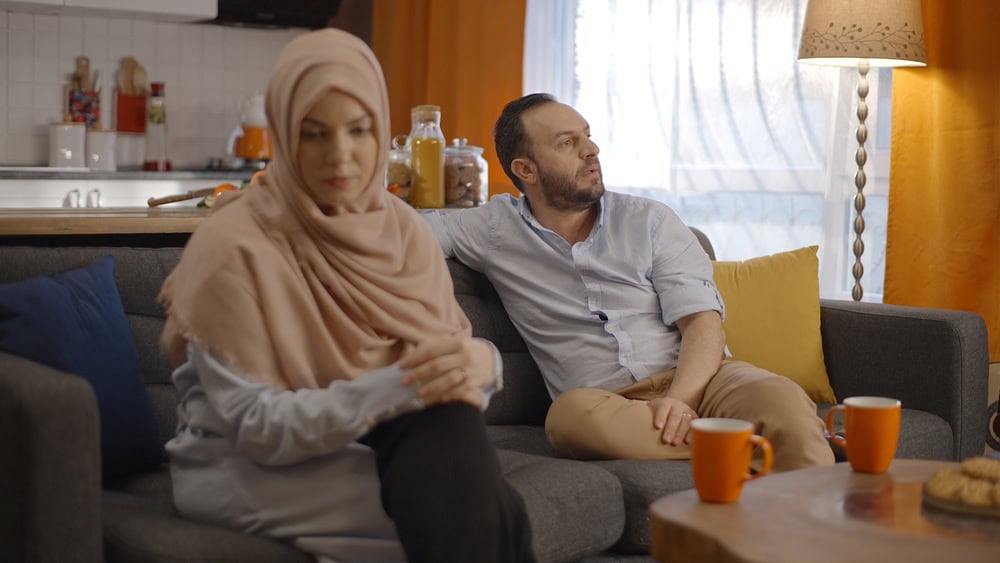
What Should I Do if My Husband Insults My Appearance?
Hanafi Fiqh
Answered by Shaykh Faraz Rabbani
Question
We married only three months ago, and for all three months, I have heard from him that I am old, ugly, and do not meet his expectations.
I am three and a half years older than him, and it is a cross-cultural marriage, so I do not look like the women where he is from. Is it not unjust to blame me for this when he knew it from the beginning?
He said he married me only for my religion, but now he thinks that is not enough.
He also reproaches me for my past — I began wearing hijab only two years ago, though well before meeting him — and he thinks I sinned by going to umra in a group without a mahram. He does not want to divorce me because of his family, but he is not happy with me.
Answer
In the Name of Allah, the Most Merciful and Compassionate.
I am sorry. Three months into a marriage, you should be settling into someone’s kindness, and instead, you are being told daily that you are not enough. That is a real hurt, and I do not want to move past it quickly.
Let me answer plainly, then the harder part underneath.
Yes, You Are Right: This Is Unjust
You asked whether it is unjust to blame you for what he knew before he married you. It is. You are not mistaken, and you are not being oversensitive.
He saw your age. He saw your face. He chose. To choose with open eyes and then reproach you for what he chose is a wrong done to you, and no amount of framing it as disappointment makes it something else.
And the manner of it is its own wrong, separate from the substance. Allah commands: “But rather live with them graciously and reasonably; If you merely dislike them, you may well dislike something, and Allah make tremendous good in it.” [Quran 4:19; Keller, The Quran Beheld]
Read the second half. The verse anticipates a husband who does not feel what he hoped to feel, and its instruction to him is not to say so daily. It is to live well with her and leave room for Allah to put good in what he did not choose warmly.
The Prophet (Allah bless him and give him peace) said the same thing in the language of the heart: “Let no believing man hate a believing woman; if he dislikes one of her traits, he will be pleased with another.” [Sahih Muslim]
The instruction is to look for the other trait, not to itemize the first.
And: “The best of you is the one who is best to his family, and I am the best of you to my family.” [Sunan al-Tirmidhi and Sunan al-Darimi; sound] That is the standard he is being measured against, and he is not near it.
About the Things He Reproaches You For
I want to take these one at a time, because if they are left standing, they will keep working on you.
You began wearing hijab two years ago. That is not a defect. It is a person turning toward Allah, exactly what he says he married you for. To reproach someone for the date they began obeying Allah is to reproach them for having a beginning, and every one of us has one.
Your umra without a mahram. Whatever the ruling on the travel (and the schools differ, with real scholarly latitude on a woman traveling in a safe, organized group), it was done, it is past, and it is between you and Allah.
A husband is not an auditor of his wife’s life before him.
Allah says: “Shun much of suspicion: Verily some suspicion is heinous sin; Nor pry into the private matters of others.” [Quran 49:12; Keller, The Quran Beheld]
Raking over a spouse’s past is prying, and using it as a weapon in an argument is worse than prying.
He said he married you for your religion and now says it is not enough. Notice what that sentence actually admits: he got what he asked for. That is not a failure on your side.
On What to Do
Here I will not decide for you, because I should not and because you are better placed than I am.
What I can do is name what is true, so that whatever you choose, you choose it clearly.
You are not obliged to accept being demeaned. A woman has rights in marriage that are real and enforceable, and kind treatment is among them. Allah says: “And women possess rights like those they are bound to fulfill, in lawful fairness.” [Quran 2:228; Keller, The Quran Beheld]
Three months is early, and early is not the same as hopeless. Some men enter marriage carrying an expectation formed by images rather than by people, and that expectation can break and be replaced by something truer. That does happen. It happens more often when it is named than when it is endured in silence.
And staying is not the only form of piety. Where a marriage is causing real harm and does not change, a woman may seek release, and the Law provides for it. Choosing that is not a failure of patience.
What I Would Have You Do Next
Four things, in order.
Tell him plainly, once, calmly, and outside an argument: this is hurting me, and I need it to stop. Not a plea and not a fight: a statement. Many men do not realize the weight of what they say until it is said back to them.
Bring in someone he respects. His family is the reason he says he will not divorce, so they can move him. An older relative, an imam, a couple you both trust.
Allah has told us to do exactly this: “And should you fear a rift between man and wife, send an arbiter from his kin and an arbiter from hers; And if both truly desire to settle between the couple, Allah will restore harmony between them.” [Quran 4:35; Keller, The Quran Beheld]
Give it a defined period, not an open one. Say to yourself: six months, with real effort on both sides, and then I will look again honestly. Open-ended endurance with no review is how people lose years.
And do not carry this alone. Speak with someone regularly: a teacher, a counsellor, a woman of religion you trust. Our Office Hours exist for exactly this, and I would encourage you to book: https://seekersguidance.org/office-hours/
Your Worth Is Not His to Set
Do not let him tell you what you are worth. He is describing his expectations, not your value. Allah made you, and He did not make a mistake.
“And of His truly wondrous signs is having created for you, from your own kind, wives to repose in solace to, and made between you tender love and mercy.” [Quran 30:21; Keller, The Quran Beheld] Solace, tenderness, mercy. That is what a marriage is for. Ask for it. You are entitled to ask.
May Allah soften his heart, give you clarity, and grant you a home you are at rest in.
And Allah knows best.
[Shaykh] Faraz Rabbani
Related SeekersGuidance Answers
- Should I Leave This Marriage as My Husband Complains about My Looks and Education? – Addresses whether persistent criticism of a wife’s appearance and education is sufficient reason to consider leaving a marriage.
- I Feel Unwanted by My Husband and Ashamed – Offers guidance for dealing with feelings of rejection, shame, and emotional hurt within marriage.
- How Important Is Physical Attraction in Marriage? – Explains the role of physical attraction in marriage and the rights and responsibilities of both spouses in this regard.
- Resolving Conflict Between Husband and Wife – Outlines practical Islamic methods for resolving marital conflict, including reconciliation and the involvement of suitable arbiters.
- Etiquette of Marriage: A Comprehensive Reader – Provides a broader overview of the rights, responsibilities, etiquette, and good character expected from both spouses.
Shaykh Faraz Rabbani is a recognized specialist scholar in the Islamic sciences, having studied under leading scholars from around the world. He is the Founder and Executive Director of SeekersGuidance.
Shaykh Faraz stands as a distinguished figure in Islamic scholarship. His journey in seeking knowledge is marked by dedication and depth. He spent ten years studying under some of the most revered scholars of our times. His initial studies took place in Damascus. He then continued in Amman, Jordan.
In Damascus, he was privileged to learn from the late Shaykh Adib al-Kallas. Shaykh Adib al-Kallas was renowned as the foremost theologian of his time. Shaykh Faraz also studied under Shaykh Hassan al-Hindi in Damascus. Shaykh Hassan is recognized as one of the leading Hanafi jurists of our era.
Upon completing his studies, Shaykh Faraz returned to Canada in 2007. His return marked a new chapter in his service to the community. He founded SeekersGuidance. The organization reflects his commitment to spreading Islamic knowledge. It aims to be reliable, relevant, inspiring, and accessible. This mission addresses both online and on-the-ground needs.
Shaykh Faraz is also an accomplished author. His notable work includes “Absolute Essentials of Islam: Faith, Prayer, and the Path of Salvation According to the Hanafi School.” This book, published by White Thread Press in 2004, is a significant contribution to Islamic literature.
His influence extends beyond his immediate community. Since 2011, Shaykh Faraz has been recognized as one of the 500 most influential Muslims. This recognition comes from the Royal Islamic Strategic Studies Center. It underscores his impact on the global Islamic discourse.
Shaykh Faraz Rabbani’s life and work embody a profound commitment to Islamic scholarship. His teachings continue to enlighten and guide seekers of knowledge worldwide.
النصوص
[مسلم]
«لَا يَفْرَكْ مُؤْمِنٌ مُؤْمِنَةً، إِنْ كَرِهَ مِنْهَا خُلُقًا رَضِيَ مِنْهَا آخَرَ».
[الترمذي والدارمي، صحيح]
«خَيْرُكُمْ خَيْرُكُمْ لِأَهْلِهِ، وَأَنَا خَيْرُكُمْ لِأَهْلِي».
[البخاري ومسلم]
«اسْتَوْصُوا بِالنِّسَاءِ خَيْرًا، فَإِنَّهُنَّ خُلِقْنَ مِنْ ضِلَعٍ، وَإِنَّ أَعْوَجَ شَيْءٍ فِي الضِّلَعِ أَعْلَاهُ، فَإِنْ ذَهَبْتَ تُقِيمُهُ كَسَرْتَهُ، وَإِنْ تَرَكْتَهُ لَمْ يَزَلْ أَعْوَجَ، فَاسْتَوْصُوا بِالنِّسَاءِ».
