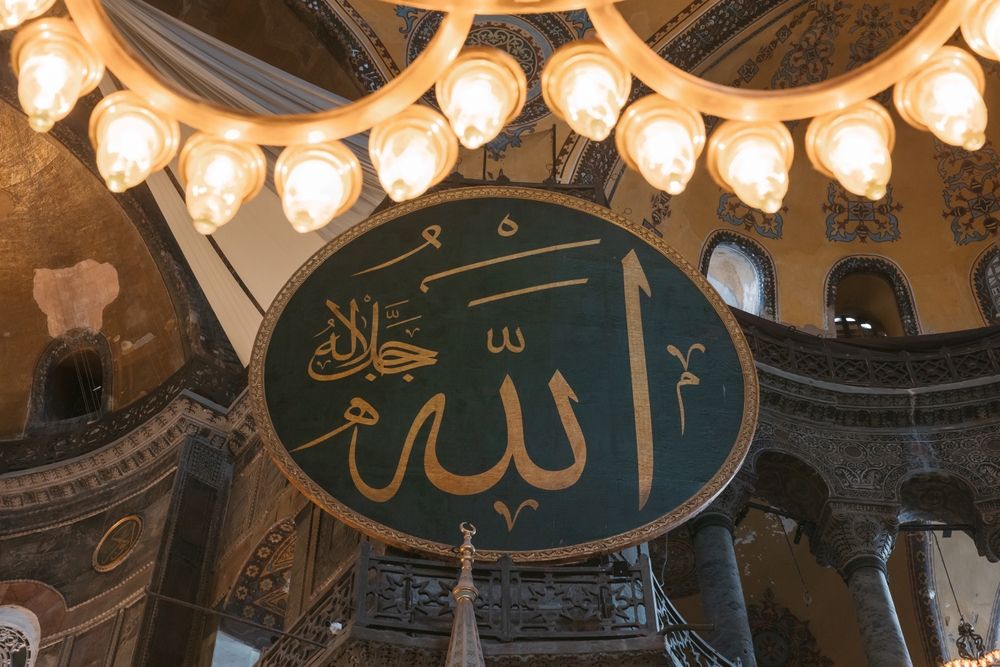
What Does It Mean to Say That Allah Is “All-Free”?
Answered by Shaykh Faraz Rabbani
Question
What is meant by the statement that Allah is “All-Free,” indicating that He is free of all need and bears no resemblance to creation?
Answer
In the Name of Allah, the Merciful and Compassionate.
To state that Allah is “All-Free” (al-Ghani) affirms that He is entirely independent of His creation, whereas every created being is utterly dependent upon Him. His existence, perfection, and sufficiency are intrinsic to His essence. He is indebted to no one and is deficient in nothing.
The Quran presses this on us plainly: “O mankind: it is you who are in utter need of Allah, and Allah is the Far Exalted above Need for Any, the All-laudable of bounty.” [Quran 35:15; Keller, The Quran Beheld]
Commentators interpret this wording as the utmost emphasis: human need is so absolute that, in comparison, the need of all other creatures is negligible. Allah alone is self-sufficient by His very essence, requiring neither human worship nor existence, and remains unaffected even if the entire world were to turn away. [Nasafi, Madarik al-Tanzil; Abu al-Suud, Irshad al-Aql al-Salim]
The dependency is entirely one-sided.
The Independent (al-Samad)
The name al-Samad conveys a similar meaning: He is the One to whom all turn in every need, while He turns to none. “Allah is the Sole Indomitable Recourse for all needs.” [Quran 112:2; Keller, The Quran Beheld]
All of creation depends entirely upon Him; He depends on nothing.
Because He is in need of nothing, Allah is free from all characteristics associated with created, dependent beings. He is free from body, form, and limbs, as well as from place, direction, time, and any resemblance to creation (mukhalafa li’l-hawadith).
Possessing a body entails occupying space and dependence upon it; being in a direction implies containment. Both attributes pertain to created and contingent beings, whereas Allah transcends such limitations. [Bajuri, Tuhfat al-Murid]
The Distinctness of Allah
This rests on Allah’s own word: “There is nothing whatsoever like unto Him, and He is the All-Hearing, the All-Seeing.” [Quran 42:11]
Commentators interpret this verse as a complete negation of resemblance in every respect: essence, attributes, and actions. One commentator articulates the established creed as affirming an essence unlike all other essences, never devoid of its attributes; His essence is distinct from any other essence, and His attributes are unlike any other attributes. [Qurtubi, al-Jami‘ li-Ahkam al-Quran]
This transcendence (tanzih) does not negate His reality; rather, it represents the highest affirmation of it. His attributes of majesty and beauty are affirmed as He has described them, while also affirming that they bear no resemblance to anything in creation.
Why This Settles the Heart
This principle is liberating: Allah is in need of nothing, while human beings require Him for everything. It should guide the direction of one’s need, hope, and reliance toward the One who alone can fulfill them, rather than toward the means He has created.
The One upon whom you rely is perfect and self-sufficient, never diminished by what He bestows. The more one asks of Him, the more His generosity becomes evident.
And Allah knows best.
[Shaykh] Faraz Rabbani
Related Answers
- How Do We Understand Allah’s Transcendence in Relation to Time? — Allah is transcendent above any quality of creation, including time and space, as that would entail limitation.
- Allah’s Relationship with Time and Space — Allah is transcendent above existing within time or space; His timeless attributes do not enter creation.
- A Reader on Understanding the Attributes of Allah — A curated reader on tawhid and Allah’s divine attributes, affirming there is nothing like Him.
Shaykh Faraz Rabbani is a recognized specialist scholar in the Islamic sciences, having studied under leading scholars from around the world. He is the Founder and Executive Director of SeekersGuidance.
Shaykh Faraz stands as a distinguished figure in Islamic scholarship. His journey in seeking knowledge is marked by dedication and depth. He spent ten years studying under some of the most revered scholars of our times. His initial studies took place in Damascus. He then continued in Amman, Jordan.
In Damascus, he was privileged to learn from the late Shaykh Adib al-Kallas. Shaykh Adib al-Kallas was renowned as the foremost theologian of his time. Shaykh Faraz also studied under Shaykh Hassan al-Hindi in Damascus. Shaykh Hassan is recognized as one of the leading Hanafi jurists of our era.
Upon completing his studies, Shaykh Faraz returned to Canada in 2007. His return marked a new chapter in his service to the community. He founded SeekersGuidance. The organization reflects his commitment to spreading Islamic knowledge. It aims to be reliable, relevant, inspiring, and accessible. This mission addresses both online and on-the-ground needs.
Shaykh Faraz is also an accomplished author. His notable work includes “Absolute Essentials of Islam: Faith, Prayer, and the Path of Salvation According to the Hanafi School,” published by White Thread Press in 2004, which is a significant contribution to Islamic literature.
His influence extends beyond his immediate community. Since 2011, Shaykh Faraz has been recognized as one of the 500 most influential Muslims. This recognition comes from the Royal Islamic Strategic Studies Center. It underscores his impact on the global Islamic discourse.
Shaykh Faraz Rabbani’s life and work embody a profound commitment to Islamic scholarship. His teachings continue to enlighten and guide seekers of knowledge worldwide.
