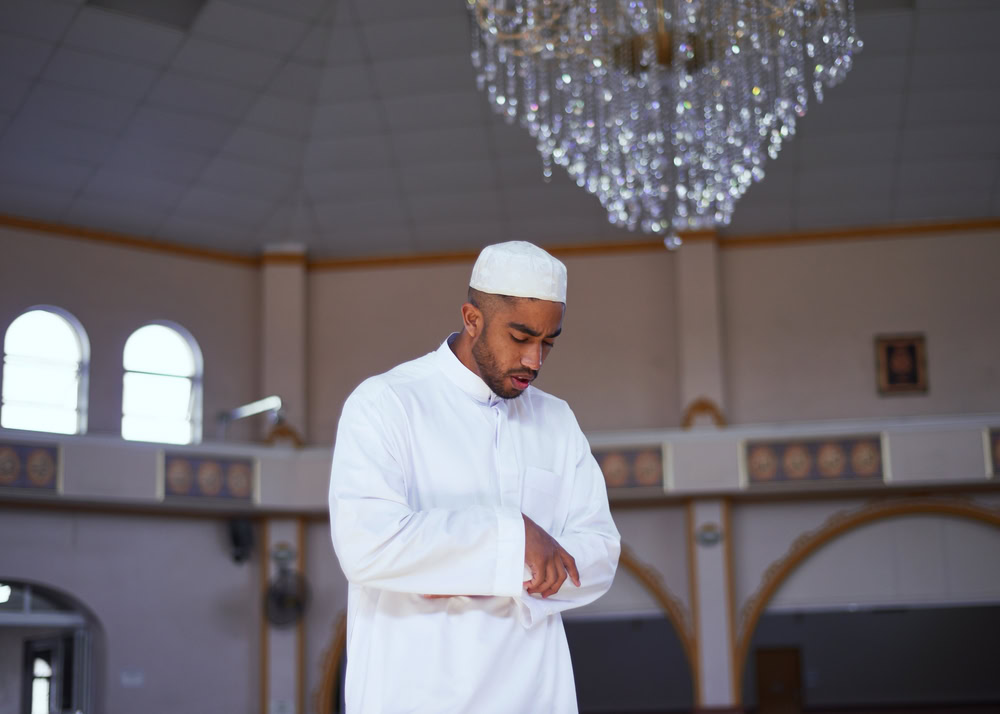
Does Shafi‘i Prayer Require Hearing Yourself Recite?
Shafi'i Fiqh
Answered by Shaykh Irshaad Sedick
Question
In the Shafi‘i school, must I hear myself when reciting Al-Fatiha silently, or is moving the lips and tongue enough? Does the same apply to other parts of the prayer, like the Tashahhud?
Answer
In the Name of Allah, the Most Merciful and Compassionate.
May Allah alleviate our difficulties and guide us to what pleases Him. Amin.
In the Shafi‘i School, the key to silent recitation is that it must be uttered loud enough for the individual to hear themselves. This means that when reciting Al-Fatiha silently in the prayer, it is not sufficient to merely move the lips and tongue without any sound. The recitation must be audible to the person themselves, though it need not be loud enough for others to hear.
Minimal Audibility
Imam Nawawi (Allah have mercy on him) elaborates on this point in his Kitab al-Adhkar, stating that invocations, whether during prayer or outside of it—are not considered truly recited until one utters them audibly enough for oneself to hear. This applies to both the obligatory and recommended invocations, and Imam Nawawi specifically emphasizes that “silent recitation” is actually recitation that is heard by the person doing it, even if only at a low volume [Ibn ‘Allan, al-Futuhat al-Rabbaniyya]
Shaykh Ibn ‘Allan (Allah have mercy on him) expands on this by explaining that the distinction between “loud” and “silent” recitation is not based on whether others can hear you, but rather on whether you can hear yourself. In silent recitation, the volume is low enough that only you, not your neighbors, can hear it.
Ruling on Silent Recitation
Therefore, when reciting Al-Fatiha silently, moving your lips and tongue without any audible sound will not meet the requirement of “recitation” as defined in the Shafi‘i School. The same principle applies to other parts of the prayer, such as the Tashahhud. Whether reciting silently or loudly, the critical condition is that the recitation must be uttered in such a way that you hear it yourself.
Agreement
This ruling is not a point of disagreement among the schools of law, as it is generally understood that reciting in the mind without uttering the words, even silently, is not considered a valid form of recital.
And Allah knows best.
[Shaykh] Irshaad Sedick (Adapted from Shaykh Hamza Karamali’s Related Answer)
Checked and Approved by Shaykh Faraz Rabbani
Shaykh Irshaad Sedick was raised in South Africa in a traditional Muslim family. He graduated from Dar al-Ulum al-Arabiyyah al-Islamiyyah in Strand, Western Cape, under the guidance of the late world-renowned scholar Shaykh Taha Karaan (Allah have mercy on him), where he taught.
Shaykh Irshaad received Ijaza from many luminaries of the Islamic world, including Shaykh Taha Karaan, Shaykh Muhammad Awama, Shaykh Muhammad Hasan Hitu, and Mawlana Abdul Hafeez Makki, among others.
He is the author of the text “The Musnad of Ahmad ibn Hanbal: A Hujjah or not?” He has been the Director of the Discover Islam Centre, and for six years, he has been the Khatib of Masjid Ar-Rashideen, Mowbray, Cape Town.
Shaykh Irshaad has fifteen years of teaching experience at some of the leading Islamic institutes in Cape Town. He is currently building an Islamic podcast, education, and media platform called ‘Isnad Academy’ and has completed his Master’s degree in the study of Islam at the University of Johannesburg. He has a keen interest in healthy Prophetic living and fitness.
