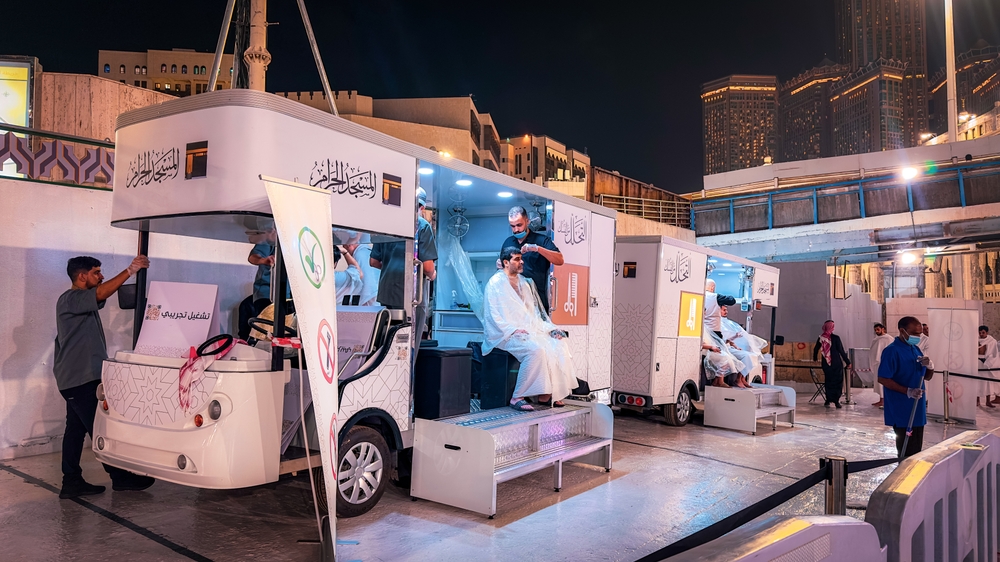
Is Trimming the Beard during Hajj or Umra Recommended in the Shafi‘i School and Is There a Specified Limit??
Shafi'i Fiqh
Answered by Shaykh Irshaad Sedick
Question
Based on Imam Shafi‘i’s statement in al-Umm and Imam Nawawi’s transmission in al-Majmu‘, is trimming the beard during Hajj or Umra recommended or just allowed? Also, is there a specific amount that must be trimmed?
Answer
In the Name of Allah, the Most Merciful and Compassionate.
In the Shafi‘i school, trimming the beard or mustache during Hajj or Umra is considered sunna or mustahabb, meaning it is recommended but not required. The classical sources do not set a minimum or maximum amount. They simply use the word “shay’an” (something), so the act is left open-ended.
Recommended or Merely Permitted?
Imam Shafi’i (Allah have mercy on him) states that he prefers (uhibbu) that a pilgrim take from his beard and mustache during the rites, so that he offers some of his hair for the sake of Allah. He also makes clear that if one does not do so, nothing is due, since the obligatory nusuk pertains to the head alone. [Shafi‘i, al-Umm, 2:232]
The word “uhibbu” (I prefer) in Imam Shafi‘i’s usage signals recommendation (istihbab), that is, a recommended act. This is not the language of mere permissibility (ibaha), nor is it the language of obligation (wujub).
Imam Nawawi confirms this in al-Majmu‘ Sharh al-Muhadhdhab, transmitting the same position from the Shafi‘i school: it is sunna to take something from the mustache, and the language used throughout the tradition is either “yusannu” (it is sunna) or “yustahabbu” (it is recommended).
Shafi‘i Fiqh literature gives the reason that the pilgrim thereby fulfills the meaning of offering hair to Allah, even though the obligatory act of head-shaving or trimming has already been performed separately.
Ruling
Trimming from the beard or mustache in Hajj or Umra is a recommended (sunna/mustahabb) act. It is not obligatory, and it is not merely permitted (mubah).
Is There a Specified Limit?
No. There is no specified minimum or maximum in the classical sources for this beard-trimming in the context of Hajj or Umra. Imam Shafi‘i’s own language in al-Umm is “something from his beard (shay’an min lihyatihi)”, and this indefinite usage is consistent across the tradition.
The main point of this ruling is to offer some hair to Allah with sincerity, not to remove a specific amount. Since this trimming was never required, scholars did not set any specific measurement for it.
This stands in clear contrast to the obligatory rites of the head (shaving or shortening). There, the scholars debated at length whether the minimum is one hair, three hairs, or full coverage. The Shafi‘i school settled on three hairs as the minimum for the obligatory act. No equivalent discussion exists for the beard because the beard trimming was never obligatory in the first place. [Shirbini, Mughni al-Muhtaj]
On the Fist-Length Rule
The “fist-length” rule that sometimes enters these discussions belongs to an entirely separate chapter: the general question of trimming and shaving the beard as a matter of personal appearance, which falls under the discussion of “natural grooming (zina al-fitra)” and the permissibility of shortening the beard. That ruling has no bearing on this context of Hajj and Umra. The two discussions must not be conflated.
In the context of Hajj and Umra, the texts say, “take something” and leave it there. The Shafi‘I fuqaha do not set a threshold where none is given, and neither should we. [ibid.]
Practical Guidance
Where the scholars have left a matter unquantified, it is meant to maintain some flexibility. Beard trimming during Hajj and Umra is a recommended act of devotion. Taking any small amount fulfills the Sunna.
If you are performing Hajj or Umra, you may take a small amount from your beard or mustache after completing the obligatory rites of shaving/shortening the head, intending thereby to offer some hair to Allah. If you choose not to, nothing is owed.
We ask Allah (Most High) to grant you a blessed and accepted pilgrimage.
And Allah (Most High) knows best.
[Shaykh] Irshaad Sedick
Checked and Approved by Shaykh Faraz Rabbani
Related: Does One Have to Shave or Cut Their Hair Short during the Pilgrimage? (Shafi‘i)
Shaykh Irshaad Sedick was raised in South Africa in a traditional Muslim family. He graduated from Dar al-Ulum al-Arabiyyah al-Islamiyyah in Strand, Western Cape, under the guidance of the late world-renowned scholar Shaykh Taha Karaan (Allah have mercy on him), who taught there.
Shaykh Irshaad received Ijaza from many luminaries of the Islamic world, including Shaykh Taha Karaan, Shaykh Muhammad Awama, Shaykh Muhammad Hasan Hitu, and Mawlana Abdul Hafeez Makki, among others.
He is the author of the text “The Musnad of Ahmad ibn Hanbal: A Hujjah or not?” He has been the Director of the Discover Islam Center and, for 6 years, the Khatib of Masjid Ar-Rashideen, Mowbray, Cape Town.
Shaykh Irshaad has 15 years of teaching experience at some of Cape Town’s leading Islamic institutes. He is currently building an Islamic podcast, education, and media platform called ‘Isnad Academy’ and has completed his Master’s degree in the study of Islam at the University of Johannesburg. He has a keen interest in healthy Prophetic living and fitness.
