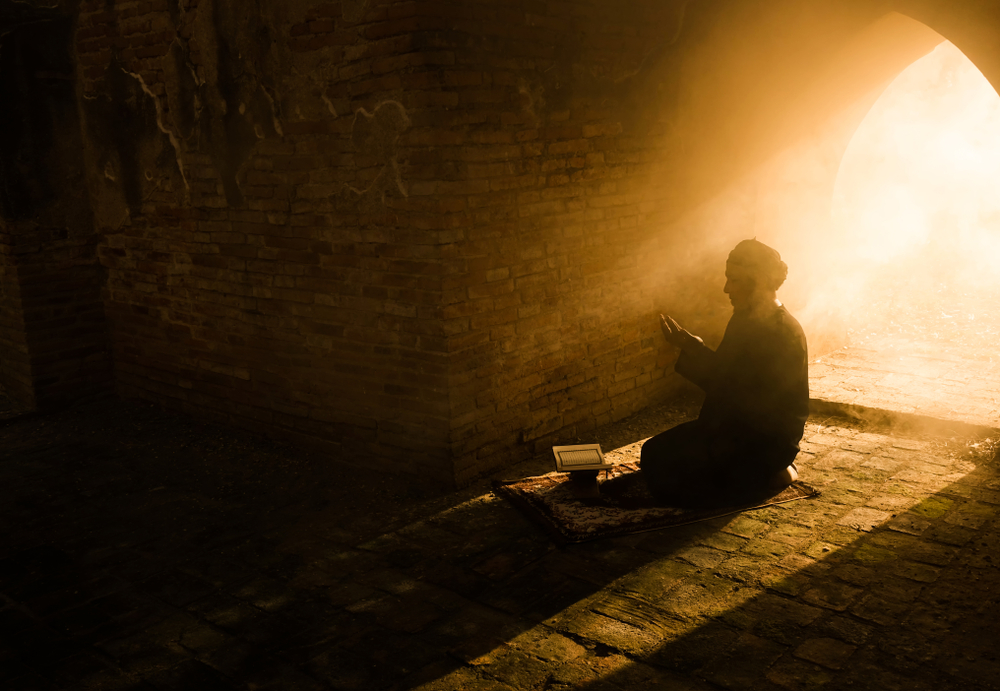
What Is the Ruling on Forty-Day Spiritual Seclusion (Khalwa), Its Proofs, and Proper Guidance?
Answered by Shaykh Faraz Rabbani
Question
What is the ruling on undertaking a forty-day spiritual seclusion (khalwa)?
Answer
In the Name of Allah, Most Merciful and Compassionate.
The short answer is: do not do this without a qualified guide, and do not abandon the congregation.
Spiritual seclusion (khalwa) has a sound basis in the Quran and the Sunna. Allah Most High mentions the forty nights of Musa (peace and blessings be upon him), Maryam’s withdrawal (peace and blessings be upon her), the youths’ refuge in the cave, and devotional seclusion (itikaf) in the mosques.
The Prophet (Allah bless him and give him peace) loved seclusion in Hira before revelation, and after revelation, his established model of retreat was devotional seclusion (itikaf) in the mosque.
So the basis of retreat is sound. But its sound form is disciplined withdrawal for worship, remembrance (dhikr), repentance, and reflection—not a self-designed isolation that sets aside the Sacred Law or the mosque.
What Is Seclusion (Khalwa)?
On the spiritual path, seclusion (khalwa) is a period of solitude for remembrance (dhikr) and other devotions under the supervision of an authorized guide (murshid). It is an intense period of spiritual training used by the great masters to develop their students’ inward states.
But the masters of the spiritual path distinguish mere physical isolation from true spiritual retreat. Jurayri (Allah have mercy on him, d. 311 AH) said:
“It is to enter the crowd while keeping them from crowding your heart.” [Qushayri, Risala]
And Dhu al-Nun al-Misri (Allah have mercy on him, d. 245 AH) said:
“The one veiled from creation by physical seclusion is not like the one veiled from them by Allah.” [Qushayri, Risala]
The highest seclusion (khalwa) is not merely spatial. It is inward detachment with presence.
A Qualified Spiritual Guide
This practice should be undertaken only under the guidance of a spiritual master deeply rooted in knowledge of the Sacred Law and the spiritual path. Ibn al-Hajj (Allah have mercy on him, d. 737 AH) states:
“The seeker should not enter seclusion (khalwa) by himself, for the danger in that is immense.” [Ibn al-Hajj, Madkhal]
Shaykh Nuh Keller relates from his shaykh, Shaykh ‘Abd al-Rahman al-Shaghuri (Allah have mercy on him, d. 1425 AH), that only a few of those who took the spiritual path (tariqa) from him entered the seclusion (khalwa). By no means all who asked were admitted—only those whom the shaykh’s spiritual intuition told him would benefit, given their state, their time, and their readiness.
The disciple should have listened to the teachings for several years, so that his life would be fairly free of problems, and that he would first complete the preliminary stages of spiritual vigilance (muraqaba). [Keller, Sea Without Shore]
Those I know who practice seclusion (khalwa) do much shorter retreats—and only after rigorous prior religious and spiritual preparation, and even then with exacting supervision throughout.
Quranic Proofs Cited by the Scholars
One. The Forty Nights of Musa (Peace and Blessings be Upon Him):
وَإِذْ وَاعَدْنَا مُوسَىٰ أَرْبَعِينَ لَيْلَةً
“And when We agreed to meet Moses in forty nights, yet incredibly you took the calf just as soon as he had gone, committing utter idolatrous wrong.” [Quran, 2:51]
This is the most frequently cited verse in connection with the forty-day retreat. It is an indicator of the spiritual significance of forty, not a binding devotional template. [Alusi (d. 1270 AH), Ruh al-Ma‘ani, 1:257; Ibn Ashur (d. 1393 AH), Tahrir wa al-Tanwir, 1:497]
Two. The Youth of the Cave:
وَإِذِ اعْتَزَلْتُمُوهُمْ وَمَا يَعْبُدُونَ إِلَّا اللَّهَ فَأْوُوا إِلَى الْكَهْفِ يَنْشُرْ لَكُمْ رَبُّكُم مِّن رَّحْمَتِهِ
“One said, ‘Since you have forsaken them and all they worship but Allah, take refuge in the great cave, and your Lord will lavish on you of His mercy, and ready you from this matter of yours every comfort and ease.’” [Quran, 18:16]
Ibn Kathir (Allah have mercy on him, d. 774 AH) notes that this withdrawal is legislated in circumstances of religious persecution, whereas ordinarily one should not forfeit the benefits of congregational and Friday prayers. [Ibn Kathir, Tafsir]
Three. Maryam’s Withdrawal (Peace and Blessings be Upon Him):
فَاتَّخَذَتْ مِن دُونِهِمْ حِجَابًا
“And make mention in the Book of Mary when she drew off from her family to an easterly place. And she took a screen apart from them; Whereat We sent to her Our spirit the supreme Archangel….” [Quran, 19:16–17]
Four. Ibrahim’s Withdrawal (Peace and Blessings be Upon Him):
وَأَعْتَزِلُكُمْ وَمَا تَدْعُونَ مِن دُونِ اللَّهِ وَأَدْعُو رَبِّي
“‘And I shall leave you and all you call on short of Allah, and pray to my Lord; that haply I may never be in my prayer to my Lord disappointed.’” [Quran, 19:48]
Five. Devotional Seclusion in the Mosques:
وَلَا تُبَاشِرُوهُنَّ وَأَنتُمْ عَاكِفُونَ فِي الْمَسَاجِدِ
“… while on retreat in mosques: ….” [Quran, 2:187]
Six. The Stillness of the Night:
إِنَّ نَاشِئَةَ اللَّيْلِ هِيَ أَشَدُّ وَطْئًا وَأَقْوَمُ قِيلًا
“Truly the works that thrive in the night are stronger in firming the good into place, and better for soulful words.” [Quran, 73:6]
Prophetic Precedent
One. The Cave of Hira:
A’isha (Allah be pleased with her) said:
“Solitude was made beloved to him, and he would seclude himself in the cave of Hira, devoting himself to worship therein.” [Bukhari; Muslim]
Hafidh Ibn Hajar (Allah have mercy on him, d. 852 AH) commented: “Seclusion is the emptying of the heart of everything except Allah.” [Ibn Hajar, Fath al-Bari Sharh Sahih al-Bukhari]
Imam Nawawi (Allah have mercy on him, d. 676 AH) said: “Being alone with the Beloved is the true seclusion; it is the way of the righteous and the knowers.” [Nawawi, Sharh Sahih Muslim]
Imam Zuhri (Allah have mercy on him, d. 124 AH) said: “I marvel at people who have abandoned seclusion (khalwa). The Prophet (Allah bless him and give him peace) did some things and then left them, yet he never abandoned seclusion until he passed away.” [Cited in Fath al-Bari]
The Prophet’s (Allah bless him and give him peace) extended seclusion at Hira was before his commissioning. After the revelation, his established model of retreat was devotional seclusion (itikaf) in the mosque, particularly in the last ten nights of Ramadan.
Two. The Seven Shaded by Allah Most High:
The Prophet (peace and blessings be upon him) referred to
“…a man who remembers Allah in seclusion until his eyes overflow with tears.” [Bukhari; Muslim]
Three. The Hadith of “Forty Days and Springs of Wisdom”:
“Whoever devotes himself sincerely to Allah for forty days, the wellsprings of wisdom shall manifest from his heart upon his tongue.”
Though this hadith is weak (da‘if). [Sakhawi, Maqasid al-Hasana] The scholars don’t base the general practice of the spiritual seclusion (khalwa).
Rather, the scholars of the spiritual path–and others–found that 40 days is often a good time to establish and change habits.
Thus, the great early imam, Sahl al-Tustari (Allah have mercy on him, d. 283 AH) said,
“Whoever renounces worldliness for forty days with sincere devotion, wonders shall manifest from him. If they do not, there is an absence of truthfulness in his renunciation.” [Qushayri, Risala]
Imam Munawi (Allah have mercy on him, d. 1031 AH) stated: “The wisdom in mentioning forty days is that this is the duration required to persist in changing ingrained habits—as is known through experience.” [Munawi, Fayd al-Qadir]
The key is inward transformation—not the number of days.
The Hikam Tradition: The Aim of Seclusion (Khalwa)
Ibn Ata’illah (Allah have mercy on him, d. 709 AH) states the core principle:
ما نفع القلب شيء مثل عزلة يدخل بها ميدان فكرة
“Nothing benefits the heart like some seclusion (uzla) by which it enters the plains of reflection.” [Ibn Ata’illah, Hikam, no. 12]
Ibn ‘Ajiba (Allah have mercy on him, d. 1224 AH) explains: “Nothing is more beneficial to the heart than seclusion joined to reflection. There is no good in a seclusion without reflection, and reflection does not properly rise without some seclusion.” [Ibn Ajiba, Iqadh al-Himam]
The aim of seclusion (khalwa) is the emptying of the heart for reflection, self-reckoning, and presence with Allah Most High.
Seclusion and Full Religious and Spiritual Cultivation
Ibn Ata’illah also ties seclusion to obscurity (khumul), and striving to complete one’s religious and spiritual cultivation:
ادفن وجودك في أرض الخمول، فما نبت مما لم يدفن لا يتم نتاجه
“Bury your existence in the earth of obscurity, for anything that grows without first being buried does not bear full yield.” [Ibn Ata’illah, Hikam]
Ibn Ajiba (d. 1224 AH) comments that the seeker should “bury” oneself in obscurity until obscurity becomes sweeter to him than fame, because this is the path to sincerity. Seclusion (khalwa) is a means to sincerity—not an end unto itself.
Benefits of Seclusion (Khalwa)
From the Classical Masters
Dhu al-Nun (Allah have mercy on him, d. 245 AH) said: “I have not seen anything more conducive to sincerity than seclusion (khalwa).” [Qushayri, Risala]
Ibn ‘Ajiba (d. 1224 AH) lists concrete benefits in Iqadh al-Himam: “Safety from the blights of the tongue… guarding the gaze… guarding the heart from ostentation, compromise, and other illnesses… the attainment of detachment from the world and contentment.” [Ibn ‘Ajiba, Iqadh al-Himam]
Seclusion (khalwa) is also useful because it reduces the inflow of distraction and vanity.
Sahl al-Tustari (Allah have mercy on him, d. 283 AH) adds a prerequisite: “Seclusion (khalwa) is not sound except with lawful intake, and lawful intake is not sound except by fulfilling the due of Allah.” [Qushayri, Risala]
Cautions and Dangers
Imam Ghazali (Allah have mercy on him, d. 505 AH) does not absolutize seclusion. For some, after discipline and grounding, it is more helpful. But the matter differs by circumstances and persons and cannot be judged in an absolute way.
For some, at some times, sound companionship may be better, because the heart needs relief and the right company in religion. The criterion is not whim. It is what most helps one obey Allah Most High, purify the heart, and remain balanced. [Ghazali, Ihya Ulum al-Din, Kitab al-Uzla]
Such judgment requires consulting scholars deeply rooted in spiritual guidance.
Follow-Up Is Indispensable
Shaykh Nuh Keller gives a critical caution: a fruitful spiritual seclusion (khalwa) is not a one-time event that permanently transforms a person. Rather, its meanings must be consolidated through years of consistent spiritual works, especially nightly devotion. He says, “A seclusion (khalwa) is great through its follow-up. If there is little concern and little follow-up, the meanings fade until they become like a barely remembered dream.” [Keller, Sea Without Shore]
Vices and Worldly Preoccupations Delay Progress
Shaykh Nuh Keller relates the account of a farmer who entered seclusion (khalwa) while his crops were sprouting. He told his shaykh how difficult the remembrance (dhikr) was, for he kept thinking about his onions. The shaykh told him to simply repeat “onions, onions” until he could clear his heart—and only then return to the true remembrance (dhikr). [Keller, Sea Without Shore]
Don’t, of course, repeat ‘onions, onions’–rather: leave behind spiritual distractions.
The Grave Danger of Going Without a Guide
Shaykh Nuh Keller recounts the story of a man who obtained a “do-it-yourself” book on subjugating jinn and locked himself in a dark cellar for forty days without a guide. Instead of spiritual elevation, he experienced horrifying hallucinations and emerged having gone completely mad. [Keller, Sea Without Shore]
Seeking the Gift Rather Than the Giver
Qunawi (Allah have mercy on him, d. 673 AH) cautioned: “In this Hadith lies a secret that must be heeded: one must guard against making one’s sincerity itself a means of seeking the appearance of the springs of wisdom—for in that case, one has not truly been sincere to Allah.” [Cited in Munawi (d. 1031 AH), Fayd al-Qadir]
We worship seeking Allah, not the spiritual gifts.
Neglect of Obligations
The Sacred Law’s demands—congregational prayer, family responsibilities, the rights of others—are not suspended by voluntary spiritual exercises. Allah Most High says in the Hadith Qudsi:
ما تقرب إلي عبدي بشيء أحب إلي مما افترضت عليه
“My servant draws near to Me by nothing more beloved to Me than what I have made obligatory upon him.” [Bukhari]
The Wide Path: Daily Retreat from Worldliness
The early path manuals do not treat spiritual life as a rare heroic retreat. They teach a daily rhythm of recurring seclusion (khalwa).
Abu Talib al-Makki (Allah have mercy on him, d. 386 AH) devotes early sections of Qut al-Qulub to the seeker’s practice in the day and night: the devotions after Fajr, the litanies of the day and night, prayer between Maghrib and ‘Isha, Witr, tahajjud, and the regular portion (wird) of glorification and remembrance (dhikr).
Most people need a daily seclusion (khalwa) far more than an extended one.
Get to the prayer early and pray with presence. Remain after prayer for remembrance (dhikr), supplication, and reflection.
Guard a quiet devotional period after Fajr—stillness, recollection, and detachment from worldly preoccupation. Add the mid-morning prayer (Duha) as one is able.
Guard some prayer and seeking of forgiveness (istighfar) in the night, even if brief.
Night devotion—even a small amount—is the seclusion (khalwa) of the prophets and the righteous.
The Prophet (Allah bless him and give him peace) counseled:
لا يزال لسانك رطبا من ذكر الله
“Keep your tongue moist with the remembrance of Allah.” [Tirmidhi; Ibn Maja]
Spiritual Grounding: Knowledge before Seclusion
Imam Ghazali (Allah have mercy on him, d. 505 AH) transmits a counsel of great economy: “Learn first, then withdraw.
Knowledge, then discipline. Grounding, then seclusion. Not the other way around.
His Bidayat al-Hidaya—one of his last works—embodies this principle. It is arranged as a daily program: acts of obedience from waking to sleep, the sins of the limbs from which one must refrain, and the etiquette of companionship with the Creator and with creation.
He tells the reader: “You will never be capable of this unless you manage your time and organize your routine of worship from morning to night.” [Ghazali, Bidayat al-Hidaya]
And: “A prayer in congregation is twenty-seven times better than a prayer alone. If you are negligent of such a profitable act, then what benefit is there for you in the pursuit of knowledge? After all, the fruit of knowledge is acting upon it.” [Ghazali, Bidayat al-Hidaya]
This is the daily seclusion (khalwa). The structuring of one’s day—from Fajr to sleep—as an act of devotion, watchfulness, and turning to Allah Most High. Not in a dark cellar or a remote mountain, but in the mosque, the home, the marketplace, and the classroom.
The Bidaya teaches that the seeker guards his limbs—tongue, eyes, ears, hands, feet, stomach, and private parts—as the outward dimension of retreat, while cultivating presence, self-reckoning, and sincerity as its inward dimension.
Conclusion: Consistent Routines, Religious and Spiritual Knowledge, Over a Lifetime of Turning to Allah
The consistent has a deeper impact than the dramatic. The Prophet (Allah bless him and give him peace) said:
“The most beloved of deeds to Allah are the most consistent, even if small.” [Bukhari; Muslim]
Seclusion (khalwa) is a powerful spiritual medicine. But medicine requires a physician, a diagnosis, and a regimen. Its sound form is under guidance, with preparation, with the obligations intact.
For most seekers, the path is not a forty-day retreat but a lifetime of daily turning to Allah Most High: in prayer with presence, in remembrance (dhikr) with constancy, in the night with devotion, and in the day with watchfulness.
That is the seclusion (khalwa) that lasts.
“So if you seek, pay the price,” as the imams of this religion say.
And Allah alone gives success.
[Shaykh] Faraz Rabbani
Shaykh Faraz Rabbani is a recognized specialist scholar in the Islamic sciences, having studied under leading scholars from around the world. He is the Founder and Executive Director of SeekersGuidance.
Shaykh Faraz stands as a distinguished figure in Islamic scholarship. His journey in seeking knowledge is marked by dedication and depth. He spent ten years studying under some of the most revered scholars of our times. His initial studies took place in Damascus. He then continued in Amman, Jordan.
In Damascus, he was privileged to learn from the late Shaykh Adib al-Kallas. Shaykh Adib al-Kallas was renowned as the foremost theologian of his time. Shaykh Faraz also studied under Shaykh Hassan al-Hindi in Damascus. Shaykh Hassan is recognized as one of the leading Hanafi jurists of our era.
Upon completing his studies, Shaykh Faraz returned to Canada in 2007. His return marked a new chapter in his service to the community. He founded SeekersGuidance. The organization reflects his commitment to spreading Islamic knowledge. It aims to be reliable, relevant, inspiring, and accessible. This mission addresses both online and on-the-ground needs.
Shaykh Faraz is also an accomplished author. His notable work includes “Absolute Essentials of Islam: Faith, Prayer, and the Path of Salvation According to the Hanafi School,” which was published by White Thread Press in 2004 and is a significant contribution to Islamic literature.
His influence extends beyond his immediate community. Since 2011, Shaykh Faraz has been recognized as one of the 500 most influential Muslims. This recognition comes from the Royal Islamic Strategic Studies Center. It underscores his impact on the global Islamic discourse.
Shaykh Faraz Rabbani’s life and work embody a profound commitment to Islamic scholarship. His teachings continue to enlighten and guide seekers of knowledge worldwide.
