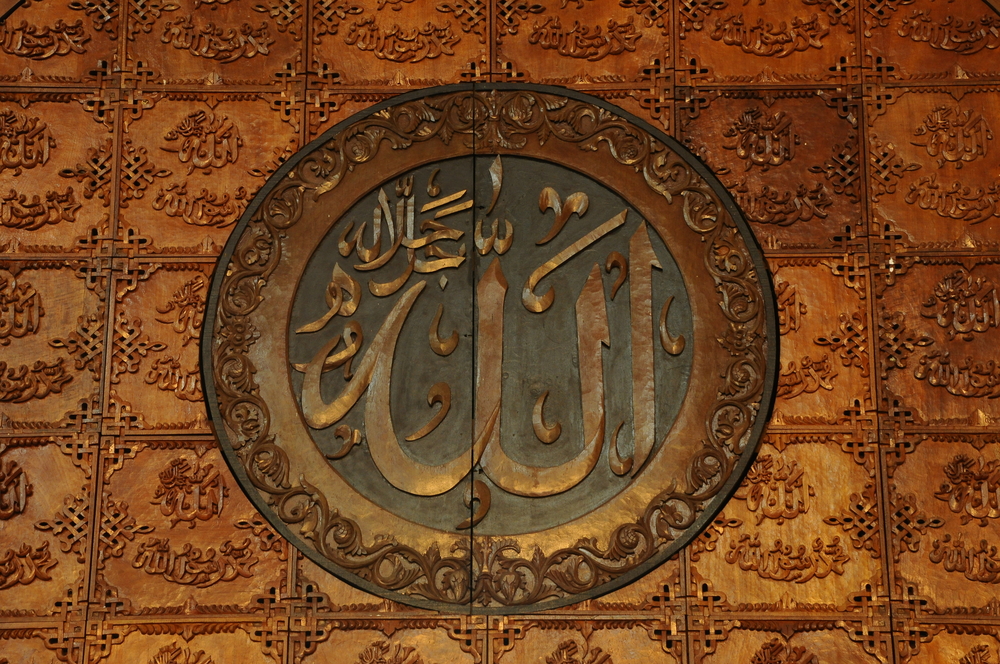
Can I Own and Display a Framed Nad e Ali with Numeric Squares in a Sunni Home?
Answered by Shaykh Faraz Rabbani
Question
My father was given framed pictures said to be for protection, and he passed a couple on to me, one of them a Nad e Ali written in the shape of a lion, with writing underneath and numeric boxes in each corner, like a taweez. May I own and display such things in a Sunni Hanafi home?
Answer
In the name of Allah, the Most Merciful, the Most Compassionate.
Take it down. Relying on it for protection is what is not allowed, and hanging writing you cannot read is why it comes off the wall; owning it is neither, so wrap it, put it away, and find out what it says. Your father’s other pictures follow the same test.
Nothing in this touches Sayyiduna Ali (Allah ennoble his face). Love for the Prophet (Allah bless him and give him peace) and his family is part of the religion. Asking Allah while mentioning a beloved servant of His is not associating partners with Allah; holding that a creature gives protection in his own right is another matter, and that is the line.
Nad e Ali itself is a question of transmission: it has no chain in Sunni hadith literature. Mulla Ali al-Qari (Allah have mercy on him), a Hanafi, placed it among fabricated reports and traced it to Shiʿi sources, and Imam Ajluni (Allah have mercy on him) transmits his verdict. [Ajluni, Kashf al-Khafaʾ 2:363]
Your corner boxes are numerical squares (awfaq), numbers laid into geometric figures in a particular form. [al-Mawsuʿa al-Fiqhiyya al-Kuwaytiyya 24:261] “There is no disagreement among the jurists that an amulet is not permitted when it contains a name whose meaning is not known, because what is not understood cannot be secured against containing something of associating partners with Allah.” [al-Mawsuʿa al-Fiqhiyya al-Kuwaytiyya 14:30] Numbers in boxes are not a name, but that reason is about what cannot be understood, and it reaches them. A thing that neither benefits nor harms is what the Quran warns against turning to. [Quran 10:106]
Ibn Abidin (Allah have mercy on him) draws the Hanafi line on the written amulet (tamima): there is no harm in one carrying the Quran or the Names of Allah, and the objection is to what is not known, since sorcery or disbelief may have entered it. [Ibn Abidin, Radd al-Muhtar 6:363]
The Messenger of Allah (Allah bless him and give him peace) said, “Whoever attaches himself to a thing is entrusted to it.” [Abu Dawud] A thing the family walks past every day starts to be trusted, and nobody ever decides to trust it.
This is a ruling on an object, not a verdict on anyone in your family. Your father was handed these and told they would protect him, and nothing you have written puts his Islam in question. Ask him who gave them and what he was told, and keep it a question rather than an accusation. If anyone else asks why the wall is bare, you owe them no verdict on anybody.
Read the Words Before Anything Goes on Your Wall
Out of respect, wrap anything bearing the Name of Allah or a Quranic verse rather than throwing it away. If a picture contains only the Quran or the Names of Allah in Arabic, keep it as calligraphy; only the boxes remain problematic. If you want something on that wall, hang words you can read and would gladly say in your prayer. The protection your father was hoping for is real. It was never in the frame.
And Allah knows best.
Faraz Rabbani
Related Answers
- Is Using a Ta’wiz (Amulet) Permissible? — A written amulet is sound when it carries only Quranic words or the Names of Allah, worn with the belief that Allah alone protects.
- Can I Use Protective or Healing Words (Ruqya) and Amulets (Ta’wiz) Using Numbers? — An amulet’s wording must be understood as Arabic naming Allah, which is exactly why number-based versions are best avoided.
- Is Istighatha—Seeking Help Through a Prophet or a Righteous Believer—Shirk? — Asking a righteous person to intercede is not shirk so long as the heart knows Allah alone truly gives and withholds.
- Is There Any Significance to Numerology in Islam? — Certain numbers carry real weight in our sources, but believing a numbering system itself causes benefit or harm is baseless superstition.
