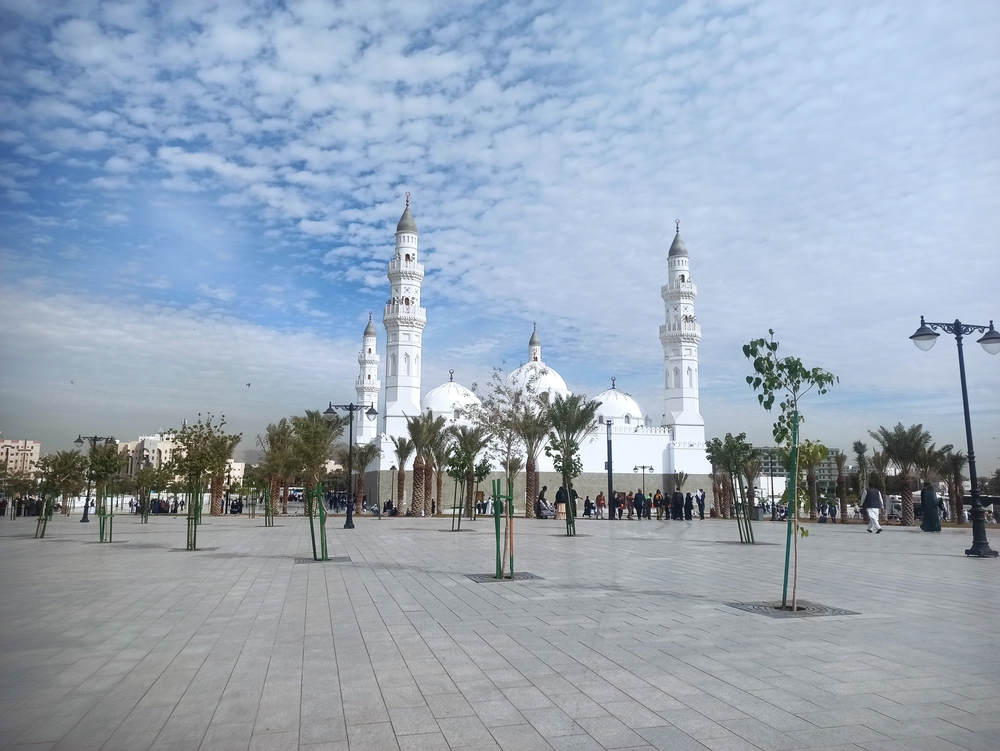
Is Visiting Historical Sites in and around Madina Permissible?
Answered by Shaykh Yusuf Weltch
Question
Is it permissible to visit historical sites in and around Madina beyond Quba and Baqi — such as Qiblatayn, Khandaq, Badr, and Ta’if?
Answer
In the Name of Allah, the Most Merciful and Compassionate.
It is permissible (and perhaps praiseworthy) to visit historical sites in Madina, including, but not limited to, the mosques of historical significance.
Firstly, the basis of all issues is permissibility until evidence is established indicating its impermissibility. [Ibn Nujaym, al-Ashbah wa al-Naza’ir]
There is no evidence precluding the permissibility of visiting such sites. In fact, it is established in the Prophetic Sunna that the Messenger of Allah (Allah bless him and give him peace) showed veneration for the historical sites of previous Prophets.
The Story of the Night Journey
The story of the Prophet’s (Allah bless him and give him peace) night journey is filled with visits to historical sites out of reverence for their significance. The narration is too long to mention in full, but a summary is as follows:
The Angel Jibril (upon him be peace) commanded the Messenger of Allah (Allah bless him and give him peace) to descend from the Buraq and pray. After he prayed, Angel Jibril asked, “Do you know where you prayed?” The Messegner replied, “Allah knows best.” Angel Jibril said, “You prayed in Yathrib, Tayba (Madina).”
He then commanded him to descend and pray again. After praying, Angel Jibril asked, “Do you know where you prayed?” The Messenger replied, “Allah knows best.” Angel Jibril said, “You prayed in Madyan, at the tree of Musa (Moses).”
He then commanded him to descend and pray a third time. After praying, Angel Jibrīl asked, “Do you know where you prayed?” The Prophet (Allah bless him and give him peace) replied, “Allah knows best.” Jibril said, “You prayed in Bayt Lahm (Bethlehem), where Jesus Christ, the son of Maryam, was born.” Thereafter, they continued on until they reached Bayt al-Maqdis (Jerusalem). [Tabarani]
Visiting with Righteous Intentions
When visiting places of Islamic historical significance, especially those connected with the blessed life of the best of creation, the Messenger of Allah (Allah bless him and give him peace), it is important to have the correct intentions.
Among the intentions one should have is to connect oneself to the life and guidance of the Messenger of Allah (Allah bless him and give him peace). To gain a deeper appreciation of the sacrifice of the Messenger of Allah (Allah bless him and give him peace) and those before us in the Umma.
Regarding historical mosques, it is recommended to perform two units of prayer upon entering. That is, as long as it is not at a time when voluntary prayers are disliked.
Visiting the Messenger of Allah (Allah Bless Him and Give Him Peace)
As for visiting the Messenger of Allah (Allah bless him and give him peace) at his blessed resting place in Madina al-Munawwara, this is highly encouraged for anyone who can do so.
Visiting the Messenger of Allah (Allah bless him and give him peace) and His blessed mosque are established in the texts and have been encouraged since the time of the Companions (Allah be pleased with them all).
The Messenger of Allah (Allah bless him and give him peace) said, “Whoever visits my grave after my passing, it is as though he visited me during my life.” [Tabarani]
The Messenger of Allah (Allah bless him and give him peace) said, “Whoever visits me, I will intercede (or I will be a witness) for them; and whoever dies in either of the two Sacred lands (Mecca or Madina), Allah will raise them among those who are safe on the Day of Judgment.” [Bayhaqi]
The Messenger of Allah (Allah bless him and give him peace) said, “Whoever visits my grave, my intercession is incumbent for them.” [Ibid.]
And Allah knows best
[Shaykh] Yusuf Weltch
Checked and Approved by Shaykh Faraz Rabbani
Related
- The Adab of the Visitation (Ziyara) of the Prophet — The manners and meaning of ziyara.
- Manners of Visiting the Messenger of Allah — Adab of the visit, transferable to the wider sites.
- Traveler Status while in Madina — A practical adjacent ruling for those touring the area.
Shaykh Yusuf Weltch is a teacher of Arabic, Islamic law, and spirituality. After accepting Islam in 2008, he studied at Darul Uloom Seminary in New York and later completed his studies at Darul Mustafa in Tarim, Yemen.
There, he completed memorization of the Quran and his studies in Islamic Sciences. Throughout his years of study, he was blessed to learn from many great scholars: Habib Umar bin Hafiz, Habib Kazhim al-Saqqaf, Shaykh ‘Umar bin Husayn al-Khatib, and others.
Upon returning, he joined the SeekersGuidance faculty in the summer of 2019.
