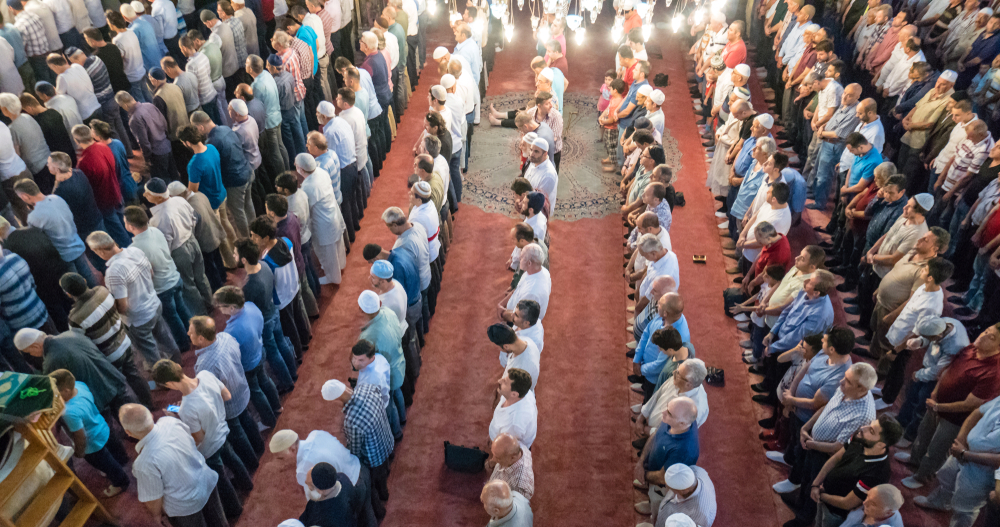
What Is the Ruling on Performing Prayer in Congregation (Salat Al-Jama’a)?
Answered by Shaykh Dr. Muhammad Abu Bakr Badhib
Question
What is the ruling on performing prayer in congregation (Salat al-Jama‘a)?
Answer
In the name of Allah, and all praise is due to Allah, and blessings and peace be upon our master Muhammad, the Messenger of Allah, his Family, his Companions, and those who follow him.
Congregational prayer holds a significant place in Islam, and its superiority over praying individually is well-established in authentic hadiths. The Prophet (Allah bless him and give him peace) said:
“The prayer in congregation is twenty-seven times superior to the prayer performed individually.” [Bukhari; Muslim]
Scholars have expressed multiple opinions regarding the ruling of congregational prayer, ranging from whether it is obligatory or not to whether its abandonment is sinful. The main positions are as follows:
First Opinion: Communal Obligation
It is a communal obligation (fard kifaya). This is the view of the Shafi‘i school and one of the opinions within the Hanafi and Maliki schools. [See: Shirbini, Mughni al-Muhtaj; Ibn Humam, Fath al-Qadir; Dasuqi, Hashiyat al-Dasuqi; Ibn Hajar, Fath al-Bari]
Second Opinion: Sunna
It is a confirmed Sunna (sunnah mu’akkada). This is the established position of the Hanafi and Maliki schools. [See: Kasani, Bada’i‘ al-Sana’i‘; Mawwaq, al-Taj wa al-Iklil]
Third Opinion: Individual Obligation
It is an individual obligation (fard ‘ayn) but not a condition for the validity of the prayer. This is the opinion of the Hanbali school.
According to this view, one who neglects congregational prayer is sinful, but the validity of their prayer remains intact.
Summary
In short, this is a summary of the positions, while the books of Islamic jurisprudence contain more detailed discussions on this issue.
A Muslim who is keen on their faith should maintain regularity in performing prayers in congregation and should not be negligent about it.
By doing so, one can avoid the disagreement of those who consider it obligatory and can also hope to attain the great reward associated with it.
And Allah is the one who grants success and guides us to the right path.
[Shaykh] Dr. Muhammad Abu Bakr Badhib
Shaykh Dr Muhammad Abu Bakr Badhib is a prominent Islamic scholar from Yemen born in Shibam, Hadhramaut, in 1976. He received his degree in Shari‘a from Al-Ahqaf University, a master’s degree from the Islamic University of Beirut, and a PhD in Usul al-Din from Aligarh Muslim University (AMU).
He studied under great scholars such as Shaykh al-Habib Ahmad Mashhur al-Haddad, Shaykh Fadl Ba‘ fadl, Habib Salim al-Shatiri, Habib Ali Mashhur bin Hafeez, and others. He has served as the Director of Publications at Dar al-Fiqh, the former Deputy Director of Cultural Relations at Al-Ahqaf University, a former Assistant for Employee Affairs at Atiyah Iron Company, a researcher at the Sunna Center affiliated with the Dallah al-Baraka Foundation, and a researcher at Al-Furqan Foundation’s Makka al-Mukarrama and Madina al-Munawwara Encyclopedia branch.
Currently, he is a researcher at Al-Furqan Foundation’s Makka al-Mukarrama and Madina al-Munawwara Encyclopedia branch, teaches traditionally through the Ijaza system at Dar al-Fuqaha in Turkey, supervises the Arabic department at Nur al-Huda International Institute (SeekersGuidance), and is a member of the Board of Trustees of the Manuscript House in Istanbul.
His works include “The Efforts of Hadhramaut Jurists in Serving the Shafi‘i School,” “Contributions of Hadhramaut Scholars in Spreading Islam and its Sciences in India,” “Hada’iq al-Na‘im in Shafi‘i Fiqh,” in addition to verifying several books in Fiqh, history, the art of biographies, and Asanid (chains of narration).
