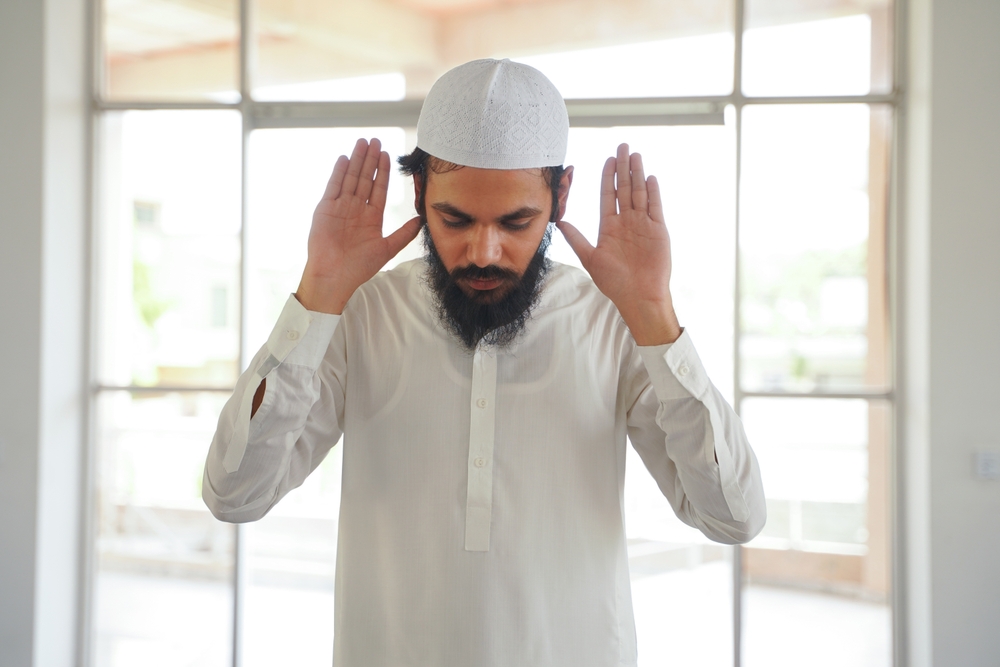
Does Raising the Hands at Each Rak’a Invalidate the Prayer?
Hanafi Fiqh
Answered by Shaykh Faraz Rabbani
Question
A worshipper raises his hands at the start of each rak’a. Does this invalidate his prayer, or the prayer of the person beside him?
Answer
In the Name of Allah, the Most Merciful and Compassionate.
No. Raising the hands invalidates no one’s prayer—neither the one who does it nor the one praying beside him.
Raising the hands (raf’ al-yadayn) is not a pillar (rukn) of the prayer, so it cannot count as an invalidating addition. A prayer breaks when someone drops a pillar, or moves so much (amal kathir) that an onlooker would judge him not to be praying.
A brief raising of the hands is a slight movement (Amal Yasir), and a slight movement never invalidates.
To Raise or Not to Raise the Hands: A Matter of Recommendation, the Validity
What lies behind the question is a difference over a recommended act, not a dispute over validity. The relied-upon (mu’tamad) position in the Hanafi school is that the hands rise at the opening takbir (takbirat al-ihram) alone.
This rests on the report of Ibn Mas’ud (Allah be pleased with him), who prayed as the Messenger of Allah (Allah bless him and give him peace) prayed and did not raise his hands except at first. [Abu Dawud; Tirmidhi, who graded it hasan] Ibn al-Humam relies on this in Fath al-Qadir.
The other schools hold that the hands also rise when going into and rising from bowing (ruku’), and their practice also traces to sound Prophetic reports. This is a respected difference among the imams — not an innovation or an error that breaks the prayer.
Ibn Abidin notes in Radd al-Muhtar that the contrary practice does not affect the soundness of the prayer in any case.
The point about slight movement is no loose claim. Imam Jassas (Allah have mercy on him) sets it down as a settled principle: slight movement in the prayer is pardoned and does not invalidate it, while movement so great that it is no longer part of the prayer invalidates it by consensus. [Jassas, al-Fusul fi’l-Usul]
The same distinction runs through the Hanafi books down to Ibn Abidin. And the verses themselves call only to stillness and presence — “Stand before Allah devoutly obedient” [Quran 2:238] — which counsels excellence, not a condition of validity.
A Difference of Practice, Not a Question of Validity
The governing principle is simple: a prayer breaks only when someone omits a pillar or moves so much that it no longer looks like prayer.
Raising the hands is neither. So set the worry down. If you follow the Hanafi school, raise your hands at the opening takbir and keep them at your sides afterward.
If you pray beside someone who raises at each rakat, his prayer and yours are both sound, and there is no call to correct him over a matter the imams themselves differed upon with respect.
And Allah knows best.
[Shaykh] Faraz Rabbani
Related Answers
Should I Raise My Hands during the Prayer?
Explains when raising the hands is recommended in prayer and the scholarly basis for the practice.
What Is the Ruling and Method of Raising the Hands for the Opening Takbir?
Clarifies the ruling and proper manner of raising the hands at the start of prayer.
Should I Avoid Raising My Hands When Praying With Hanafis? (Shafi’i)
Discusses maintaining prayer etiquette and unity when praying behind followers of another school.
Raising the Hands When Going Into Qunut: Hanafi Legal Methodology
Explains the Hanafi reasoning regarding raising the hands before and during the qunut supplication.
Shaykh Faraz Rabbani is a recognized specialist scholar in the Islamic sciences, having studied under leading scholars from around the world. He is the Founder and Executive Director of SeekersGuidance.
Shaykh Faraz stands as a distinguished figure in Islamic scholarship. His journey in seeking knowledge is marked by dedication and depth. He spent ten years studying under some of the most revered scholars of our times. His initial studies took place in Damascus. He then continued in Amman, Jordan.
In Damascus, he was privileged to learn from the late Shaykh Adib al-Kallas. Shaykh Adib al-Kallas was renowned as the foremost theologian of his time. Shaykh Faraz also studied under Shaykh Hassan al-Hindi in Damascus. Shaykh Hassan is recognized as one of the leading Hanafi jurists of our era.
Upon completing his studies, Shaykh Faraz returned to Canada in 2007. His return marked a new chapter in his service to the community. He founded SeekersGuidance. The organization reflects his commitment to spreading Islamic knowledge. It aims to be reliable, relevant, inspiring, and accessible. This mission addresses both online and on-the-ground needs.
Shaykh Faraz is also an accomplished author. His notable work includes “Absolute Essentials of Islam: Faith, Prayer, and the Path of Salvation According to the Hanafi School.” This book, published by White Thread Press in 2004, is a significant contribution to Islamic literature.
His influence extends beyond his immediate community. Since 2011, Shaykh Faraz has been recognized as one of the 500 most influential Muslims. This recognition comes from the Royal Islamic Strategic Studies Center. It underscores his impact on the global Islamic discourse.
Shaykh Faraz Rabbani’s life and work embody a profound commitment to Islamic scholarship. His teachings continue to enlighten and guide seekers of knowledge worldwide.
