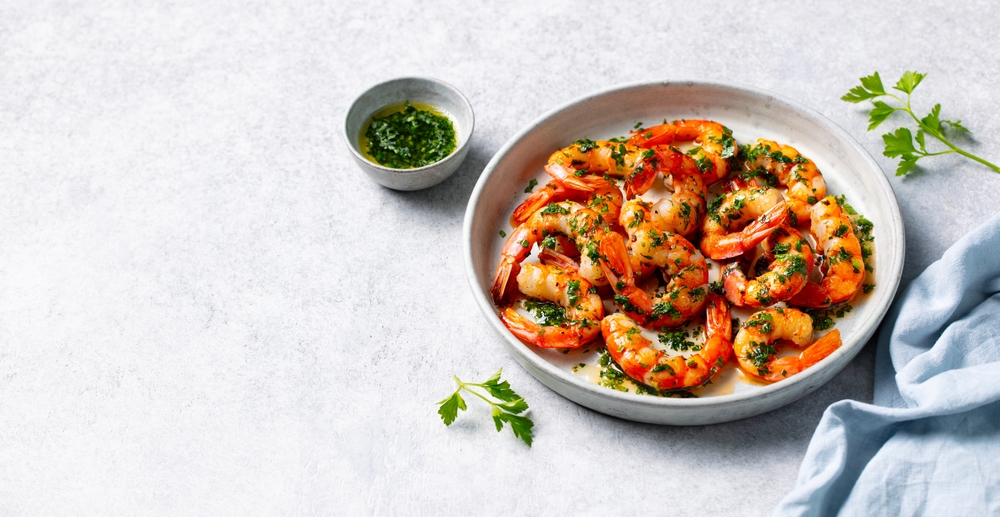
How Does the Hanafi School Classify Shrimp and Other Seafood?
Hanafi Fiqh
Answered by Shaykh Faraz Rabbani
Question
Why does the Hanafi school treat shrimp as lawful? The Arabs considered it fish, and why should the Arabic understanding of “fish” be normative when Islam is for all peoples?
Answer
In the name of Allah, the Most Merciful, the Most Compassionate.
The Quran was revealed in Arabic, and it names the lawful sea creature as samak (fish).
To know what that word meant when Allah Most High used it, the jurists look to Arabic usage at the time of revelation.
This is a standard principle of Quranic interpretation across all four schools. It is not a Hanafi quirk and not a way around the text.
The Operative Principle
Allah Most High says, “Lawful for you is the game of the sea and its food, as a provision for you and for travelers.” [Quran 5:96; Keller, The Quran Beheld]
The Hanafi jurists and major Quranic exegetes understood the lawful “game of the sea” in this verse to refer specifically to fish (samak).
The Hanafis hold that only what falls under “fish” by the original Arabic usage is included in this permission.
Other sea creatures, such as crabs and frogs, were classified as “vile things” (khaba’ith), which the sacred law independently prohibits
So the Hanafi position rests on two pillars, not on cultural preference:
First: the Quranic word samak.
Second: the broader Quranic prohibition of vile things in Surat al-A’raf. [Quran 7:157]
Why Arabic Usage Matters
The Quran addresses humanity in the language that Allah chose. Arabic words carry the meanings they bore at the time of revelation. [Sarakhsi, Usul; Jassas, Ahkam al-Quran]
When Hanafis and other schools interpret the Quran, they ask what the words meant to the first community that received them. This is the most basic safeguard against rewriting revelation across cultures and centuries.
The same method governs every act of worship. We pray five times because the early community understood the Quran and the Sunna of the Prophet (Allah bless him and give him peace) that way.
We fast Ramadan, give zakat, and perform Hajj on the same basis.
The Hanafi treatment of “fish” is not a special move for shrimp. It is the ordinary work of reading revelation in its own tongue.
On Shrimp Specifically
The soundest position in the Hanafi school would appear to be that the Arabs customarily considered shrimp and prawns to be fish.
So shrimp is lawful in the Hanafi school. Not as an exception, but because shrimp falls within the original meaning of samak. There is no need to feel uneasy about eating it. Please find related answers below.
The Universality of Islam Cuts the Other Way
The universality of Islam itself provides a stable interpretive method. If every culture redefined Quranic terms by its own categories, the rulings would drift in every generation.
The sacred law speaks in a particular language, with particular terms, at a particular moment. Those terms carry the meanings they carried then.
Every culture is invited into the rulings as given. No culture is invited to redraw them.
This is not a limit on Islam’s reach. It is what makes Islam reachable at all. A Quranic ruling that means one thing in Damascus and another in Jakarta is not one law for the umma; it is many laws stitched together by accident.
The Shafi’i Position
The Shafi’i school takes a broader view of the same verse. The Shafi’i permits nearly all sea creatures, with limited exceptions. That is a valid position one may adopt if drawn to it.
So the matter is not closed; it is open to the breadth of the schools’ provision. Whichever school one follows, one is on solid ground.
The point is not that the Hanafis are right and the Shafi’is are wrong, or the other way.
The point is that both readings are honest, principled, and grounded in the Quran read in its own tongue.
And Allah knows best.
[Shaykh] Faraz Rabbani
Related SeekersGuidance answers
On What Criteria Does the Hanafi School Distinguish Fish from Other Sea Creatures? — Shaykh Yusuf Weltch’s clearest statement of the operative Hanafi criterion with classical references.
Is Eating Seafood Like Fish or Shrimp Makruh in the Hanafi Madhhab? — Shaykh Abdul-Rahim Reasat addresses shrimp directly.
Are There Any Hadiths That Prohibit Eating Shrimp? — Absence of prohibitive text.
Which Types of Shrimp Are Considered Halal in the Hanafi School? — Contemporary varieties under the lawful category.
Is Lobster Permissible According to the Hanafi School? — The same principle applied to a contested sea creature.
Shaykh Faraz Rabbani is a recognized specialist scholar in the Islamic sciences, having studied under leading scholars from around the world. He is the Founder and Executive Director of SeekersGuidance.
Shaykh Faraz stands as a distinguished figure in Islamic scholarship. His journey in seeking knowledge is marked by dedication and depth. He spent ten years studying under some of the most revered scholars of our times. His initial studies took place in Damascus. He then continued in Amman, Jordan.
In Damascus, he was privileged to learn from the late Shaykh Adib al-Kallas. Shaykh Adib al-Kallas was renowned as the foremost theologian of his time. Shaykh Faraz also studied under Shaykh Hassan al-Hindi in Damascus. Shaykh Hassan is recognized as one of the leading Hanafi jurists of our era.
Upon completing his studies, Shaykh Faraz returned to Canada in 2007. His return marked a new chapter in his service to the community. He founded SeekersGuidance. The organization reflects his commitment to spreading Islamic knowledge. It aims to be reliable, relevant, inspiring, and accessible. This mission addresses both online and on-the-ground needs.
Shaykh Faraz is also an accomplished author. His notable work includes “Absolute Essentials of Islam: Faith, Prayer, and the Path of Salvation According to the Hanafi School.” This book, published by White Thread Press in 2004, is a significant contribution to Islamic literature.
His influence extends beyond his immediate community. Since 2011, Shaykh Faraz has been recognized as one of the 500 most influential Muslims. This recognition comes from the Royal Islamic Strategic Studies Center. It underscores his impact on the global Islamic discourse.
Shaykh Faraz Rabbani’s life and work embody a profound commitment to Islamic scholarship. His teachings continue to enlighten and guide seekers of knowledge worldwide.
