What Are the Prayer Rulings for a Woman Unable to Dress or Wash Herself?
Hanafi Fiqh
Answered by Mawlana Ilyas Patel
Question
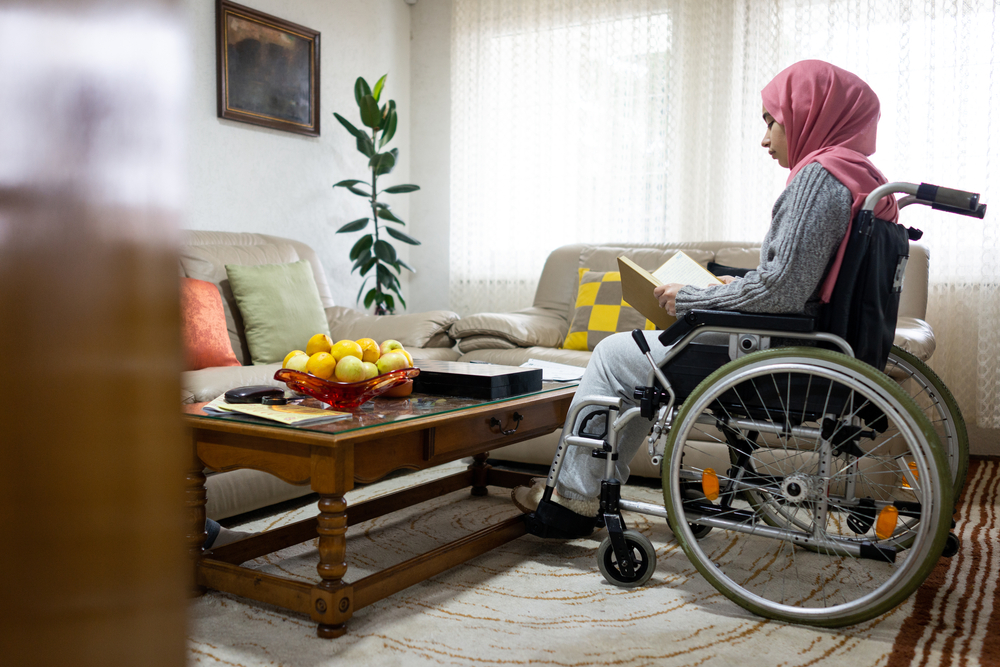
If a woman is not able to wash herself, dress herself, or put on a hijab by herself due to a disability, how is the person supposed to make wudu or put on the hijab to pray?
Answer
In the Name of Allah, the Most Merciful and Compassionate.
May He grant her immense reward in this world and the Next and allow her to accept her test with courage.
She is responsible only to the extent of her ability. She covers what she can, including her nakedness (awra) and prayer-garment, as her ability allows. If she cannot perform ablution (wudu) by herself or with permissible help from others, she will perform a simple dry purification (tayammum).
Sacred Law never burdens a soul beyond its capacity, and anything beyond her falls away.
A helper could be a sibling, a husband, an unmarriageable relative (mahram), or another woman. They may assist her in her wudu. If no one is available for a prayer, she moves to dry purification.
Allah Most High says in the Quran, “Allah does not tax any soul but what it can bear.” [Quran, 2.286]
Allah does not make a person responsible for more than they can bear. This demonstrates Allah’s kindness, compassion, and generosity towards His creation. [Ibn Kathir, Tafsir Ibn Kathir]
The Prophet (Allah bless him and give him peace) said, “The greatness of the reward is with the greatness of the trial. When Allah Most High loves a people, He tests them. Whoever is content has His good pleasure, and whoever is discontent has His displeasure.” [Tirmidhi; Ibn Majah]
The Prophet (Allah bless him and give him peace) said, “No fatigue, nor disease, nor sorrow, nor sadness, nor hurt, nor distress befalls a Muslim, even if it were the prick he receives from a thorn, but that Allah expiates some of his sins for that.” [Agreed Upon]
Tayammum (Dry Purification)
One intends for tayammum. One should touch clean earth or clean stone with both hands, wipe one’s face, then touch the earth or clean stone again to wipe one’s hands and arms up to the elbows.
Additionally, it is worth noting that in the Hanafi school, using a clean stone, even a small one, to perform tayammum is valid. Dust or dirt is not a requirement. [Ibn ‘Abidin, Radd al-Muhtar]
May Allah Most High make this test a way to increase her status with Him and draw her closer to Him. Amin.
And Allah knows best.
[Mawlana] Ilyas Patel
Checked and Approved by Shaykh Faraz Rabbani
Related Answers
How Will a Completely Paralyzed Person Perform His Wudu/Tayammum and Prayers?
Explains how a completely paralyzed person fulfills purification and prayer obligations according to their ability.
Praying Rulings for the Sick, Injured, and Hospitalized
Outlines the concessions and practical rulings that enable ill or injured Muslims to maintain their prayers
How Should a Sick Person Pray?
Details the various ways a sick person may perform prayer when unable to stand, bow, or prostrate normally.
Mawlana Ilyas Patel has received traditional education in various countries. He started his schooling in the UK and completed his hifz of the Quran in India. After that, he joined an Islamic seminary in the UK, where he studied secular and Aalimiyya sciences. Later, he traveled to Karachi, Pakistan, and other Middle Eastern countries to further his education. Mawlana has served as an Imam in the Republic of Ireland for several years and taught the Quran and other Islamic sciences to both children and adults. He also worked as a teacher and librarian at a local Islamic seminary in the UK for 12 years. Presently, he lives in the UK with his wife and is interested in books and gardening.
