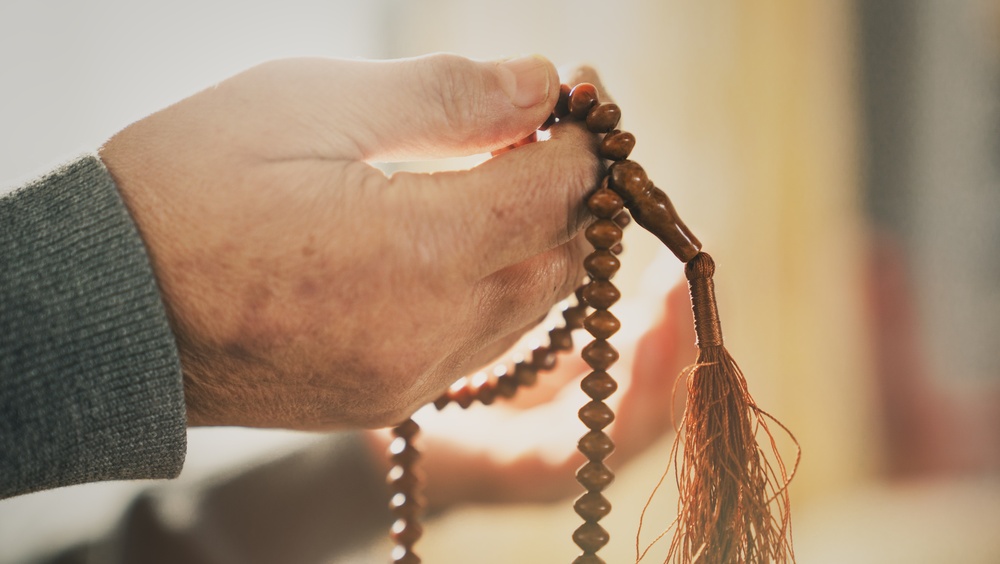
When Should Post-Prayer Remembrance (Tasbih) Be Done If Witr Is Delayed?
Hanafi Fiqh
Answered by Mawlana Ilyas Patel
Question
In the Hanafi school, when should the post-prayer tasbih (33× Subhan Allah, etc.) be performed if Witr is delayed until later in the night?
If one prays the Isha farḍ and sunna now but delays Witr until Tahajjud time, should the tasbiḥ be done after the sunna prayers or after Witr?
Answer
In the Name of Allah, the Most Merciful and Compassionate.
The post-prayer remembrance (Tasbih) should be done before the Witr. However, if you forget, you can do it after Witr too. Read the links below.
The Hanafi positions are: 1) pray sunna immediately after the fard without delay; 2) pray sunna immediately, with minimal dhikr first (e.g., “Allahumma anta al-Salam…” or brief istighfar); 3) or do regular adhkar/du’a before sunna, though many scholars see this as less ideal.
The Virtue of Post-Prayer Remembrance (Tasbih)
Abu Hurairah (Allah be pleased with him) reported from Allah’s Messenger (Allah bless him and give him peace), he said:
“Whoever glorifies Allah (by saying Subhan-Allah) after every prayer (salat) thirty-three times, and praises Allah (by saying Alhamdu-lillah) thirty-three times, and exalts Allah (by saying Allahu Akbar) thirty-three times, those are ninety-nine in all, and says to complete a hundred: La ilaha ill-Allahu, wahdahu la sharika lahu, lahul-mulku wa lahulhamdu, wa Huwa’ ala kulli shai’in Qadir (There is nothing which deserves to be worshipped except Allah Alone Who has no partner; to Him belongs the kingdom, to Him praise is due, and He has power over everything), his sins will be forgiven, even if they are as abundant as the foam of the sea.” [ Muslim]
Three Hanafi Positions on the Sunna after the Obligatory Prayer
There are three positions in our school:
1. It is slightly disliked to delay the sunna prayers from the obligatory prayers. Therefore, one should always immediately pray them after completing the obligatory prayer without delay.
2. It is slightly disliked to delay the sunna prayers from the obligatory prayers, unless the delay is due to the recitation of a short litany akin in length to what has been established in the prophetic narratives, in which case it would be permitted.
3. It is best to get up immediately for the sunna prayer after the obligatory prayers. However, if someone wants to make supplication or recite a litany they are accustomed to, this is permitted. This is the view of Halwani, although some scholars interpret it differently to align with the second view, stating that, contrary to what is optimal (khilaf al-awla), it is very close to being slightly disliked. [Ibrahim al-Halabi, Gunyat al-Mutamalli fi Sharh Munyat al-Musalli]
Differences of Opinion Should Not Become a Source of Dispute
The jurists say that there is no condemnation in genuine differences of opinion and that it should not be a source of dispute among people. Otherwise, each person can choose the position that best suits their practice. What matters most is performing both the Sunna and the prescribed remembrance of Allah (dhikr), without neglecting either. This should be done without distractions, before speaking to others or engaging in worldly affairs.
And Allah knows best.
[Mawlana] Ilyas Patel
Checked and Approved by Shaykh Faraz Rabbani
Related
- When Does One Recite the Post-Prayer Tasbihat?
- Praying Witr after Tahajjud and Making Up Missed Prayers
- Is It Compulsory to Perform Witr after Tahajjud?
- The Fiqh of Voluntary (Nafl) Prayers
Mawlana Ilyas Patel has received a traditional education in various countries. He started his schooling in the UK and completed his hifz of the Quran in India. After that, he joined an Islamic seminary in the UK, where he studied secular and Aalimiyya sciences. Later, he traveled to Karachi, Pakistan, and other Middle Eastern countries to further his education. Mawlana has served as an Imam in the Republic of Ireland for several years and taught the Quran and other Islamic sciences to both children and adults. He also worked as a teacher and librarian at a local Islamic seminary in the UK for 12 years. Currently, he resides in the UK with his wife and is interested in reading and gardening.
