Is It Sinful to Write Allah or the Prophet’s Name Without Capitals or Salawat?
Answered by Shaykh Faraz Rabbani
Question
Is writing Allah or Muhammad with small starting letters, and without “Peace be upon him” or its Arabic version, impermissible? What if I don’t even write the abbreviation?
Also, is genuinely questioning things about the Prophet (Allah bless him and give him peace) or the sahaba haram? For example, asking why or how the Prophet’s words could make the old woman panic who was told that old people don’t go to Jannah.
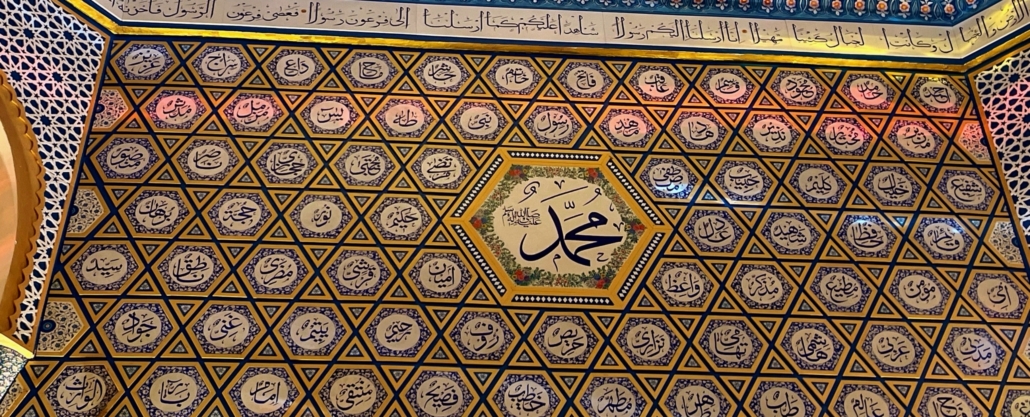
Can we hang the name “Muhammad” on the walls of our home, above or at equal height with the word “Allah”?
Answer
In the Name of Allah, the Merciful and Compassionate.
I hope you’re doing well, in sha’ Allah.
Writing “Allah” or “Muhammad” with a small first letter, or without the blessings on the Prophet (Allah bless him and give him peace), is not necessarily an outright sin—but writing the blessings in full, without abbreviating them, is recommended, as the scholars of Islam, such as Imam Nawawi, understand from the guidance of Allah and the Messenger (peace and blessings be upon him).
As for asking questions: Asking sincere questions about the Prophet (Allah bless him and give him peace) and his Companions (Allah be pleased with them) is not haram. Rather, it is part of faith, when you ask to learn and take your answers from qualified scholars.
You may hang the name of the Prophet (peace and blessings be upon him) in your home, and the adab is to place it level with the Name of Allah, or below it, when both are on the same wall.
Reverence for Allah’s Symbols Lives in the Heart
Allah Most High says, “And whoso exalts the things inviolable to Allah in pilgrimage, verily it comes of the godfearingness of the very hearts.” [Quran 22:32; Keller, The Quran Beheld]
Imam Qurtubi (Allah have mercy on him) explains that the symbols of Allah are “the markers of His religion…” [Qurtubi, al-Jamiʿ li Ahkam al-Quran] The verse ties godfearingness (taqwa) to the hearts “because the reality of godfearingness is in the heart.” [Ibid.]
The name of Allah and the name of His Messenger are among the greatest of these markers and signs of Allah Most High.
Qadi Iyad (Allah have mercy on him) writes that honoring and revering the Prophet (Allah bless him and give him peace) after his passing “is binding, as it was in his lifetime,” when he is mentioned, when his hadith and Sunna are mentioned, and when his name and his life story are heard. [Qadi Iyad, al-Shifa]
So writing each name with a capital letter is a small outward sign of that inward reverence. It is at least good adab, so keep to it where you can.
Write the Blessings in Full, in Any Language
Imam Nawawi (Allah have mercy on him) writes that it is recommended for one who writes hadith, on reaching the name of Allah, to add words of praise such as “Mighty and Majestic” or “Most High.”
Likewise, he writes, when we come to the mention of the Prophet, one writes the blessings and peace in full, not abbreviating them, nor limiting oneself to one of them. [Nawawi, Sharh Muslim]
So write out the blessings in English or Arabic, rather than as initials. It is a simple way to honor him each time you write his name. (In digital mediums, you can set up shortcuts that write the full honorifics out for you.)
Two Ways of Asking About the Prophet and the Companions
Questions about the religion, or Allah Most High, or about the Messenger of Allah (Allah bless him and give him peace), or his noble Companions (Allah be pleased with them all) can be asked in two ways.
One is to ask sincerely, seeking to learn, and that is part of what faith entails.
The angels themselves asked Allah about the wisdom of creating Adam (peace be upon him).
Allah Most High relates, “They said, Will You place in it one who will wreak corruption in it again and again, and spill much innocent blood; While we extoll Your infinite glory in praise, and Your exalted pure perfection?” [Quran 2:30; Keller, The Quran Beheld]
Imam Ibn Kathir (Allah have mercy on him) explains that the angels didn’t say this by way of objecting to Allah, nor out of envy of the children of Adam. [Ibn Kathir, Tafsir al-Quran al-Adhim] Rather, he explains, it is a question seeking to know and to uncover the wisdom in that. [Ibid.]
Sayyidina Ibrahim (peace be upon him) asked to see how Allah gives life.
Allah Most High mentions this in the Quran: “And recall when Abraham said, ‘My Lord, show me how You revive the dead.’ He said, ‘Have you not then already long believed?’ He said, ‘I certainly have, yet so my heart may be serene in peace.’” [Quran 2:260; Keller, The Quran Beheld]
That is the angelic question and the Abrahamic question, and both are blessed. Seek their answers by connecting with qualified scholars, who give clarity and confidence.
Your own example has such an answer. Imam Tirmidhi, in his work on the character of the Prophet (peace and blessings be upon him), relates a beautiful hadith in his chapter on the humor of the Prophet (Allah bless him and give him peace):
When the old woman turned away weeping, he said, “Tell her that she will not enter it as an old woman,” and recited the verse in which Allah says He brings them forth anew. [Tirmidhi, al-Shamaʾil al-Muhammadiyya]
This was something the woman was wondering about and worried about, and the way the Beloved Messenger of Allah (Allah bless him and give him peace) conveyed it amplified her relief and brought her great joy.
The other way is to ask with latent arrogance. Just as people don’t like the arrogant, neither does our Merciful Lord: “Verily He loves not the haughtily proud.” [Quran 16:23; Keller, The Quran Beheld]
Hanging His Name Beside the Name of Allah
You may hang the name of the Prophet (Allah bless him and give him peace) in your home. When his name shares a wall with the name of Allah, set it level with His name or below it, rather than above.
Your Concern Is a Sign of Faith
These questions arise from an underlying concern, and that concern is a sign of faith and of seeking uprightness.
This is blessed. Cultivate this concern, and turn your heart to Allah every time you say in your prayer, “Guide us the Straight Way.” [Quran 1:6; Keller, The Quran Beheld]
In the hadith of Abu Dharr (Allah be pleased with him), which Imam Nawawi placed in his Forty Hadith, Allah declares, “O My servants, all of you are astray except those whom I have guided, so seek guidance from Me and I shall guide you.” [Muslim]
This is part of a longer hadith, full of wisdom and guidance, and is explained in our in-depth course on the Forty Hadith of Imam Nawawi, Nawawi’s 40 Hadith Explained. You’ll find it, with many other free courses, in the SeekersGuidance course catalog.
May Allah answer your asking with His guidance, and keep your heart turned to Him.
And Allah knows best.
Faraz Rabbani
Related Answers
One. Would It Be Considered Sinful Not to Repeat Salawat? — Shaykh Faraz Rabbani: Whether one must repeat the blessings each time his name comes up.
Two. Is It Obligatory to Send Salawat Every Time the Prophet’s Name Is Mentioned? — Mawlana Ilyas Patel: The Hanafi position on saying the blessings when his name is mentioned in a gathering.
Three. Treating the Qur’an and the Name of Allah With Respect — Ustadh Salman Younas: Reverence for Allah’s signs in the heart, and the rulings on particular acts of respect.
Four. Rulings Regarding Selling and Displaying Islamic Wall Stickers — Sidi Wasim Shiliwala: Displaying sacred words in the home, and where not to.
Courses for Further Study
Every course here is free, taught by a qualified teacher, and gives you the opportunity to ask questions directly as you study.
One. Nawawi’s 40 Hadith Explained: In-Depth Explanation of the Essential Wisdom of Prophetic Teachings — Shaykh Faraz Rabbani: Learn to live the Prophet’s wisdom through the most foundational hadith, the hadith of Abu Dharr among them.
Two. The Shifa of Qadi Iyad: Lessons on the Character and Virtue of the Prophet Muhammad — Shaykh Faraz Rabbani: Qadi Iyad’s Shifa on the blessed person and life of the Prophet, and the reverence owed to him.
Three. How to Seek Islamic Knowledge: Imam Ghazali’s Proper Manners of Students Explained — Shaykh Ahmed Saad Al-Azhari: Imam Ghazali on the proper manners of the student who seeks knowledge from teachers.
النصوص · Source-Texts
[القرطبي، الجامع لأحكام القرآن]
«فَشَعَائِرُ اللَّهِ أَعْلَامُ دِينِهِ لَا سِيَّمَا مَا يَتَعَلَّقُ بِالْمَنَاسِكِ.»
[المصدر نفسه]
«وَأَضَافَ التَّقْوَى إِلَى الْقُلُوبِ لِأَنَّ حَقِيقَةَ التَّقْوَى فِي الْقَلْبِ»
[القاضي عياض، الشفا بتعريف حقوق المصطفى]
«وَاعْلَمْ أَنَّ حُرْمَةَ النَّبِيّ ﷺ بَعْدَ مَوْتِهِ وَتَوْقِيرَهُ وَتَعْظِيمَهُ لازِمٌ كَمَا كَانَ حَالَ حَيَاتِهِ وَذَلِكَ عِنْدَ ذِكْرِهِ ﷺ وذكر حَدِيثِهِ وَسُنّتِهِ وَسَمَاعِ اسْمِهِ وَسِيرَتِهِ»
[النووي، شرح مسلم]
«يستحب لكاتب الحديث اذا مر بذكر الله عز وجل أن يكتب (عز وجل) أو (تعالى) أو (سبحانه وتعالى) أو (تبارك وتعالى) أو (جل ذكره) أو (تبارك اسمه) أو (جلت عظمته) أو ما أشبه ذلك وكذلك يكتب عند ذكر النبى صلى الله عليه وسلم بكمالهما لا رامزا اليهما ولا مقتصرا على أحدهما»
[ابن كثير، تفسير القرآن العظيم]
«وقول الملائكة هذا ليس على وجه الاعتراض على اللّه، ولا على وجه الحسد لبني آدم كما قد يتوهمه بعض المفسرين»
[المصدر نفسه]
«وإنما هو سؤال استعلام واستكشاف عن الحكمة في ذلك»
[الترمذي، الشمائل المحمدية]
«فولت تبكي فقال: أخبروها أنها لا تدخلها وهي عجوز إن الله تعالى يقول: إِنَّا أَنْشَأْناهُنَّ إِنْشاءً»
[صحيح مسلم]
«يا عبادي! كلكم ضال إلا من هديته. فاستهدوني أهدكم.»
[صحيح مسلم]
«يا عبادي! إني حرمت الظلم على نفسي وجعلته بينكم محرما. فلا تظالموا. يا عبادي! كلكم ضال إلا من هديته. فاستهدوني أهدكم. يا عبادي! كلكم جائع إلا من أطعمته. فاستطعموني أطعمكم. يا عبادي! كلكم عار إلا من كسوته. فاستكسوني أكسكم. يا عبادي! إنكم تخطئون بالليل والنهار، وأنا أغفر الذنوب جميعا. فاستغفروني أغفر لكم. يا عبادي! إنكم لن تبلغوا ضري فتضروني. ولن تبلغوا نفعي فتنفعوني. يا عبادي! لو أن أولكم وآخركم وإنسكم وجنكم. كانوا على أتقى قلب رجل واحد منكم. ما زاد ذلك في ملكي شيئا. يا عبادي! لو أن أولكم وآخركم. وإنسكم وجنكم. كانوا على أفجر قلب رجل واحد. ما نقص ذلك من ملكي شيئا. يا عبادي! لو أن أولكم وآخركم. وإنسكم وجنكم. قاموا في صعيد واحد فسألوني. فأعطيت كل إنسان مسألته. ما نقص ذلك مما عندي إلا كما ينقص المخيط إذا أدخل البحر. يا عبادي! إنما هي أعمالكم أحصيها لكم. ثم أوفيكم إياها. فمن وجد خيرا فليحمد الله. ومن وجد غير ذلك فلا يلومن إلا نفسه»
Shaykh Faraz Rabbani is a recognized specialist scholar in the Islamic sciences, having studied under leading scholars from around the world. He is the Founder and Executive Director of SeekersGuidance. Shaykh Faraz stands as a distinguished figure in Islamic scholarship. His journey in seeking knowledge is marked by dedication and depth. He spent ten years studying under some of the most revered scholars of our times. His initial studies took place in Damascus. He then continued in Amman, Jordan. In Damascus, he was privileged to learn from the late Shaykh Adib al-Kallas. Shaykh Adib al-Kallas was renowned as the foremost theologian of his time. Shaykh Faraz also studied under Shaykh Hassan al-Hindi in Damascus. Shaykh Hassan is recognized as one of the leading Hanafi jurists of our era. Upon completing his studies, Shaykh Faraz returned to Canada in 2007. His return marked a new chapter in his service to the community. He founded SeekersGuidance. The organization reflects his commitment to spreading Islamic knowledge. It aims to be reliable, relevant, inspiring, and accessible. This mission addresses both online and on-the-ground needs. Shaykh Faraz is also an accomplished author. His notable work includes “Absolute Essentials of Islam: Faith, Prayer, and the Path of Salvation According to the Hanafi School.” This book, published by White Thread Press in 2004, is a significant contribution to Islamic literature. His influence extends beyond his immediate community. Since 2011, Shaykh Faraz has been recognized as one of the 500 most influential Muslims. This recognition comes from the Royal Islamic Strategic Studies Center. It underscores his impact on the global Islamic discourse. Shaykh Faraz Rabbani’s life and work embody a profound commitment to Islamic scholarship. His teachings continue to enlighten and guide seekers of knowledge worldwide.
