What Is the Ruling on Intercession and Visiting Graves?
Hanafi Fiqh
Answered by Shaykh Faraz Rabbani
Question
Where is the fine line between intercession (tawassul) and idolatry (shirk), especially when visiting graves (ziyara) and making supplication (dua)?
Answer
In the Name of Allah, the Merciful and Compassionate
The very concern you express shows a heart that seeks to keep its worship for Allah alone. This is a sign of mercy from Allah.
The line is clear. Seeking a Prophet or a righteous person as a means (tawassul) to Allah is permitted. It only becomes idolatry (shirk) if someone believes that the one called upon independently gives or takes, benefits or harms, alongside Allah.
If you hold to this conviction, the rest of your question is answered.
Allah Alone Gives and Withholds
Begin with what is certain. Allah alone is the Giver and the Withholder. He alone brings benefit and decrees harm.
He says: “Whatever mercy Allah releases to men, none can withhold; and whatever He withholds, none can release after Him.” [Quran 35:2; Keller, The Quran Beheld] No Prophet, no saint, no cause in creation gives or takes a single atom of itself.
The sound believer who turns to a righteous person knows this in his marrow — the righteous grant nothing; Allah grants, and He has merely honored some of His servants by making them a means.
Seeking a Means Is a Command, Not a Rival to Allah
The whole matter rests on a single verse: “O you who believe, fear Allah, and seek a means of drawing lovingly near Him.” [Quran 5:35]
Seeking the supplication and standing of a righteous person before Allah is one such means. It is a way of drawing near, not a partner set beside Him.
We do this without a second thought when the person is alive. The Companions asked the Prophet (Allah bless him and give him peace) to pray for them, and he told Umar of Uways al-Qarani, “If you can have him ask forgiveness for you, then do so.” [Muslim]
To ask a living believer, “Pray to Allah for me,” is simply to take a means. No one imagines it is shirk.
The Sunna shows this pattern clearly. A blind man asked the Prophet (Allah bless him and give him peace) to supplicate that Allah restore his sight. He was taught to pray two units and then say: “O Allah, I ask You and turn to You through Your Prophet Muhammad, the Prophet of mercy … O Allah, accept his intercession for me.” [Tirmidhi, who graded it sound and rigorously authenticated (hasan sahih); also Ibn Maja and Ahmad]
The request is for the Prophet’s intercession before Allah, not a claim that he creates the cure. When drought struck, Umar sought rain through the dua of al-Abbas (Allah be pleased with him), saying, “O Allah, we used to ask our Prophet to invoke You, and now we ask his uncle.” [Bukhari]
The means was the standing and supplication of a righteous man before Allah. The great commentators on Bukhari, including Qastallani, Ibn Hajar, and Ayni, cite this as proof for the permissibility and Sunna of tawassul.
Where Shirk Actually Begins
The line is not in the words, but in the belief. Shirk occurs only when someone believes that the one called upon is an independent doer who gives and takes as Allah does. Such a belief takes a person outside Islam.
Without this belief, asking a righteous person, living or passed on, to intercede for you before Allah is simply a way of asking Allah. The majority of Sunni scholars, including the Hanafi school, hold it to be permissible.
If a local custom or wording risks confusing this conviction in the hearts of ordinary people, scholars advise taking the clearer path. But the act itself, with sound belief, is not shirk.
Visiting Graves Is a Recommended Sunna
Now to ziyara directly. Visiting graves is recommended for both men and women. The Prophet (Allah bless him and give him peace) said, “I had forbidden you from visiting graves; so visit them, for they remind you of the Hereafter.” [Muslim]
Imam Nawawi records in his commentary that the scholars agree visiting graves is recommended, chiefly to soften the heart and turn the visitor toward his own return to Allah [Nawawi, Sharh Sahih Muslim].
In the Hanafi school, the visit should not be to reopen grief or to wail. Rather, it is to pay one’s respects, to reflect on one’s own state, and to benefit the deceased. [Tahtawi, Hashiyat Maraqi al-Falah; Sarakhsi, al-Mabsut]
On arriving, greet the people of the graves: “Peace be upon the inhabitants of this abode from among the believers and the Muslims … and we shall, God willing, join you.” [Muslim]
Then recite what you are able of the Quran, such as the three “Qul” suras, Ayat al-Kursi, and especially Ya Sin, intending its reward for the deceased.
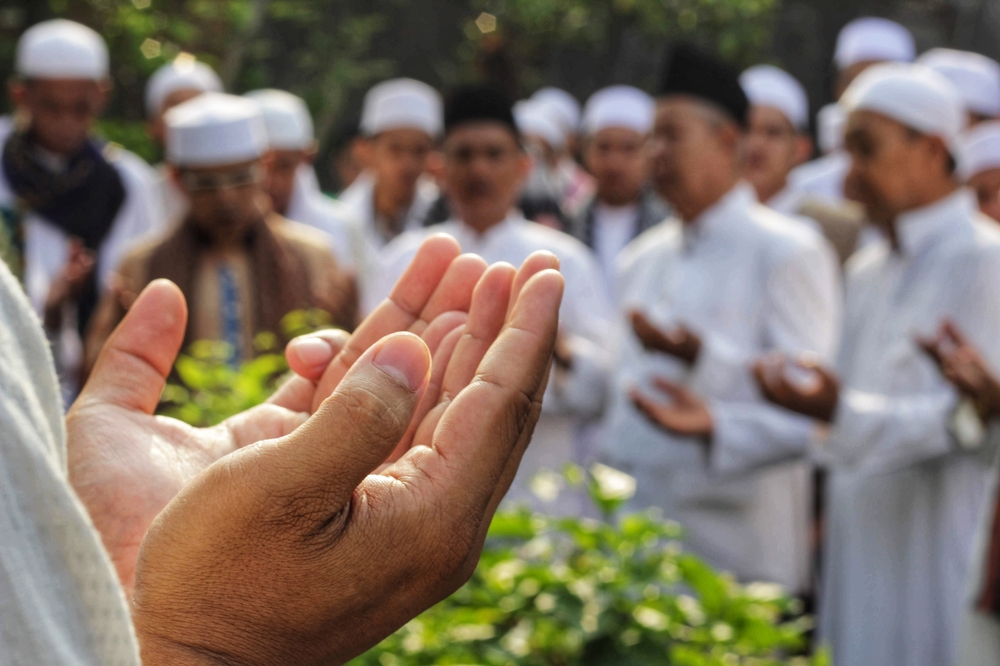
Make abundant supplication for their forgiveness. Standing to greet them, facing them, reciting, and praying for them are the established manners of the visit.
What the Sunna Does Not Include
Keep two things clear at the grave, and you need not worry. First, your dua is to Allah. You greet the deceased and pray for them, or you ask Allah, through the standing of a righteous person, to grant your need.
You do not treat the deceased as one who creates, gives, or withholds. Second, the Hanafi jurists note that kissing or rubbing the grave, or thinking such acts are Sunna, is not from proper manners and is best left. [Ibn Abidin, Radd al-Muhtar]
Reverence, reflection, greeting, recitation, and supplication are the whole of it.
Keep the Heart on Allah Alone
The entire question rests on one conviction: Allah alone gives, withholds, benefits, and harms. Every means is only a means He has honored. Guard this in your heart.
Visiting the graves and praying for their occupants then becomes what the Prophet (Allah bless him and give him peace) intended: a softening of the heart and a doorway to nearness, not a place of fear.
If any particular practice or wording clouds that certainty for you, set it aside until your heart is clear. You lose nothing. The door to Allah is always open and never crowded.
And Allah knows best.
[Shaykh] Faraz Rabbani
Related Answers
- Is Istighatha—Seeking Help Through a Prophet or a Righteous Believer—Shirk? — The full aqida treatment: tawassul is sound with correct belief; shirk enters only with the belief in an independent doer.
- Is Asking of Allah by Means of the Prophet Considered Shirk? — Why seeking a means is not shirk, with the Quran, the Sunna, and the blind man’s supplication.
- Is Tawassul Through the Prophet Permissible in the Hanafi School? — The relied-upon Hanafi ruling, with counsel to avoid needless dispute.
- The Ruling on Women Visiting Graves and Etiquettes of Visiting — The Hanafi adab of the visit and what to recite for the deceased.
- Forgotten Sunnas: Visiting Graves — The Sunna, its benefits, and the manners of the visit, with the graveside supplication.
Shaykh Faraz Rabbani is a recognized specialist scholar in the Islamic sciences, having studied under leading scholars from around the world. He is the Founder and Executive Director of SeekersGuidance.
Shaykh Faraz stands as a distinguished figure in Islamic scholarship. His journey in seeking knowledge is marked by dedication and depth. He spent ten years studying under some of the most revered scholars of our times. His initial studies took place in Damascus. He then continued in Amman, Jordan.
In Damascus, he was privileged to learn from the late Shaykh Adib al-Kallas. Shaykh Adib al-Kallas was renowned as the foremost theologian of his time. Shaykh Faraz also studied under Shaykh Hassan al-Hindi in Damascus. Shaykh Hassan is recognized as one of the leading Hanafi jurists of our era.
Upon completing his studies, Shaykh Faraz returned to Canada in 2007. His return marked a new chapter in his service to the community. He founded SeekersGuidance. The organization reflects his commitment to spreading Islamic knowledge. It aims to be reliable, relevant, inspiring, and accessible. This mission addresses both online and on-the-ground needs.
Shaykh Faraz is also an accomplished author. His notable work includes “Absolute Essentials of Islam: Faith, Prayer, and the Path of Salvation According to the Hanafi School,” published by White Thread Press in 2004, which is a significant contribution to Islamic literature.
His influence extends beyond his immediate community. Since 2011, Shaykh Faraz has been recognized as one of the 500 most influential Muslims. This recognition comes from the Royal Islamic Strategic Studies Center. It underscores his impact on the global Islamic discourse.
Shaykh Faraz Rabbani’s life and work embody a profound commitment to Islamic scholarship. His teachings continue to enlighten and guide seekers of knowledge worldwide.
