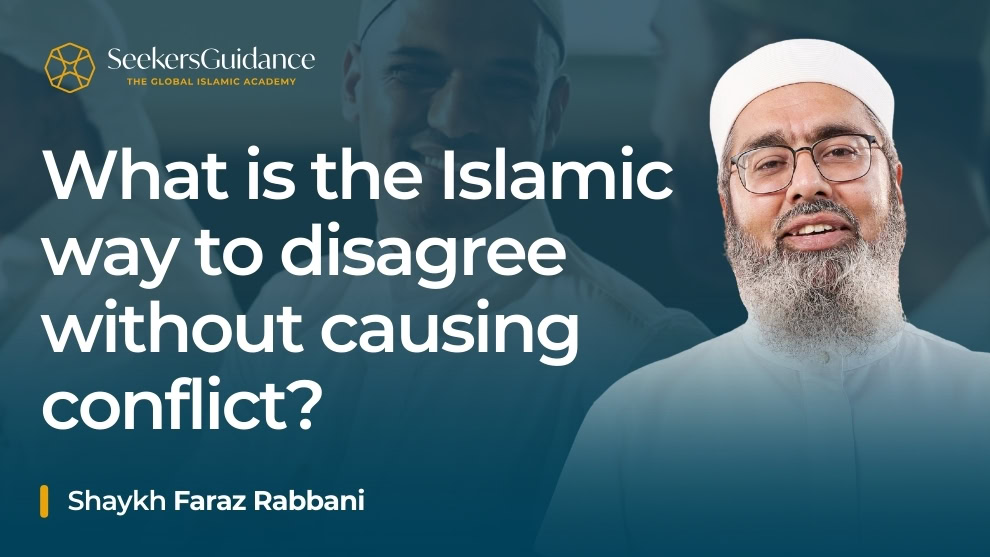
What Is the Islamic Way to Disagree Without Causing Conflict?
Answered by Shaykh Faraz Rabbani
Question
What is the Islamic way to disagree without causing conflict?
Answer
In the Name of Allah, the Merciful and Compassionate.
A foundational principle in dealing with disagreement is humility. It is attributed to Sayyiduna ‘Ali ibn Abi Talib that he said that if everyone who did not truly know were to remain silent, most arguments would cease. Many disagreements arise over matters that people are not qualified to speak about or do not have real knowledge of.
Often, people argue about issues that are ultimately inconsequential, especially in worldly matters. In such cases, it is better to acknowledge personal preference without turning it into a dispute. Reflecting on why one disagrees and whether the matter truly warrants argument is an essential step toward avoiding unnecessary conflict.
Disagreement in Worldly and Expert Matters
There are situations where discussion is necessary, particularly when expert knowledge is required, and a sound judgment must be reached. In such cases, one should consider the views of reliable, upright experts and defer to those with recognized authority in the field.
Just as one would consult a qualified professional regarding health or technical matters, one should rely on recognized experts when seeking clarity and truth.
Avoiding Argumentation in Religious Matters
In religious matters, argumentation should be avoided altogether. The Prophet (Allah bless him and give him peace) warned,
“No people went astray after Allah had guided them except that they became given to disputation.”
Scholars of the religion explain that there is no condemnation in matters of valid differences of opinion. Mainstream Sunni Islam is represented by the four schools, along with the recognized opinions within them. Matters that fall within this accepted framework should not be debated contentiously, nor should one pay attention to those who argue excessively, particularly in public or online spaces.
If one seeks the truth, the path is not to listen to arguments but to seek structured knowledge and reliable guidance. There is a difference between learning religion through systematic study and seeking guidance when one is unsure how to act in a particular matter. Both require turning to those who are learned, reliable, and upright.
Respect, Direction, and Purpose
A believer should respect others and avoid being drawn into conflict. Hearing that one scholar disagreed with another should not become a source of agitation or argument. The believer has a clear direction, seeking the straight path that leads to the pleasure of Allah.
Allah Most High reminds us of our priorities, saying,
“Rather, seek the (reward) of the Hereafter by means of what Allah has granted you, without forgetting your share of this world. And be good (to others) as Allah has been good to you. Do not seek to spread corruption in the land, for Allah certainly does not like the corruptors.” [Quran, 28:77]
Ethics of Scholarly Disagreement
For students of knowledge, there are principled ways to discuss and disagree. Islamic scholarship developed a dedicated science that governs research and debate, teaching how to engage in disagreement in a purposeful, principled, and ethical manner. The aim is to seek the truth, uphold honesty and integrity, and strive for the good of others.
There are well-known works and learning resources on the ethics of disagreement in Islam, including educational materials that address how to navigate differences with wisdom and restraint.
And Allah is the giver of success and facilitation.
[Shaykh] Faraz Rabbani
Shaykh Faraz Rabbani is a recognized specialist scholar in the Islamic sciences, having studied under leading scholars from around the world. He is the Founder and Executive Director of SeekersGuidance.
Shaykh Faraz stands as a distinguished figure in Islamic scholarship. His journey in seeking knowledge is marked by dedication and depth. He spent ten years studying under some of the most revered scholars of our times. His initial studies took place in Damascus. He then continued in Amman, Jordan.
In Damascus, he was privileged to learn from the late Shaykh Adib al-Kallas. Shaykh Adib al-Kallas was renowned as the foremost theologian of his time. Shaykh Faraz also studied under Shaykh Hassan al-Hindi in Damascus. Shaykh Hassan is recognized as one of the leading Hanafi jurists of our era.
Upon completing his studies, Shaykh Faraz returned to Canada in 2007. His return marked a new chapter in his service to the community. He founded SeekersGuidance. The organization reflects his commitment to spreading Islamic knowledge. It aims to be reliable, relevant, inspiring, and accessible. This mission addresses both online and on-the-ground needs.
Shaykh Faraz is also an accomplished author. His notable work includes “Absolute Essentials of Islam: Faith, Prayer, and the Path of Salvation According to the Hanafi School,” which was published by White Thread Press in 2004 and is a significant contribution to Islamic literature.
His influence extends beyond his immediate community. Since 2011, Shaykh Faraz has been recognized as one of the 500 most influential Muslims. This recognition comes from the Royal Islamic Strategic Studies Center. It underscores his impact on the global Islamic discourse.
Shaykh Faraz Rabbani’s life and work embody a profound commitment to Islamic scholarship. His teachings continue to enlighten and guide seekers of knowledge worldwide.
