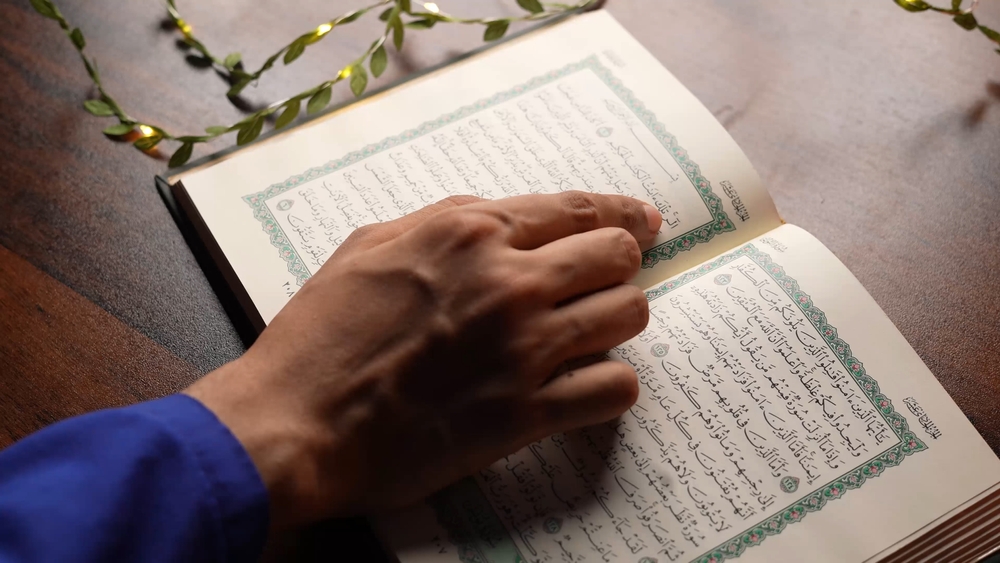
Why Are Past Tense Verbs Used in the Quran and Hadith?
Answered by Mawlana Ilyas Patel
Question
In the hadith narrated by Abu Hurayra (Allah be pleased with him), where Allah promises the unseen rewards for the righteous, why are verbs like خطر used in the past tense?
How should we understand and translate these verbs, and what do classical commentaries say about this hadith’s grammatical and rhetorical aspects?
Answer
In the Name of Allah, the Most Merciful and Compassionate
Verbs in the past tense are frequently used in the Quran and Hadith to express the future and convey the certainty that the promised future will inevitably come. This creates a sense of finality and closure that the matter will inevitably come to pass.
No One Knows the Pleasures of Paradise
Abu Huraira (Allah be pleased with him) reported that the Prophet (Allah bless him and give him peace) said, “Allah said: I have prepared for My righteous servants what no eye has seen, what no ear has heard, and what no human heart has conceived. Recite the verse if you wish: No soul knows what has been hidden for them of comfort.” [Quran, 32:17; Bukhari and Muslim]
The senses of sight and hearing were specifically mentioned because they are the means of perceiving most of what is perceptible, followed by taste and smell, whereas touch comes last. “And no human heart has ever conceived,” meaning the everlasting delight prepared for them in Paradise. Paradise is better than anything they can imagine or dream of because humans can only imagine what they know, and what they know is close to their imagination. [Al-Iraqi, Tarh al-Tathrib Fi Sharh al-Taqrib]
I would like you to go through the valuable answers and links below.
You will receive guidance and direction in sha Allah.
Related Answers
Why not begin your search for knowledge by signing up for a course on SeekersAcademy (seekersguidance.org), like from the Islamic Studies Curriculum (seekersguidance.org) or Youth Islamic Studies Curriculum (seekersguidance.org), building your way up doing each course?
I pray this helps answer your question.
[Mawlana] Ilyas Patel
Checked and Approved by Shaykh Faraz Rabbani
Mawlana Ilyas Patel has received traditional education in various countries. He started his schooling in the UK and completed his hifz of the Quran in India. After that, he joined an Islamic seminary in the UK, where he studied secular and Aalimiyya sciences. Later, he traveled to Karachi, Pakistan, and other Middle Eastern countries to further his education. Mawlana has served as an Imam in the Republic of Ireland for several years and taught the Quran and other Islamic sciences to both children and adults. He also worked as a teacher and librarian at a local Islamic seminary in the UK for 12 years. Presently, he lives in the UK with his wife and is interested in books and gardening.
