How Do I Fulfill My Oath Not to Sell My Pokémon Cards?
Shafi'i Fiqh
Answered by Shaykh Irshaad Sedick
Question
I bought Pokémon cards to resell as an investment. Doubting whether they were lawful to sell, I swore, “Wallahi, I will not sell them until I get a fatwa,” yet I kept adding to my stock. They are now worth a lot.
Can I sell them and be done with them? If not, may I at least sell them for what I paid so I do not lose money? And if I am obliged to dispose of them, I will, though it seems to me a waste of money.
Answer
In the name of Allah, the Most Gracious, the Most Merciful
You may sell the cards at their market rate and be done with them; you are neither restricted to your purchase price nor obliged to destroy them. Since you entered this without knowing the ruling and sincerely wish to comply with the Sacred Law, your case is judged retrospectively with ease.
The only real concern here is the images on the cards, and on that question, we lean on the Maliki school, which does not prohibit flat images of this kind, so the sale is sound and the proceeds are lawful.
Your oath, meanwhile, was to refrain from selling only until you obtained a fatwa, so this answer fulfills its condition: you have not broken it, and no expiation is due. Going forward, the more religiously cautious course is to avoid trading in such cards, out of regard for the Shafi’i position.
How the Matter Is Judged in Retrospect
You acted without knowing that the transaction might be problematic, and you are someone seeking a ruling and willing to live by it. In our tradition, when a matter is judged after the fact in this way, we carry people onto the easiest of the valid schools (haml al-nas’ ala aysar al-madhahib).
This is not laxity but a mercy that the fuqaha extend to one who did not act in defiance and who now wishes to set his affairs in order.
So rather than burden you with a loss or destruction of wealth arising from a past act done in good faith, we seek the ease that the wider tradition affords.
The Images and the Maliki School
The only substantive concern with these cards is that they depict animate beings, and the schools differ over flat, unshadowed images.
The Maliki school holds that what is prohibited is the image with a shadow, namely, a three-dimensional figure of a complete animate form, whereas a flat image with no shadow, such as what is drawn or printed on paper, cloth, or a wall, is not prohibited in its making. [al-Mawsu’a al-Fiqhiyya al-Kuwaytiyya, “Taswir,” 12/110]
Within the Maliki school, such flat images are at most disliked (makruh), and where they are upon something used and handled, they are merely contrary to the preferable (khilaf al-awla).
Imam Dardir states that it is unlawful to depict a complete-limbed animal, but that a flat depiction with no shadow, such as what is drawn on a wall or paper, is only disliked if it is not on something handled, and otherwise is contrary to the preferable, like a design upon bedding. [al-Dardir, al-Sharh al-Kabir]
Their evidence includes the prophetic exception, “except a design on a garment” (illa raqman fi thawb). [Bukhari and Muslim]
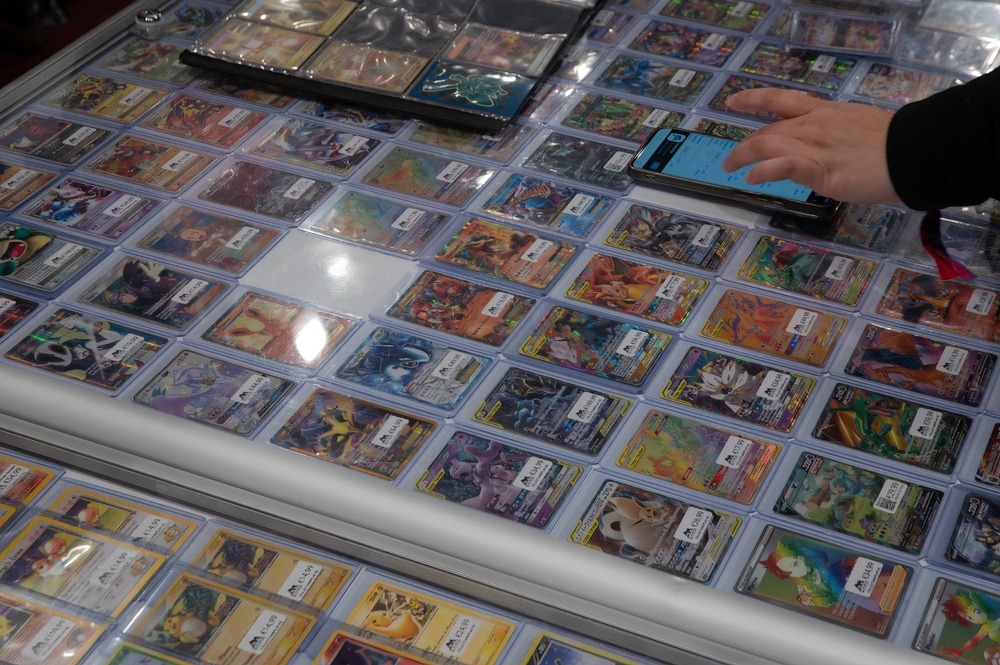
Pokémon cards are precisely such flat, printed images. Since this is a valid and recognized area of scholarly difference (khilaf sa’igh), one who follows the Maliki school in it is not to be faulted.
Applying that school, then, the cards are lawful to own and to sell, and the sale of known cards at the prevailing market rate involves no uncertainty or gambling in the transaction itself.
You may therefore sell them at their usual value, and you are under no obligation to limit yourself to your purchase price or to destroy them, for Islam discourages the wasting of wealth, and the Prophet (Allah bless him and give him peace) related that Allah dislikes for you “the wasting of wealth” (ida’at al-mal). [Bukhari and Muslim]
Your Oath
Your words, “Wallahi, I will not sell them until I get a fatwa,” are a valid oath by Allah (Most High). Its subject was selling, and its limit was obtaining a fatwa. By seeking and receiving this answer, that limit has now been reached, so the oath has run its course.
You did not violate it, since you refrained from selling until now; therefore, no expiation (kaffara) is due. Your continued buying, too, did not breach the oath, since the oath concerned selling alone, though, as you yourself sense, pausing the whole affair would have been the wiser course.
Going Forward: The More Cautious Course
What has been said settles the past. In the future, it is more religiously prudent not to deal in these cards at all, in deference to the Shafi’i position, which is the more careful one regarding images.
The Prophet (Allah bless him and give him peace) said, “Leave what makes you doubt for what does not make you doubt.” [Tirmidhi] There is vast room in lawful and wholesome trade, and choosing avenues free of any doubt brings both blessing and peace of heart.
Principle and Practical Guidance
The governing principle is that a past act done in good faith by one seeking to obey is met with the ease of the wider tradition, so here we apply the Maliki school on the images and permit the sale.
In practice, you may now sell your cards at their market value, recover their value, and be free of them, your oath having lapsed with no expiation due and no obligation to destroy anything.
Thereafter, as a matter of scrupulousness and in keeping with the Shafi’i school, it is better to leave the trade in such cards for investments untouched by any doubt.
And Allah (Most High) knows best.
[Shaykh] Irshaad Sedick
Checked and Approved by Shaykh Faraz Rabbani
Related Answers
Is Saying “Ya Allah, I Will Not Do This Again” a Promise or an Oath? — Clarifies the distinction between a promise and an oath, and when kaffara is or is not required.
Do I Need to Expiate for My Unfulfilled Promise to Allah? — Explains that breaking a promise does not require expiation unless it was made as a legally binding oath or vow.
Should My Oath Be Taken Literally or Based on My Intent? — Explains that an oath is interpreted according to the person’s original intention and outlines the expiation (kaffara) if it is broken.
Shaykh Irshaad Sedick was raised in South Africa in a traditional Muslim family. He graduated from Dar al-Ulum al-Arabiyyah al-Islamiyyah in Strand, Western Cape, under the guidance of the late world-renowned scholar Shaykh Taha Karaan (Allah have mercy on him), where he taught.
Shaykh Irshaad received Ijaza from many luminaries of the Islamic world, including Shaykh Taha Karaan, Shaykh Muhammad Awama, Shaykh Muhammad Hasan Hitu, and Mawlana Abdul Hafeez Makki, among others.
He is the author of the text “The Musnad of Ahmad ibn Hanbal: A Hujjah or not?” He has been the Director of the Discover Islam Centre, and for six years, he has been the Khatib of Masjid Ar-Rashideen, Mowbray, Cape Town.
Shaykh Irshaad has fifteen years of teaching experience at some of the leading Islamic institutes in Cape Town). He is currently building an Islamic podcast, education, and media platform called ‘Isnad Academy’ and has completed his Master’s degree in the study of Islam at the University of Johannesburg. He has a keen interest in healthy Prophetic living and fitness.
