Do I Shorten Prayers During Frequent Work Travel?
Hanafi Fiqh
Answered by Shaykh Faraz Rabbani
Question
I travel between cities for work, usually 90–120 km each way. Sometimes I leave early and return the same night. Can I shorten my prayers? Does the ruling change if this travel is my regular routine? And can I pray in offices, train stations, or service areas?
Answer
In the Name of Allah, the Most Merciful and Compassionate.
Yes, you should shorten your four-unit prayers to two units each when you travel beyond your home city.
Allah Most High has said, “And when you travel through the earth, there is no blame on you to shorten the prayer.” [Quran 4:101]
In the Hanafi school, the minimum distance for travel is about 78 kilometers, which is roughly 48 miles.
This is the distance that would take about three days of moderate travel at the time of the Prophet. Your journeys of 90 to 120 kilometers clearly meet this requirement.
Shortening is a Duty
In the Hanafi school, shortening the prayer is obligatory, not optional. The original prayer was two units. This was increased for those at home, but for travelers, the two units remain the established rule.
Imam Shurunbulali: “Shortening in our school is an azima (binding determination), not a dispensation.” [Shurunbulali, Nur al-Idah]
Imam Kasani in Bada’i al-Sana’i puts it clearly: “The two rakats are not a shortening in reality for him — they are the full prayer of the traveler….” [Kasani, Bada’i al-Sana’i, via Ibn Abidin, Radd al-Muhtar]
The Sunna Foundation
The foundation of the Sunna is the practice of the Prophet and his closest Companions. Ibn Umar (Allah be pleased with them) said, “I accompanied the Messenger of Allah (Allah bless him and give him peace), and he never prayed more than two rakats on a journey. The same was true of Abu Bakr, Umar, and Uthman (Allah be pleased with them).” [Bukhari; Muslim]
Umar himself said, “The traveler’s prayer is two rakats — complete, not shortened, on the tongue of your Prophet (Allah bless him and give him peace). The Fajr and Maghrib prayers remain unchanged when you travel.d Maghrib stays as it is.
You are considered a traveler from the moment you leave the outskirts of your home city until you return to it.
Combining Prayers
In the Hanafi school, it is not permitted to combine two prayers into one time, as is allowed in some other schools. Pray each prayer in its own time, as best you are able.
Following Another School
However, the leading scholars of the Hanafi school have stated that it is permitted to follow another school, as long as you follow its conditions and principles.
See this:
Can I Follow Another School (Madhhab) When I Need To?
There Are Facilitations
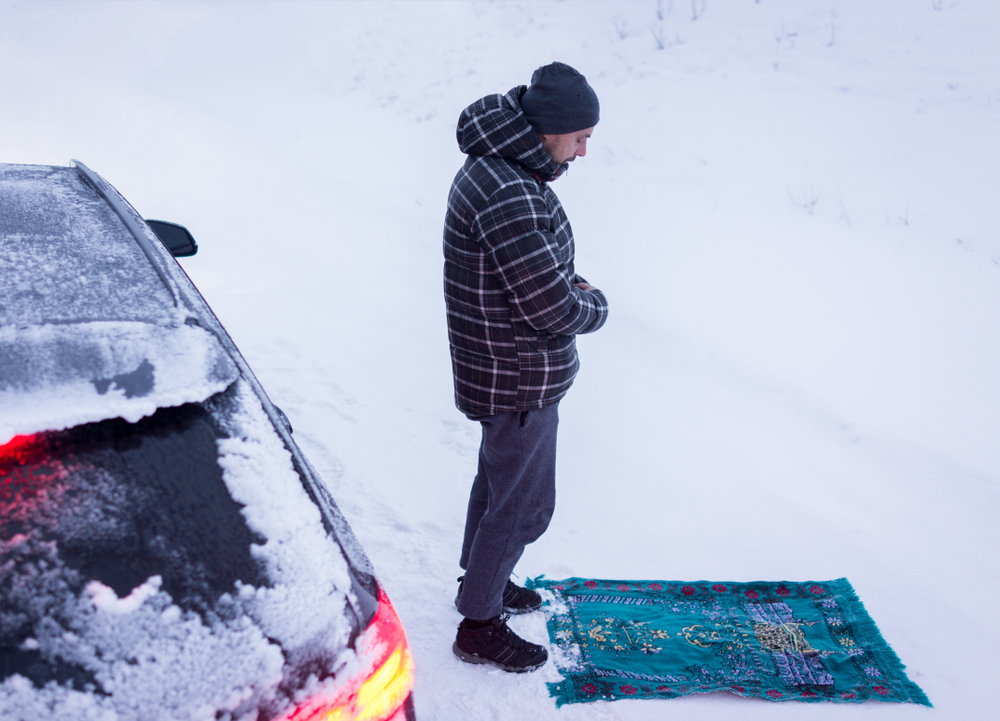
It is completely valid to pray in offices, train stations, or service areas. Find a clean spot, face the qibla as best you are able, and perform your prayer.
The Messenger of Allah (Allah bless him and give him peace) said, “I have been given five things that no one before me was given … and the earth has been made for me a place of purification and a place of prostration. So whichever of my people the prayer overtakes, let him pray wherever he is.” [Bukhari; Muslim]
From my own experience traveling for much of the year, I have found no difficulty praying in many public places around the world.
And Allah knows best.
[Shaykh] Faraz Rabbani
Related Answers
- Can I Follow Another School (Madhhab) When I Need To?
Explains that the general public is not strictly bound to one school and may follow another reliable school if a need arises.Warns against “talfiq” (mixing opinions in a way that makes an action invalid in all schools) and seeking dispensations purely for convenience. - May I Follow Alternative Positions for My Worship?
Clarifies that a person’s worship is valid as long as it aligns with the teachings of any of the four mujtahid Imams.Suggest following the school that is most accessible in your region or taught by local scholars to ensure practical ease. - How to Choose to Follow an Opinion within a School of Law?
Highlights that even “convenience” (like scheduling conflicts) can sometimes be a valid reason to adopt a different opinion.Advises that while flexibility exists, one should not make a habit of constantly “hunting” for the easiest possible answers.
Shaykh Faraz Rabbani is a recognized specialist scholar in the Islamic sciences, having studied under leading scholars from around the world. He is the Founder and Executive Director of SeekersGuidance.
Shaykh Faraz stands as a distinguished figure in Islamic scholarship. His journey in seeking knowledge is marked by dedication and depth. He spent ten years studying under some of the most revered scholars of our times. His initial studies took place in Damascus. He then continued in Amman, Jordan.
In Damascus, he was privileged to learn from the late Shaykh Adib al-Kallas. Shaykh Adib al-Kallas was renowned as the foremost theologian of his time. Shaykh Faraz also studied under Shaykh Hassan al-Hindi in Damascus. Shaykh Hassan is recognized as one of the leading Hanafi jurists of our era.
Upon completing his studies, Shaykh Faraz returned to Canada in 2007. His return marked a new chapter in his service to the community. He founded SeekersGuidance. The organization reflects his commitment to spreading Islamic knowledge. It aims to be reliable, relevant, inspiring, and accessible. This mission addresses both online and on-the-ground needs.
Shaykh Faraz is also an accomplished author. His notable work includes “Absolute Essentials of Islam: Faith, Prayer, and the Path of Salvation According to the Hanafi School,” published by White Thread Press in 2004, which is a significant contribution to Islamic literature.
His influence extends beyond his immediate community. Since 2011, Shaykh Faraz has been recognized as one of the 500 most influential Muslims. This recognition comes from the Royal Islamic Strategic Studies Center. It underscores his impact on the global Islamic discourse.
Shaykh Faraz Rabbani’s life and work embody a profound commitment to Islamic scholarship. His teachings continue to enlighten and guide seekers of knowledge worldwide.
