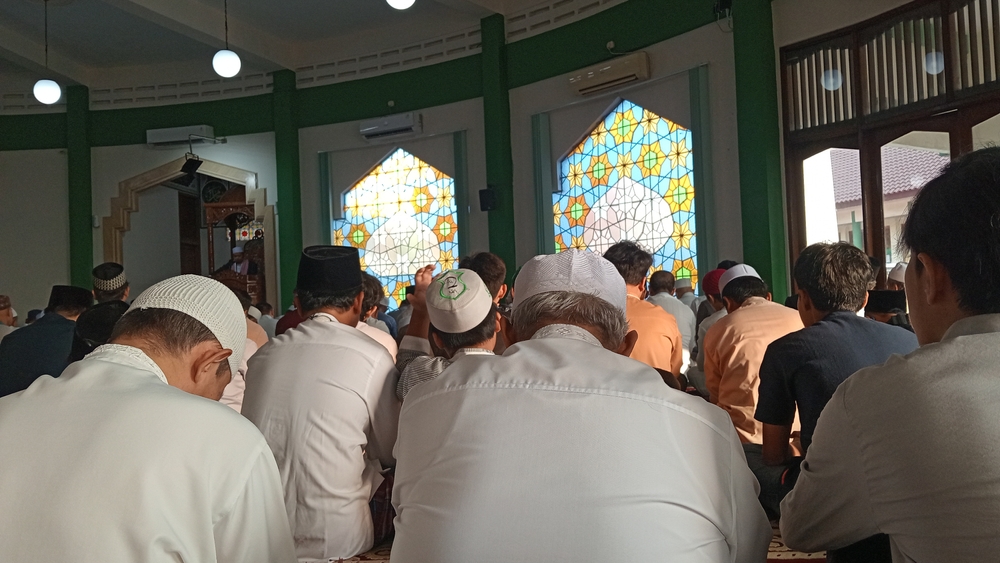
How Should a Listener Sit During the Friday Sermon?
Hanafi Fiqh
Answered by Shaykh Faraz Rabbani
Question
Is there any evidence for folding the arms during the first part of the khutba and placing the hands on the legs during the second part, similar to the sitting posture in prayer?
Answer
In the Name of Allah, the Merciful and Compassionate.
According to the Hanafi school, the listener during the Friday sermon (khutba) is subject to the same restrictions as the worshipper in prayer.
Speech, fidgeting (al-‘abath), eating, drinking, and turning around are all considered disliked or prohibited during the delivery of the khutba. [Shurunbulali, Maraqi al-Falah]
The Sunna of Stillness and Attentiveness During the Sermon
The sunna of the Messenger of Allah (peace and blessings be upon him) is to maintain stillness and attentiveness during the sermon (khutba), similar to the conduct observed in prayer.
The Prophet (peace and blessings be upon him) said, “If, on Friday while the imam is delivering the khutba, you say to your companion, ‘Be silent,’ you have engaged in vain speech.” [Bukhari; Muslim]
The Messenger of Allah (peace and blessings be upon him) said, “Whoever performs wudu well, then comes to the Friday prayer, listens attentively, and remains silent shall be forgiven for what is between that Friday and the next, with three days more. And whoever touches the pebbles has engaged in vain action.” [Muslim]
The Prophet (peace and blessings be upon him) said, “Whoever bathes on Friday, purifies himself as much as he can, applies oil or perfume available in his home, then goes out, does not separate between two people, prays what has been written for him, then remains silent when the imam speaks, shall be forgiven for what is between that Friday and the next.” [Bukhari]
These texts emphasize the requirements of silence, stillness, and attentive presence for the listener, rather than prescribing a specific hand position.
The Scholars’ Recommendation: A Means
The described practice constitutes a refined etiquette (adab) that some Hanafi scholars commend. It reflects the adab of the sitting position (qa‘da) in ritual prayer and serves as a means to facilitate stillness and attentiveness.
This renders the practice excellent and praiseworthy. However, it is not a binding sunna established by explicit textual evidence from the Prophet (Allah bless him and give him peace) or his Companions. [Ibn Abidin, Radd al-Muhtar]
Engaging in this practice is commendable. Sitting attentively with hands resting on the thighs throughout the sermon is also considered fully valid.
The foundation of this discussion is the divine command. Allah Most High states, “When the Quran is recited, listen attentively to it and remain silent, so that you may receive mercy.” [Quran 7:204; Keller, The Quran Beheld] Scholars apply this verse directly to the sermon (khutba) as well.
The Heart of Khutba Etiquette
The sunna is silent attentiveness with a present heart. Sit as you would in tashahhud, eyes low, ears open. If the hand transitions help you embody that presence, take them up as a beautiful adab.
Simply sitting still with hands resting on the thighs throughout the sermon (khutba) fulfills its requirements.
And Allah knows best.
[Shaykh] Faraz Rabbani
Related Answers
- Ways to Sit during the Khutba — Discusses permissible sitting positions while listening to the Friday sermon.
- Can I Speak Quietly during the Sermon (Khutba)? — Explains the obligation of silence and attentiveness during the sermon.
- Why Is It Sinful To Pray During the Friday Sermon (Khutba)? — Explains why engaging in prayer or other distractions during the khutba is discouraged.
- Can We Pray Sunna Prayers during the Friday Sermon? — Discusses the ruling on voluntary prayers while the imam is delivering the khutba.
- Friday: Praying Sunnas Upon Entering after the Khutba Starts — Covers the Hanafi position on entering the mosque after the sermon has begun.
Shaykh Faraz Rabbani is a recognized specialist scholar in the Islamic sciences, having studied under leading scholars from around the world. He is the Founder and Executive Director of SeekersGuidance.
Shaykh Faraz stands as a distinguished figure in Islamic scholarship. His journey in seeking knowledge is marked by dedication and depth. He spent ten years studying under some of the most revered scholars of our times. His initial studies took place in Damascus. He then continued in Amman, Jordan.
In Damascus, he was privileged to learn from the late Shaykh Adib al-Kallas. Shaykh Adib al-Kallas was renowned as the foremost theologian of his time. Shaykh Faraz also studied under Shaykh Hassan al-Hindi in Damascus. Shaykh Hassan is recognized as one of the leading Hanafi jurists of our era.
Upon completing his studies, Shaykh Faraz returned to Canada in 2007. His return marked a new chapter in his service to the community. He founded SeekersGuidance. The organization reflects his commitment to spreading Islamic knowledge. It aims to be reliable, relevant, inspiring, and accessible. This mission addresses both online and on-the-ground needs.
Shaykh Faraz is also an accomplished author. His notable work includes “Absolute Essentials of Islam: Faith, Prayer, and the Path of Salvation According to the Hanafi School,” published by White Thread Press in 2004, which is a significant contribution to Islamic literature.
His influence extends beyond his immediate community. Since 2011, Shaykh Faraz has been recognized as one of the 500 most influential Muslims. This recognition comes from the Royal Islamic Strategic Studies Center. It underscores his impact on the global Islamic discourse.
Shaykh Faraz Rabbani’s life and work embody a profound commitment to Islamic scholarship. His teachings continue to enlighten and guide seekers of knowledge worldwide.
