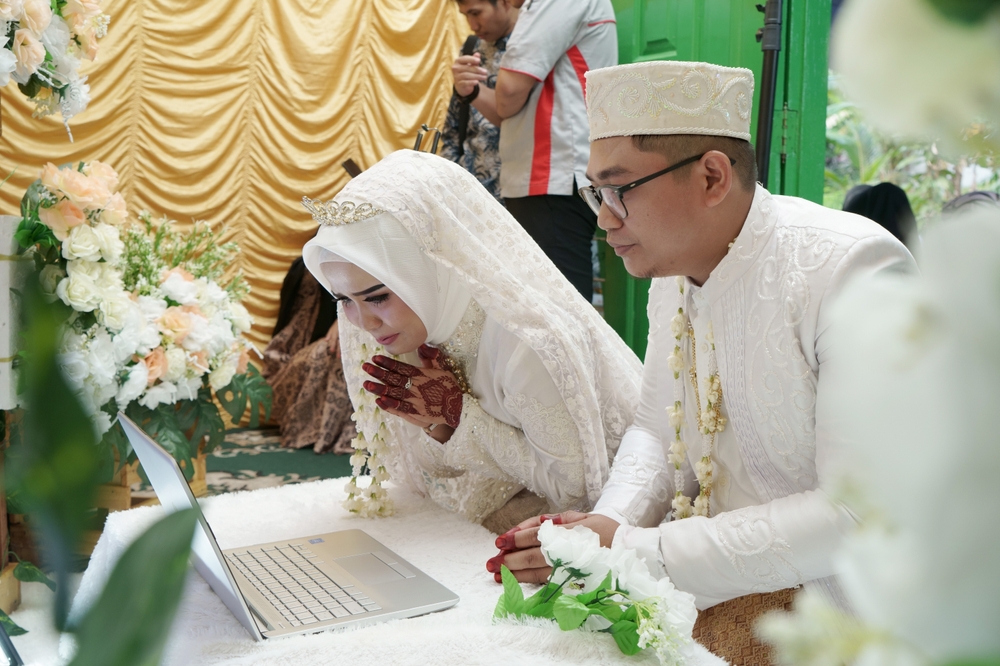
Is a Nikah by Text Message Valid Without Witnesses?
Hanafi Fiqh
Answered by Shaykh Faraz Rabbani
Question
Was my nikah valid when it was done by text on Messenger, with no witnesses on my side, and the man reading out my written proposal to the two witnesses on his side?
Answer
In the Name of Allah, the Most Merciful and Compassionate.
That this concerns you is itself a sign of faith. May Allah ease your heart.
This was not a valid nikah. You are not currently a wife. You do not need to seek a divorce from him. And if Allah opens the way to marriage with someone else, that marriage would be a fully proper Islamic marriage, not zina. The guilt that is consuming you is misplaced. Please hear this calmly.
Why was the marriage (nikah) not valid in the Hanafi school? The Hanafi school requires several conditions for a valid nikah.
The relevant ones here are an ijab (offer) and qabul (acceptance), and two trustworthy Muslim male witnesses (or one male and two female) who hear the offer and the acceptance from the contracting parties or their duly authorized agents, in one session (ittihad al-majlis). [Qudri Basha, al-Ahkam al-Shar`iyya fi’l Ahwal al-Shakhsiyya; Ibn Abidin, Radd al-Muhtar]
Witnesses are a Critical Condition
The point that resolves your case is the requirement for witness testimony.
The Hanafi masters, including Imam Ibn Abidin (Allah have mercy on him) in Radd al-Muhtar, Imam Marghinani (Allah have mercy on him) in al-Hidaya, and the Fatawa al-Hindiyya, hold that the witnesses must hear the words of both parties, either directly or from their authorized representatives.
A written proposal from an absent party can serve as an offer (ijab) under certain circumstances, but only with conditions.
In your situation, the witnesses heard only him. They heard him read a text and accept.
They did not hear you, they did not hear an authorized agent of yours, and there is no indication that the proper representation was established as the school requires.
On the relied-upon Hanafi position, the witnessing requirement was not fulfilled, and the nikah therefore did not take effect. [Qudri Basha; Haskafi, al-Durr al-Mukhtar]
The Guardian (Waly)
This is also why a guardian on the woman’s side is the sunna and practical norm for an unmarried woman of her age.
The presence of a guardian and witnesses on her side is what makes the nikah Islamically witnessable, not merely registered in some online sense. [Mawsuli, al-Ikhtiyar Sharh al-Mukhtar; Zuhayli, al-Usra al-Muslima]
You do not need to find him or seek a divorce. Because no nikah occurred, there is no marriage to dissolve.
There is no obligation on you to track him down, recall his name, or seek a formal divorce. Allah does not burden a soul beyond its capacity. [Quran 2:286]
The fact that you remember almost nothing about him, that years have passed, that there is no contact and no way to find him; these are practical mercies that follow when a contract did not occur in the first place.
You are free to marry someone else. If Allah brings a proper marriage to you, with a waliy, witnesses on your side, and the conditions of the Hanafi school properly met, that is a fully valid marriage. It is not zina. Marry, with Allah’s blessing.
A Door Not Closed
Turn your face forward. Allah forgives the past, and He is wider in mercy and forgiveness than the worry we carry.
Allah Most High says, “Say, ‘O My servants who have committed excesses against their very selves, despair not of the mercy of Allah: Verily Allah forgives all sins soever: Truly He is the All-forgiving, the All-compassionate.” [Quran, 39:53]
And Allah knows best.
[Shaykh] Faraz Rabbani
Related Answers
Is a Nikah Valid over Text If One Side Has Witnesses?
Clarifies that a marriage contract conducted via text message is invalid unless the written proposal is read out audibly and the acceptance is declared audibly in the immediate, physical presence of at least two qualified witnesses.
Is Nikah Valid If the Imam Can Only Be Reached via Zoom?
Explains that while an officiating leader can connect remotely, the essential contracting parties and witnesses must be physically present in the exact same physical assembly for the contract to hold legal validity.
Is My Nikah Valid Without the Bride’s Wali’s Permission?
Discusses how conducting a marriage remotely over telecommunications requires appointing a physical proxy or agent (wakil) to pronounce the offer or acceptance audibly before the witnesses in a single physical gathering.
Is an Online Marriage (Nikah) With Appointed Lawyers and Witnesses Physically Present With the Facilitator (Aqid) Valid?
Confirms that marriage contracts utilizing digital means are only validated when authorized physical representatives (agents) stand in the physical presence of the witnesses to execute the audible offer and acceptance.
Is a Nikah via Video Call or Telecommunications Valid?
Details that direct telecommunication nikahs generally fail the legal criteria for a valid contract due to strict requirements for a unified physical assembly, unless a valid physical proxy is explicitly designated.
Making Love Last: Prophetic Principles for a Successful Marriage
An on-demand course exploring the fundamental purposes of Islamic marriage, providing foundational legal insights and prophetic guidance for establishing a spiritually upright, legally sound, and successful lifelong partnership.
Tying the Knot: Rights, Responsibilities, and Balance
An on-demand series diving into the timeless wisdom of Islamic law regarding marriage contracts, explicitly outlining the precise legal elements, marital conditions, and mutual responsibilities required to maintain balance.
Shaykh Faraz Rabbani is a recognized specialist scholar in the Islamic sciences, having studied under leading scholars from around the world. He is the Founder and Executive Director of SeekersGuidance.
Shaykh Faraz stands as a distinguished figure in Islamic scholarship. His journey in seeking knowledge is marked by dedication and depth. He spent ten years studying under some of the most revered scholars of our times. His initial studies took place in Damascus. He then continued in Amman, Jordan.
In Damascus, he was privileged to learn from the late Shaykh Adib al-Kallas. Shaykh Adib al-Kallas was renowned as the foremost theologian of his time. Shaykh Faraz also studied under Shaykh Hassan al-Hindi in Damascus. Shaykh Hassan is recognized as one of the leading Hanafi jurists of our era.
Upon completing his studies, Shaykh Faraz returned to Canada in 2007. His return marked a new chapter in his service to the community. He founded SeekersGuidance. The organization reflects his commitment to spreading Islamic knowledge. It aims to be reliable, relevant, inspiring, and accessible. This mission addresses both online and on-the-ground needs.
Shaykh Faraz is also an accomplished author. His notable work includes “Absolute Essentials of Islam: Faith, Prayer, and the Path of Salvation According to the Hanafi School.” This book, published by White Thread Press in 2004, is a significant contribution to Islamic literature.
His influence extends beyond his immediate community. Since 2011, Shaykh Faraz has been recognized as one of the 500 most influential Muslims. This recognition comes from the Royal Islamic Strategic Studies Center. It underscores his impact on the global Islamic discourse.
Shaykh Faraz Rabbani’s life and work embody a profound commitment to Islamic scholarship. His teachings continue to enlighten and guide seekers of knowledge worldwide.
