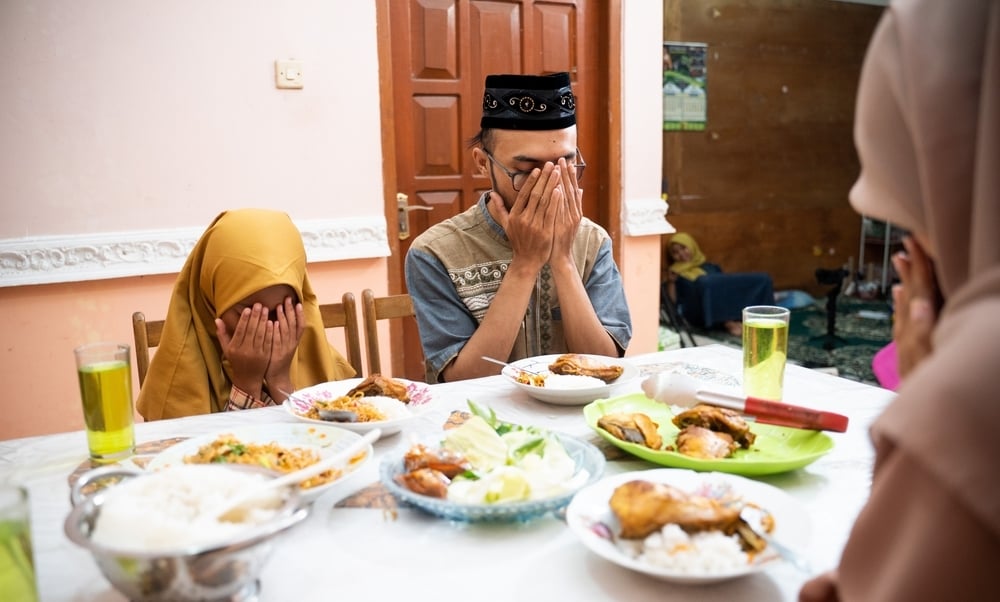
Is It Permissible to Eat More Than I Need While Palestinians Are Starving?
Hanafi Fiqh
Answered by Shaykh Faraz Rabbani
Question
Is it permissible for me to eat more than I need to stand upright while the Palestinians are starving? By that I mean more than one meal a day, really, the minimum of food I need to consume.
Answer
In the Name of Allah, the Most Merciful and Compassionate.
Your concern is not a flaw in your faith. It is a sign of mercy. The discomfort you feel while others suffer is a mark of a living heart. May Allah reward you for this compassion.
Please know that what follows is offered with respect for your sincere care.
The Ruling
You are not permitted to reduce your intake to the bare minimum needed to stand. Eating enough to maintain your health and strength is not just allowed; it is required. Your body is a trust from Allah.
We are responsible for caring for it as He has commanded. Deliberately weakening yourself is not sought by the Sacred Law.
The Prophet (Allah bless him and give him peace) judged, “that there be no harming nor reciprocating of harm.” [Sunan Ibn Maja]
Imam Malik relates the same in al-Muwatta. The scholars built one of the governing maxims of the whole Sacred Law on it.
That maxim does not begin at the edge of your own skin. The harm you inflict on yourself is harm.
What the Tradition Actually Praises
Moderation, not deprivation. Allah Most High says, “And eat and drink, but not in prodigal waste. Verily, He loves not those who exceed the due bounds.” [Quran 7:31; Keller, The Quran Beheld]
Reflect on the wording. The command is to eat and drink. The restriction is against waste and excess, not against sufficiency.
The Prophet (Allah bless him and give him peace) said, “No son of Adam has filled a vessel worse than his stomach.
A few morsels are enough for a man to keep his back straight. But if it must be more, then a third for his food, a third for his drink, and a third for his breath.” [Sunan al-Tirmidhi; also Sunan Ibn Maja]
Read it carefully. Even the strictest reading of this hadith gives you a third of the stomach for food and a third for drink. It is a warning against filling yourself, not an instruction to empty yourself.
Choosing to eat only one meal a day, at the minimum needed to survive, is not what the guidance above describes.
Over time, this weakens your strength, focus, worship, and ability to benefit others. Please avoid this approach.
Where Does the Mercy You Are Feeling Belong
Your grief is real and deserves a true outlet. However, your hunger does not reach those in Gaza. These actions do:
Give, and give in a way that you feel. This is closest to what your heart seeks. Unlike self-deprivation, this support truly reaches them. If you wish your sacrifice to be meaningful, let it be through your wealth rather than your health.
Pray for them by name, in the depths of the night, in your prostration, and between the adhan and iqama. Do not think this is insignificant. It is a door that no power on earth can close.
Speak and act wherever you have any influence. This may be through advocacy, boycott, writing, or organizing. Do what is within your capacity and entrust the rest to Allah.
Keep yourself strong enough to sustain these actions. A weakened body cannot give, cannot stand in prayer at night, and cannot advocate for others.
A Word on the Guilt Itself
You are not asked to carry the burden of Gaza alone. You are asked to do what is within your capacity. Allah Most High does not burden a soul beyond its capacity. Eat properly, then use that strength to act on their behalf.
May Allah relieve the people of Palestine, accept your efforts, and place blessings in your concern.
And Allah knows best.
[Shaykh] Faraz Rabbani
Related SeekersGuidance Answers
- How Do I Respond to the Tribulations Our Brethren in Palestine Face? – Offers a three-part response to the suffering in Palestine: what to cultivate in the heart, what to do spiritually, and what practical action to take.
- How to Make a Powerful Du’a for the Oppressed in Islam? – Explains how to make sincere and powerful supplication for those facing oppression and affliction.
- How Do I Combat a Sense of Helplessness Regarding the State of the Umma? – Addresses feelings of helplessness over the condition of Muslims and explains how to turn concern into spiritually grounded action.
- Is It Best to Eat and Sleep Well and Worship More or to Eat and Sleep Less and Worship Less? – Explains the importance of moderation in worship, sleep, and food while emphasizing the rights of the body and avoiding harmful excess.
- What Does ‘Your Self Has a Right over You’ Mean? – Explains the hadith of Salman and Abu al-Dardaʾ and the Prophetic principle that worship should not come at the expense of the body’s legitimate rights.
- How Can I Stop Overeating and Regain the Will To Live? – Addresses overeating through Islamic guidance and practical steps, including the Prophetic guidance on moderation in eating.
Shaykh Faraz Rabbani is a recognized specialist scholar in the Islamic sciences, having studied under leading scholars from around the world. He is the Founder and Executive Director of SeekersGuidance.
Shaykh Faraz stands as a distinguished figure in Islamic scholarship. His journey in seeking knowledge is marked by dedication and depth. He spent ten years studying under some of the most revered scholars of our times. His initial studies took place in Damascus. He then continued in Amman, Jordan.
In Damascus, he was privileged to learn from the late Shaykh Adib al-Kallas. Shaykh Adib al-Kallas was renowned as the foremost theologian of his time. Shaykh Faraz also studied under Shaykh Hassan al-Hindi in Damascus. Shaykh Hassan is recognized as one of the leading Hanafi jurists of our era.
Upon completing his studies, Shaykh Faraz returned to Canada in 2007. His return marked a new chapter in his service to the community. He founded SeekersGuidance. The organization reflects his commitment to spreading Islamic knowledge. It aims to be reliable, relevant, inspiring, and accessible. This mission addresses both online and on-the-ground needs.
Shaykh Faraz is also an accomplished author. His notable work includes “Absolute Essentials of Islam: Faith, Prayer, and the Path of Salvation According to the Hanafi School.” This book, published by White Thread Press in 2004, is a significant contribution to Islamic literature.
His influence extends beyond his immediate community. Since 2011, Shaykh Faraz has been recognized as one of the 500 most influential Muslims. This recognition comes from the Royal Islamic Strategic Studies Center. It underscores his impact on the global Islamic discourse.
Shaykh Faraz Rabbani’s life and work embody a profound commitment to Islamic scholarship. His teachings continue to enlighten and guide seekers of knowledge worldwide.
«النصوص» · Source texts
﴿۞ يَـٰبَنِىٓ ءَادَمَ خُذُوا۟ زِينَتَكُمْ عِندَ كُلِّ مَسْجِدٍ وَكُلُوا۟ وَٱشْرَبُوا۟ وَلَا تُسْرِفُوٓا۟ ۚ إِنَّهُۥ لَا يُحِبُّ ٱلْمُسْرِفِينَ﴾
[سورة الأعراف: ٣١]
عَنْ مِقْدَامِ بْنِ مَعْدِي كَرِبَ، قَالَ: سَمِعْتُ رَسُولَ اللهِ ﷺ يَقُولُ: «مَا مَلَأَ آدَمِيٌّ وِعَاءً شَرًّا مِنْ بَطْنٍ، بِحَسْبِ ابْنِ آدَمَ أُكُلَاتٌ يُقِمْنَ صُلْبَهُ، فَإِنْ كَانَ لَا مَحَالَةَ فَثُلُثٌ لِطَعَامِهِ وَثُلُثٌ لِشَرَابِهِ وَثُلُثٌ لِنَفَسِهِ».
[سنن الترمذي، رقم ٢٣٨٠؛ وأخرجه ابن ماجه، رقم ٣٣٤٩]
عَنْ عُبَادَةَ بْنِ الصَّامِتِ «أَنَّ رَسُولَ اللَّهِ ﷺ قَضَى أَنْ لَا ضَرَرَ وَلَا ضِرَارَ».
[سنن ابن ماجه، رقم ٢٣٤٠؛ وهو في الموطأ مرسلًا، رقم ١٤٢٩]
