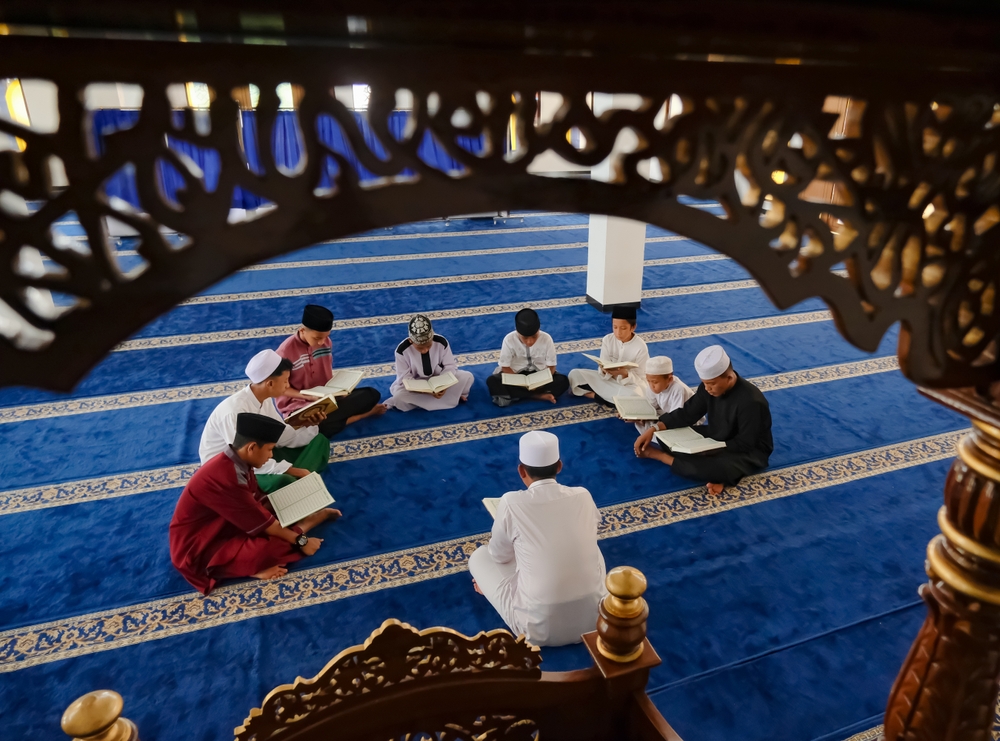
Will There Be Education, Universities, or Grades in Paradise?
Hanafi Fiqh
Answered by Shaykh Faraz Rabbani
Question
Will there be education in Heaven? For example, will there be universities and grades there?
Answer
In the name of Allah, Most Merciful and Compassionate.
Two things at once: Paradise is not arranged like the schools we know, with universities, terms, and grades; yet learning, knowledge, and a ceaseless increase very much continue there, in a form far greater than any study offers us now.
Consider what universities and grades are for. They are arrangements for gaining bounded knowledge under limited time, limited memory, and the pressure of examination.
Paradise is the home of fulfillment, not of striving and deferral.
What we chase through study here, understanding, nearness, the sheer joy of knowing, is given there directly and in fullness.
So the picture of lecture halls and report cards does not fit, not because Paradise lacks knowledge, but because it is past the scaffolding we built to reach it.
An Ascent in Knowledge That Never Ends
What the texts affirm is far more wonderful than a curriculum.
Imam Alusi, in his commentary Ruh al-Maani, describes the people of Paradise rising through ranks of knowledge: the ordinary believers there come to know what the scholars knew in this world, the scholars rise to what the prophets knew, and the prophets to the knowledge of the Prophet Muhammad (Allah bless him and give him peace), whose knowledge of his Lord is the summit, beyond the reach of any angel brought near or messenger sent. [Alusi, Ruh al-Maani]
And the ascent never halts, he explains, for the journey into the knowledge of Allah has no end; His reality cannot be fully encompassed, so the people of Paradise rise forever into an ever-deepening knowing of Him.
This is what the Quran points to when it names the gift beyond every reward. Allah Most High says: “For them is whatever they desire therein, and with Us is yet more.” [Quran 50:35; Keller, The Quran Beheld]
And: “Those who do good are Paradise’s most beautiful reward, and yet more.” [Quran 10:26; Keller, The Quran Beheld]
The commentators read the “yet more” to include this rising of the heart in knowledge and gnosis, crowned by the greatest gift of all, the vision of Allah Most High.
That is the true education of Paradise: not an examination, but an unveiling without end. [Alusi, Ruh al-Ma’ani; Razi, Mafatih al-Ghayb]
Learning in the Best of Company
And the knowing is never solitary. The gatherings of Paradise are gatherings of light, in the company of those Allah named: “the prophets, the deeply truthful, the martyrs, and the righteous; and how excellent are those as companions.” [Quran 4:69]
To sit with the prophets, to meet what one only read about here, to live the meanings one loved in this world rather than merely study them, is the harvest of every sincere lesson.
Allah even reunites the believers with their offspring there: “And those who believed and whose progeny followed them in faith, We shall reunite their progeny with them.” [Quran 52:21]
As for the exact manner of it, that lies beyond us from where we stand. The Prophet (Allah bless him and give him peace) reported that Allah Most High says: “I have prepared for My righteous servants what no eye has seen, no ear has heard, and no heart of man has conceived.” [Bukhari; Muslim]
So we affirm that knowledge and nearness continue in Paradise, and leave its form to the One who fashioned it.
Study Now for the Knowledge That Never Ends
Let this lift your studies rather than flatten them. The learning you do here, when it is for Allah, is a seed; its harvest is a knowing in Paradise with no examination and no end, in the company of the prophets and the righteous.
Keep seeking knowledge sincerely in this life, and trust that what you love about learning will be perfected there, not abolished.
And Allah knows best.
[Shaykh] Faraz Rabbani
Related Answers
How Are the Levels of Paradise Greater or Lesser?
Explains the different levels of Paradise and how they vary according to deeds and spiritual excellence.
Will We Be With Everyone We Love in Jannah?
Explains the meaning of the hadith “You will be with those whom you love” and reunion with loved ones in Paradise.
Why Worry About Children If We Know They Will Go to Paradise?
Discusses the fate of children who die young and their place in Paradise.
What Is the Correct Belief Regarding the Vision of Allah on the Day of Judgment?
Explains the Sunni belief that seeing Allah is the greatest delight and reward of the people of Paradise.
Will We See Allah (Most High) in the Next Life (Akhira)?
Affirms the believers’ vision of Allah in the Hereafter and its place in Islamic creed.
Shaykh Faraz Rabbani is a recognized specialist scholar in the Islamic sciences, having studied under leading scholars from around the world. He is the Founder and Executive Director of SeekersGuidance.
Shaykh Faraz stands as a distinguished figure in Islamic scholarship. His journey in seeking knowledge is marked by dedication and depth. He spent ten years studying under some of the most revered scholars of our times. His initial studies took place in Damascus. He then continued in Amman, Jordan.
In Damascus, he was privileged to learn from the late Shaykh Adib al-Kallas. Shaykh Adib al-Kallas was renowned as the foremost theologian of his time. Shaykh Faraz also studied under Shaykh Hassan al-Hindi in Damascus. Shaykh Hassan is recognized as one of the leading Hanafi jurists of our era.
Upon completing his studies, Shaykh Faraz returned to Canada in 2007. His return marked a new chapter in his service to the community. He founded SeekersGuidance. The organization reflects his commitment to spreading Islamic knowledge. It aims to be reliable, relevant, inspiring, and accessible. This mission addresses both online and on-the-ground needs.
Shaykh Faraz is also an accomplished author. His notable work includes “Absolute Essentials of Islam: Faith, Prayer, and the Path of Salvation According to the Hanafi School.” This book, published by White Thread Press in 2004, is a significant contribution to Islamic literature.
His influence extends beyond his immediate community. Since 2011, Shaykh Faraz has been recognized as one of the 500 most influential Muslims. This recognition comes from the Royal Islamic Strategic Studies Center. It underscores his impact on the global Islamic discourse.
Shaykh Faraz Rabbani’s life and work embody a profound commitment to Islamic scholarship. His teachings continue to enlighten and guide seekers of knowledge worldwide.
