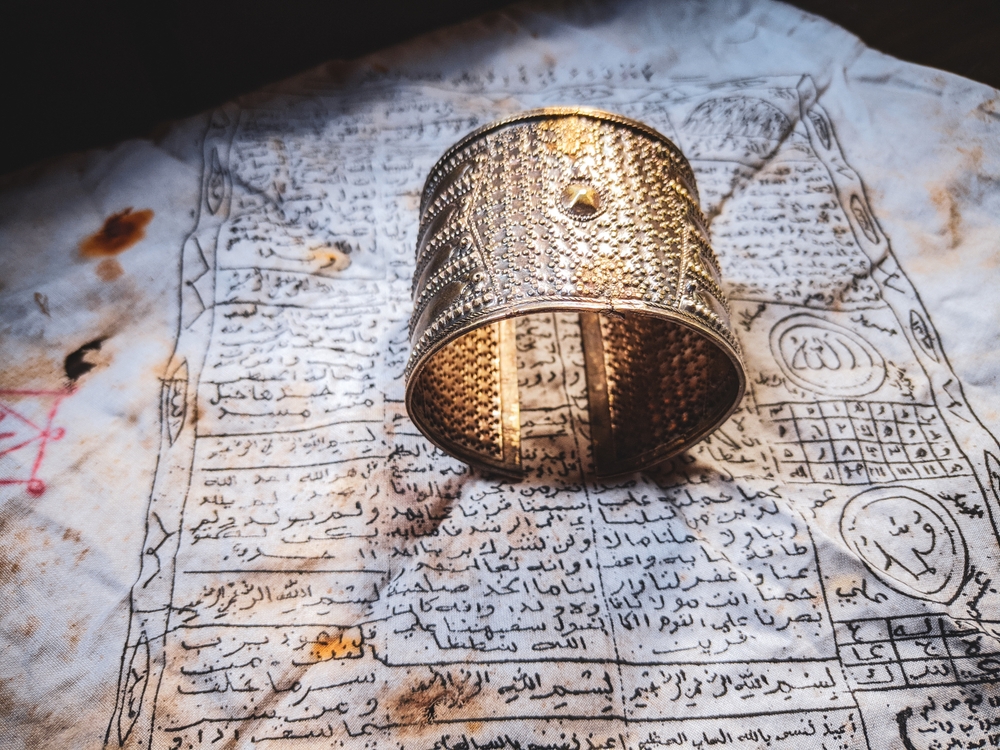
Am I Sinning for Wearing an Amulet Under Parental Pressure?
Hanafi Fiqh
Answered by Shaykh Faraz Rabbani
Question
Two young women write with the same trial: their parents compel them to wear an amulet (taweez) and to use water over which something has been written or recited.
They do not believe in these objects; they fear the practice borders on associating partners with Allah (shirk), and they fear it has harmed her prayers. May they comply outwardly to keep peace, and how should they dispose of the water?
Answer
In the Name of Allah, the Most Merciful and Compassionate
This is not necessarily sinful. It is natural to feel uneasy about anything that may go against the command of Allah Most High.
We do not obey anyone in creation, even our parents, if they ask us to do something that is clearly against Allah’s command. However, not all the practices you mention are forbidden.
An Amulet (Taweez) Is of Two Kinds
It is important to know what the Shariah says about this, as not all amulets are the same. There are two types of amulets (taweez).
The first type of amulet is forbidden. This is the amulet that contains words whose meaning is unknown, or talismanic and magical formulas, or that is worn in the belief that the object itself wards off harm or brings benefit on its own, as was the practice before Islam. To believe a thing protects independently of Allah is the danger here, and it is grave.
The second type of amulet is permitted. This is the amulet that contains the Quran, the names of Allah, lawful supplications, or sound content from the Sunna, worn while believing that all benefit and protection come from Allah alone — the object being only a means. This is the relied-upon Hanafi position.
As Khadimi explains in al-Bariqa al-Mahmudiyya, his commentary on Imam Birgivi’s al-Tariqa al-Muhammadiyya, the prohibited kind is what resembles the amulets of pre-Islamic ignorance or carries unknown words, while the permitted kind is sound.
And al-Fatawa al-Hindiyya, one of the primary references of the school, states that there is nothing wrong with wearing such amulets, adding only that one should remove them before the lavatory and before intimacy out of reverence for the sacred words they carry.
So the issue is not whether all amulets are shirk. What matters is what the amulet contains and what you believe in your heart. If it contains the Quran or the names of Allah, and you are certain that only Allah protects, then there is nothing forbidden in wearing it.
Reliance on Allah Is Highest — Yet Lawful Means Do Not Contradict It
The highest state is to rely on Allah alone (tawakkul), seeking His protection. Taking lawful means, such as protective recitation (ruqya), seeking refuge in Allah (ta’awwudh), or using a permitted amulet, does not go against reliance on Allah. These means are also from Allah.
The Prophet (Allah bless him and give him peace) himself took such means. A’isha (Allah be pleased with her) related that each night before sleeping, he would recite Surat al-Ikhlas, Surat al-Falaq, and Surat al-Nas, blow into his cupped hands, and wipe them over his body, beginning with his head and face, doing this three times. [Bukhari] So protective recitation and wiping are themselves Prophetic.
Water Over Which the Quran Is Recited Is Permissible to Drink
It is permitted to drink water over which the Quran has been recited, or in which paper with Quranic verses has been dissolved, as long as the paper and ink are pure. There is no harm in this, and many early Muslims allowed it. Using such water does not affect your faith.
Honor Your Mother, Within the Clear Limit
Through all of this, hold fast to honoring your parents, and your mother above all. A man once asked the Messenger of Allah (Allah bless him and give him peace) who was most deserving of his good company. He said, “Your mother.” The man asked again, and again he said, “Your mother.” A third time: “Your mother.” Only the fourth time did he say, “Your father.” [Bukhari]
So bear with your parents kindly, even where you differ. Allah Most High commands exactly this even toward parents who err: “And if they do their utmost to make you worship with Me what you know nothing of, obey them; but accompany them for the time in this world with gracious kindness.” [Quran 31:15; Keller, The Quran Beheld]
The one clear limit is that there is no obedience to any created being in disobedience to the Creator.
If your parents ask you to do something sound or permitted, respond with warmth and respect.
If they ask you to do something that is clearly against Allah’s command, gently and respectfully decline, while keeping kindness and good character.
And Allah knows best.
[Shaykh] Faraz Rabbani
Related Answers
Is Using a Ta’wiz (Amulet) Permissible?
Explains when the use of a taʿwīdh is permissible in Islam and the conditions scholars place on its use.
Is it Permissible to Use Tawidh Written on Dissolvable Paper and Ink?
Discusses the permissibility of drinking or washing with dissolved Quranic inscriptions for healing and spiritual benefit.
Can Quranic Verses Be Used in Supplications and Invocations?
Clarifies the use of verses from the Qur’an in duʿāʾ, ruqya, and personal supplications.
Do I Have to Obey My Parents if They Order Me to Leave Sunnah Acts?
Explains the balance between honoring one’s parents and maintaining recommended acts of worship.
Shaykh Faraz Rabbani is a recognized specialist scholar in the Islamic sciences, having studied under leading scholars from around the world. He is the Founder and Executive Director of SeekersGuidance.
Shaykh Faraz stands as a distinguished figure in Islamic scholarship. His journey in seeking knowledge is marked by dedication and depth. He spent ten years studying under some of the most revered scholars of our times. His initial studies took place in Damascus. He then continued in Amman, Jordan.
In Damascus, he was privileged to learn from the late Shaykh Adib al-Kallas. Shaykh Adib al-Kallas was renowned as the foremost theologian of his time. Shaykh Faraz also studied under Shaykh Hassan al-Hindi in Damascus. Shaykh Hassan is recognized as one of the leading Hanafi jurists of our era.
Upon completing his studies, Shaykh Faraz returned to Canada in 2007. His return marked a new chapter in his service to the community. He founded SeekersGuidance. The organization reflects his commitment to spreading Islamic knowledge. It aims to be reliable, relevant, inspiring, and accessible. This mission addresses both online and on-the-ground needs.
Shaykh Faraz is also an accomplished author. His notable work includes “Absolute Essentials of Islam: Faith, Prayer, and the Path of Salvation According to the Hanafi School.” This book, published by White Thread Press in 2004, is a significant contribution to Islamic literature.
His influence extends beyond his immediate community. Since 2011, Shaykh Faraz has been recognized as one of the 500 most influential Muslims. This recognition comes from the Royal Islamic Strategic Studies Center. It underscores his impact on the global Islamic discourse.
Shaykh Faraz Rabbani’s life and work embody a profound commitment to Islamic scholarship. His teachings continue to enlighten and guide seekers of knowledge worldwide.
