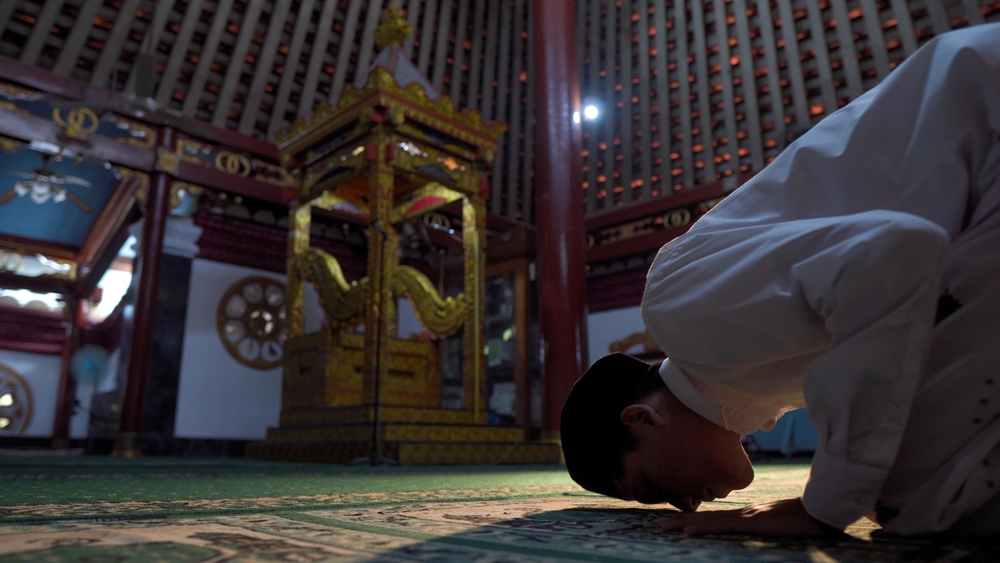
Is It Allowed to Repeat Duʿa in Prostration and Recite Verses from the Quran?
Hanafi Fiqh
Answered by Shaykh Faraz Rabbani
Question
May we repeat the same supplication in prostration (sujud) or in the seated recital (tashahhud)?
Which Quranic phrases and which remembrances may be said in sujud, in bowing (ruku), or in the sitting between them, and what else may be done to beautify the prayer (salah)?
Answer
In the Name of Allah, the Merciful and Compassionate
Yes. Repeating the same supplication in prostration (sujud) or tashahhud is permitted, and Allah loves the slave who insists in his asking, as the Messenger of Allah (peace & blessings be upon him) mentioned. [Bukhari; Muslim]
There are some considerations, however:
The Legal Framework
One. In bowing and prostration, the established emphasized sunna act is the glorification (tasbih).
In ruku: “Glory be to my Lord, the Mighty” (Subhana Rabbiya al-Azim).
In sujud: “Glory be to my Lord, the Most High” (Subhana Rabbiya al-A’la).
Once at minimum, three times to fulfill the emphasized sunna. [Hashiyat al-Tahtawi on Maraqi al-Falah; Ibn Abidin, Radd al-Muhtar].
Two. The Prophet, Allah bless him and give him peace, said: “I have been forbidden from reciting the Quran in bowing or in prostration.” [Muslim]
Therefore, Quranic verses are not recited in ruku, sujud, or the sitting between prostrations (jalsa).
A verse that is itself a supplication, however, may be said in sujud as a supplication, when the intent is to ask Allah by the meaning of the verse, not to recite it as the Quran. [Haskafi, al-Durr al-Mukhtar; Ibn Abidin, Radd al-Muhtar]
Your Specific Questions
One. Verses that are themselves supplications. “My Lord, increase me in knowledge” [Quran 20:114] is permitted in prostration, and you can repeat as you wish.
The same applies to “Our Lord, give us good in this world and good in the next” [Quran 2:201], “Our Lord, do not take us to task if we forget or err” [Quran 2:286], and “My Lord, I stand in need of any good You send down to me” [Quran 28:24].
All are permitted in prostration when said as supplication (dua). [Tahtawi/Shurunbulali, Hashiyat Maraqi al-Falah]
Two. Remembrance (dhikr). “There is no power and no strength except by Allah” is pure remembrance (dhikr). It is permitted in sujud after the tasbih.
Three. Reportive Quranic verses. “Indeed, to Allah we belong, and to Him we return” [Quran 2:156] is reportive, not supplicative. It is said outside prayer, not in prostration, except as remembrance.
Four. Long Quranic passages. The last two verses of Surat al-Baqara and the Verse of the Throne (Ayat al-Kursi), recited as Quran, belong as recitation of the Quran in standing.
If you draw from them a supplicative phrase (“Our Lord, do not load upon us..”) and intend supplication, that portion may be said in prostration.
The verses are not, on the whole, in supplicative form. The safer course is to recite them in standing, and to choose transmitted (ma’thur) supplications in prostration.
Five. Salawat on the Prophet. Salawat in sujud is permitted as dhikr. The sunna placement of the full salawat remains in the second tashahhud.
Six. “O my Lord,” repeated. Repeating “ya Rabb” while making your need in the heart is permitted, and excellent.
This is the kind of insistent supplication the Prophet (Allah bless him and give him peace) praised.
Imams: Beware!
A note for the imam. When you lead a congregation, do not lengthen the sujud or tashahhud through repetition or additions.
Keep to the sunna tasbih, only. [Shurunbulali, Maraqi al-Falah]
Our Beloved Prophet (Allah bless him and give him peace) taught: “Whoever leads people in prayer, let him lighten their prayer, for among them are the weak, the sick, and the one with a need.” [Bukhari; Muslim]
The scholars deemed it disliked for the imam to unduly lengthen their recitation, bowing, or prostration in the obligatory prayer.
The threshold, they explain, is going beyond the sunna amount. [Ibn Abidin, Radd al-Muhtar; Ibn Nujaym, al-Bahr al-Ra’iq]
To beautify your further, learn various sunna formulas for the opening invocations; different sunna remembrance and supplication for your bowing and prostration; and likewise for the supplication before the closing salam. Recite these and your Quran slowly with understanding.
Remember that meanings come before words. And guard the eyes; weep at what calls for weeping; and as the Messenger of Allah (peace & blessings be upon him) taught, pray as if it is your last.
[Samarqandi, Tanbih al-Ghafilin; Qari, Sharh Ayn al-Ilm; Maraqi al-Falah; Hashiyat al-Tahtawi; Radd al-Muhtar]
And Allah knows best.
[Shaykh] Faraz Rabbani
Related Answers
- Is It Permissible to Supplicate During Prostration (Sujud)? — Establishes the Hanafi basis for supplication in sujud and the leeway in voluntary prayer versus restraint when leading a congregation.
- How Do I Supplicate during Salah While Sitting and Prostrating? — Practical details on what may be said in sujud and the seated recital, with the Hanafi conditions.
- Can Quranic Verses Be Used in Supplications and Invocations? — Confirms that Quranic verses framed as supplication may be used as supplication, and explains the intent test.
- Is It Permissible to Recite Short Supplications in the Prayer? — Hanafi guidance on transmitted short supplications inside the prayer, including limits in obligatory prayer.
- Can We Make Supplication in the Prayer? — Sets out the categories of supplication permitted inside the prayer.
- What are the Rulings Regarding the Necessary (Wajib) Element of the Prayer and Supplications When Bowing and in Prostration? — On the wajib in ruku and sujud and how additions interact with the necessary act.
- Can We Leave the Congregation If the Imam Prolongs the Prayer? — Companion piece on the imam’s duty to lighten — relevant to the imam-note above.
- How Can I Maintain Focus and Concentration in My Prayer? — Practical adab for beautifying the prayer through presence of heart.
- What Is the Meaning of Khushu (Humility) and Its Importance? — On the inner dimension of beautifying the salah.
Shaykh Faraz Rabbani is a recognized specialist scholar in the Islamic sciences, having studied under leading scholars from around the world. He is the Founder and Executive Director of SeekersGuidance.
Shaykh Faraz stands as a distinguished figure in Islamic scholarship. His journey in seeking knowledge is marked by dedication and depth. He spent ten years studying under some of the most revered scholars of our times. His initial studies took place in Damascus. He then continued in Amman, Jordan.
In Damascus, he was privileged to learn from the late Shaykh Adib al-Kallas. Shaykh Adib al-Kallas was renowned as the foremost theologian of his time. Shaykh Faraz also studied under Shaykh Hassan al-Hindi in Damascus. Shaykh Hassan is recognized as one of the leading Hanafi jurists of our era.
Upon completing his studies, Shaykh Faraz returned to Canada in 2007. His return marked a new chapter in his service to the community. He founded SeekersGuidance. The organization reflects his commitment to spreading Islamic knowledge. It aims to be reliable, relevant, inspiring, and accessible. This mission addresses both online and on-the-ground needs.
Shaykh Faraz is also an accomplished author. His notable work includes “Absolute Essentials of Islam: Faith, Prayer, and the Path of Salvation According to the Hanafi School.” This book, published by White Thread Press in 2004, is a significant contribution to Islamic literature.
His influence extends beyond his immediate community. Since 2011, Shaykh Faraz has been recognized as one of the 500 most influential Muslims. This recognition comes from the Royal Islamic Strategic Studies Center. It underscores his impact on the global Islamic discourse.
Shaykh Faraz Rabbani’s life and work embody a profound commitment to Islamic scholarship. His teachings continue to enlighten and guide seekers of knowledge worldwide.
