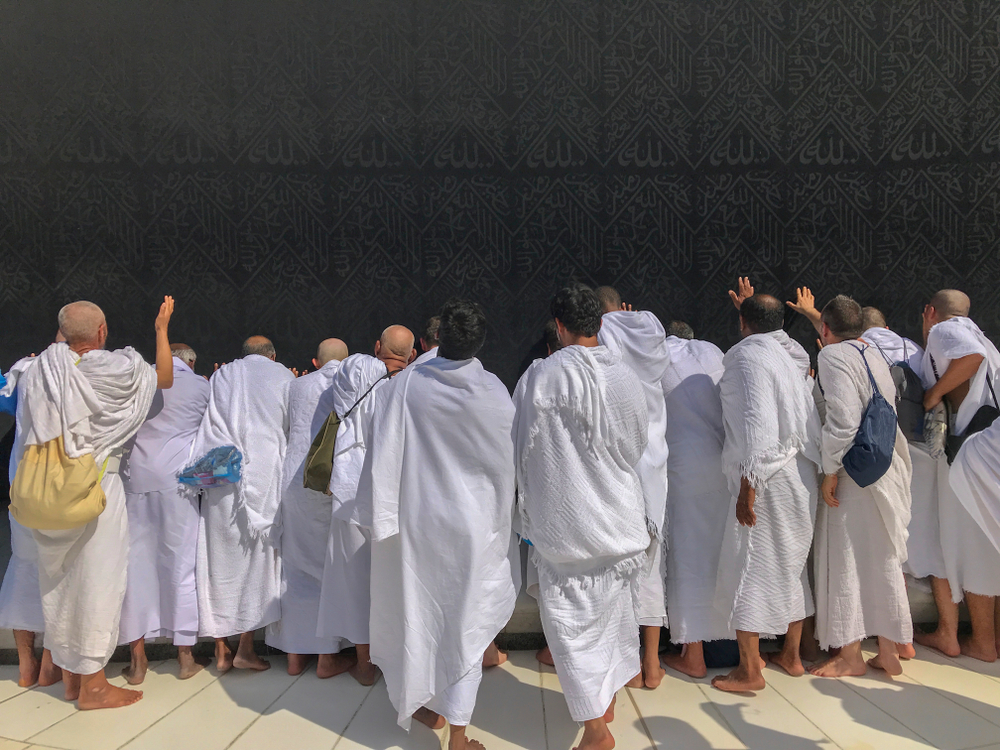
Is It a Sunna to Touch the Ka‘ba or Its Kiswa When Making Du’a?
Shafi'i Fiqh
Answered by Shaykh Irshaad Sedick
Question
Is touching the Ka‘ba or its kiswa during supplication a sunna, and is it better than simply facing it?
Answer
In the Name of Allah, the Most Merciful and Compassionate.
Touching or kissing the Ka‘ba carries a specific established sunna only in relation to the Black Stone, the Rukn al-Yamani, and the Multazam. Beyond these three, no sunna virtue is established for touching other parts of the Ka‘ba during supplication, though doing so is permissible. Facing the Ka‘ba and supplicating is itself virtuous, and no text gives it less standing than touching the Ka‘ba.
Established Sunnas Related to the Ka‘ba
About our relationship with the Ka‘ba, the House of Allah Most High, there are specific sunnas that have been established. Among them are touching and kissing the Black Stone, as well as touching the Rukn al-Yamani. These practices are well known and firmly established.
In addition, there is a sunna of clinging with one’s body to the Multazam, which is the area between the Black Stone and the door of the Ka‘ba. This includes pressing one’s body against that part of the Kabah and engaging in prayer and supplication there. It is regarded as a place where supplications are readily accepted.
Touching Other Parts of the Kaba
Beyond what has been mentioned, the juristic texts clearly state that it is neither sunna nor required to touch or kiss any other part of the Ka‘ba. This is mentioned in works such as ‘Umrat al-Salih and similar texts. At the same time, doing so is not disliked. It is permissible and generally regarded as good, but it does not carry a specific Sunna virtue.
Accordingly, there is no established sunna of touching or kissing the Ka‘ba other than the Black Stone, the Rukn al-Yamani, and supplication at the Multazam.
Facing the Ka‘ba Versus Touching It
There is virtue in simply sitting, facing the Ka‘ba, and supplicating. If a person is unable to make supplication at the Multazam or during tawaf, then supplicating while facing the Ka‘ba remains virtuous. There is no specific text that gives precedence to the one who touches the Ka‘ba over the one who sits and faces it.
Some narrations speak about mercies descending upon the Ka‘ba. These mercies apply broadly to those performing tawaf, those praying, and those looking at the Ka‘ba.
Therefore, beyond the Black Stone, the Rukn al-Yamani, and the Multazam, there is no specific virtue established for touching the Ka‘ba during supplication as opposed to simply facing it.
Personal Spiritual States
It is essential to note that the preceding discussion pertains to virtues explicitly mentioned in Revelation. Another important dimension is a person’s individual spiritual state.
One person may feel closer to Allah, more emotionally moved, and spiritually energized by touching the Ka‘ba. Another person may experience the same spiritual intensity simply by sitting and gazing at the Ka‘ba in awe, to the point that they feel unable to approach or touch it out of reverence.
As long as these spiritually heightened states arise through lawful means, such as touching the Ka‘ba, looking at it, or being within the Sacred Mosque, no one can determine that one form is spiritually superior for that individual. These are internal states, and Allah alone knows the true condition of a person’s heart.
Supplication Upon Seeing the Ka‘ba for the First Time
There is a widespread belief that the first supplication made upon seeing the Ka‘ba is guaranteed acceptance. This notion is commonly mentioned in Hajj and ‘Umra classes. However, there is no authentic or acceptable evidence establishing a specific supplication whose acceptance is guaranteed at that moment.
From the perspective of textual evidence, it is correct to say that there is no proof for a specific prescribed supplication at first sight of the Ka‘ba. However, this does not negate the spiritual reality of that moment.
A person seeing the Ka‘ba for the first time is often in a deeply elevated spiritual state. Even though no specific virtue is mentioned in the Quran or Sunna, that emotional and spiritual closeness to Allah may itself be a means for supplication to be accepted.
This meaning is reflected in the Quran when Allah mentions the story of Zakariyya (peace be upon him). When he saw that Maryam had provisions that were out of season, Allah says,
“Then and there Zakariyya prayed to his Lord.” [Quran 3:38]
There was no explicit command stating that supplication at that moment would be accepted, yet Zakariyya was moved to pray, and Allah accepted his supplication.
Similarly, a believer should take advantage of the spiritual state they experience when seeing the Ka‘ba for the first time and turn to Allah in sincere supplication.
And Allah knows best.
[Shaykh] Irshaad Sedick
Shaykh Irshaad Sedick was raised in South Africa in a traditional Muslim family. He graduated from Dar al-Ulum al-Arabiyyah al-Islamiyyah in Strand, Western Cape, under the guidance of the late world-renowned scholar Shaykh Taha Karaan (Allah have mercy on him), who taught there.
Shaykh Irshaad received Ijaza from many luminaries of the Islamic world, including Shaykh Taha Karaan, Shaykh Muhammad Awama, Shaykh Muhammad Hasan Hitu, and Mawlana Abdul Hafeez Makki, among others.
He is the author of the text “The Musnad of Ahmad ibn Hanbal: A Hujjah or not?” He has been the Director of the Discover Islam Center and, for six years, the Khatib of Masjid Ar-Rashideen, Mowbray, Cape Town.
Shaykh Irshaad has 15 years of teaching experience at some of Cape Town’s leading Islamic institutes. He is currently building an Islamic podcast, education, and media platform called ‘Isnad Academy’ and has completed his Master’s degree in the study of Islam at the University of Johannesburg. He has a keen interest in healthy Prophetic living and fitness.
