Where Does the Ankle Begin and End for Washing the Feet in Wudu?
Hanafi Fiqh
Answered by Shaykh Faraz Rabbani
Question
Where exactly does the ankle begin and end for the washing of the feet in wudu, and is it the same for men and women?
Answer
In the Name of Allah, the Merciful and Compassionate
In the Hanafi school, the ankle (kaʿb) in wudu is the protruding bone on either side of the foot—the raised knob at the joint, one on the inner side and one on the outer.
Wash both in full, along with the rest of the foot. Wash this, and go a little beyond, and then don’t investigate nor listen to any doubts or misgivings.
This ruling applies to men and women alike. May Allah reward your care for your prayer.
What Counts as the Ankle
Ibn Abidin gives it plainly: the two ankles are the two bones protruding from either side of the foot—the raised ones. He notes that this is how al-Mughrib defines them, and that al-Hidaya and others declared the definition correct. [Ibn Abidin, Radd al-Muhtar]
Ibn Nujaym and Zaylaʿi say the same. [Ibn Nujaym, al-Bahr al-Raʾiq; Zaylaʿi, Tabyin al-Haqaʾiq]
Run your finger up the inside of your foot until you feel the bony knob at the joint. That is your ankle. The same bone sits on the outside. Make sure water reaches both, and everything below.
The Ankles Are Washed, Not Just a Boundary
This matters in practice. Shurunbulali lists the third obligation of wudu as “washing his feet together with his ankles.” [Shurunbulali, Nur al-Idah]
Ibn Abidin explains why the texts chose “with” (maʿa) over “up to” (ila): “up to” leaves it open whether the ankles fall inside the washed area, while “with” says outright that they are washed too. He adds that consensus formed on their inclusion. [Ibn Abidin, Radd al-Muhtar]
The warning attached to this comes from the Prophet himself (Allah bless him and give him peace). Seeing men who had rushed their wudu with their heels still dry and gleaming, he called out at the top of his voice: “Woe to the heels from the Fire. Perform wudu completely.” [Muslim 241; Bukhari 165]
Imam Muslim placed the narration under a chapter heading on the obligation of washing the feet in their entirety. The ankles and heels are exactly where a hurried wudu leaves dry patches.
Men and Women Are the Same in This
There is no difference between men and women here. Imam Muhammad al-Shaybani was asked whether the two are equal in the ritual bath, wudu, and wiping over leather socks. He answered that they are equal in all of it, and in wiping the head as well. [Shaybani, al-Asl]
Imam Quduri gives the reason: they generally do not differ in the rulings on purification. [Quduri, Sharh Mukhtasar al-Karkhi]
In Practice
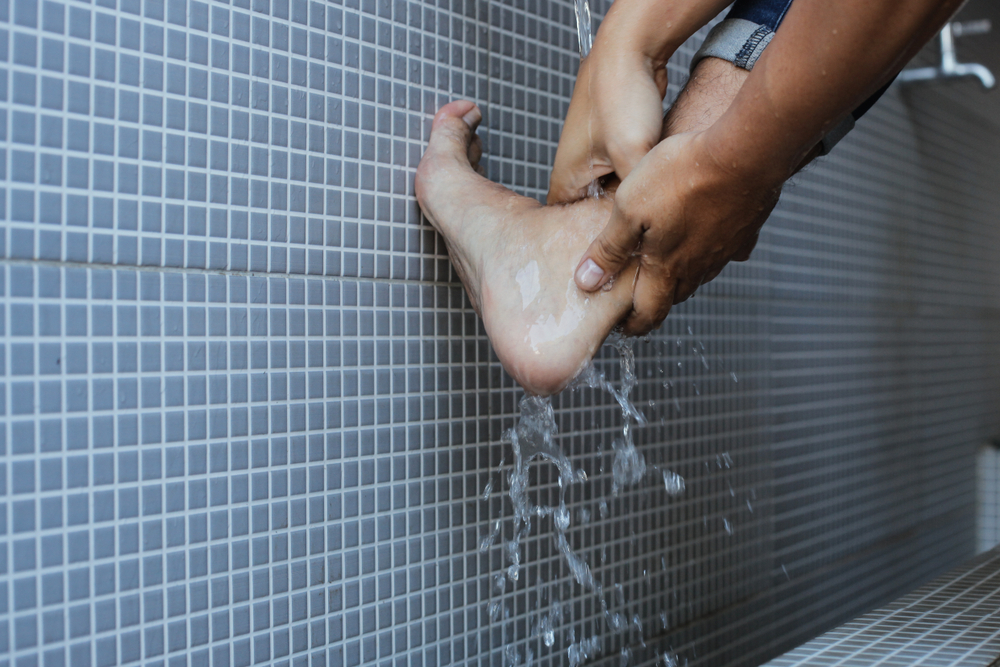
Pour water so it flows over your whole foot and past the ankle bones. Use your hand to guide the water over your heel, the sides, and between your toes.
This is all that is required. When the water has reached every part, you have completed the washing. Do not return to it out of doubt.
And Allah knows best.
[Shaykh] Faraz Rabbani
Related SeekersGuidance Answers
- The Ruling and Method of Washing the Feet in Wudu — Ustadh Tabraze Azam — the confirmed sunna of washing each foot three times and how to accomplish it.
- Difficulty Washing Feet in Wudu Due to Pregnancy — Ustadh Salman Younas — practical accommodations, and the ankles as part of the covered area for khuffs.
- Where Does the Face Begin and End in Ablution for a Person with a Receding Hairline? — Shaykh Irshaad Sedick — the parallel question for the face.
- Death by Wudu? — Shaykh Faraz Rabbani — the four obligatory acts of wudu set out.
Shaykh Faraz Rabbani is a recognized specialist scholar in the Islamic sciences, having studied under leading scholars from around the world. He is the Founder and Executive Director of SeekersGuidance.
Shaykh Faraz stands as a distinguished figure in Islamic scholarship. His journey in seeking knowledge is marked by dedication and depth. He spent ten years studying under some of the most revered scholars of our times. His initial studies took place in Damascus. He then continued in Amman, Jordan.
In Damascus, he was privileged to learn from the late Shaykh Adib al-Kallas. Shaykh Adib al-Kallas was renowned as the foremost theologian of his time. Shaykh Faraz also studied under Shaykh Hassan al-Hindi in Damascus. Shaykh Hassan is recognized as one of the leading Hanafi jurists of our era.
Upon completing his studies, Shaykh Faraz returned to Canada in 2007. His return marked a new chapter in his service to the community. He founded SeekersGuidance. The organization reflects his commitment to spreading Islamic knowledge. It aims to be reliable, relevant, inspiring, and accessible. This mission addresses both online and on-the-ground needs.
Shaykh Faraz is also an accomplished author. His notable work includes “Absolute Essentials of Islam: Faith, Prayer, and the Path of Salvation According to the Hanafi School.” This book, published by White Thread Press in 2004, is a significant contribution to Islamic literature.
His influence extends beyond his immediate community. Since 2011, Shaykh Faraz has been recognized as one of the 500 most influential Muslims. This recognition comes from the Royal Islamic Strategic Studies Center. It underscores his impact on the global Islamic discourse.
Shaykh Faraz Rabbani’s life and work embody a profound commitment to Islamic scholarship. His teachings continue to enlighten and guide seekers of knowledge worldwide.
«النصوص» · Source-Texts
[ابن عابدين، رد المحتار ١/٩٨] «قَوْلُهُ (وَالْكَعْبَيْنِ) هُمَا الْعَظْمَانِ النَّاشِزَانِ مِنْ جَانِبَيِ الْقَدَمِ أَيِ الْمُرْتَفِعَانِ، كَذَا فِي الْمُغْرِبِ وَصَحَّحَهُ فِي الْهِدَايَةِ وَغَيْرِهَا. وَرَوَى هِشَامٌ عَنْ مُحَمَّدٍ أَنَّهُ فِي ظَهْرِ الْقَدَمِ عِنْدَ مَعْقِدِ الشِّرَاكِ، قَالُوا هُوَ سَهْوٌ مِنْ هِشَامٍ، لِأَنَّ مُحَمَّدًا إِنَّمَا قَالَ ذَلِكَ فِي الْمُحْرِمِ إِذَا لَمْ يَجِدِ النَّعْلَيْنِ»
[ابن عابدين، رد المحتار ١/٩٨ — على دخول الكعبين] «وَعَدَلَ عَنِ التَّعْبِيرِ بِـ«إِلَى» الْمُحْتَمِلَةِ لِدُخُولِ الْمِرْفَقَيْنِ وَالْكَعْبَيْنِ وَعَدَمِهِ إِلَى التَّعْبِيرِ بِـ«مَعَ» الصَّرِيحَةِ بِالدُّخُولِ … بَعْدَ انْعِقَادِ الْإِجْمَاعِ عَلَى ذَلِكَ»
[ابن عابدين، رد المحتار، باب الإحرام — الفرق] «قَوْلُهُ (عِنْدَ مَعْقِدِ الشِّرَاكِ) وَهُوَ الْمَفْصِلُ الَّذِي فِي وَسَطِ الْقَدَمِ، كَذَا رَوَى هِشَامٌ عَنْ مُحَمَّدٍ، بِخِلَافِهِ فِي الْوُضُوءِ فَإِنَّهُ الْعَظْمُ النَّاتِئُ أَيِ الْمُرْتَفِعُ»
[الزيلعي، تبيين الحقائق ١/٣] «وَالْكَعْبُ هُوَ الْعَظْمُ النَّاتِئُ، وَرَوَى هِشَامٌ عَنْ مُحَمَّدٍ أَنَّهُ الْمَفْصِلُ الَّذِي عِنْدَ مَعْقِدِ الشِّرَاكِ، وَهُوَ سَهْوٌ مِنْهُ» —
[ابن نجيم، البحر الرائق ١/١٤] «وَالْكَعْبَانِ هُمَا الْعَظْمَانِ النَّاشِزَانِ مِنْ جَانِبَيِ الْقَدَمِ أَيِ الْمُرْتَفِعَانِ»
[الشرنبلالي، نور الإيضاح] «وَالثَّالِثُ: غَسْلُ رِجْلَيْهِ مَعَ كَعْبَيْهِ»
[الطحطاوي، حاشية على مراقي الفلاح ١/٥٩] «وَلَمْ يَجْمَعْهُمَا كَالْمَرَافِقِ … فَثَنَّاهُمَا لِإِفَادَةِ أَنَّ لِكُلِّ رِجْلٍ كَعْبَيْنِ»
[محمد بن الحسن الشيباني، الأصل ١/٩٤] «قُلْتُ: أَرَأَيْتَ الرَّجُلَ وَالْمَرْأَةَ، هُمَا سَوَاءٌ فِي الْغُسْلِ وَالْوُضُوءِ وَالْمَسْحِ عَلَى الْخُفَّيْنِ؟ قَالَ: نَعَمْ، هُمَا سَوَاءٌ فِي كُلِّ شَيْءٍ مِنَ الْوُضُوءِ وَالْغُسْلِ وَالْمَسْحِ عَلَى الْخُفَّيْنِ وَمَسْحِ الرَّأْسِ»
[القدوري، شرح مختصر الكرخي ١/٢٤١] «وَالرَّجُلُ وَالْمَرْأَةُ فِي ذَلِكَ سَوَاءٌ؛ لِأَنَّهُمَا لَا يَخْتَلِفَانِ فِي أَحْكَامِ الطَّهَارَةِ»
[صحيح مسلم ٢٤١، كتاب الطهارة، باب وجوب غسل الرجلين بكمالهما] «وَيْلٌ لِلْأَعْقَابِ مِنَ النَّارِ، أَسْبِغُوا الْوُضُوءَ» — عن عبد الله بن عمرو. ؛ وعند [صحيح البخاري ١٦٥، باب غسل الأعقاب] عن أبي هريرة
