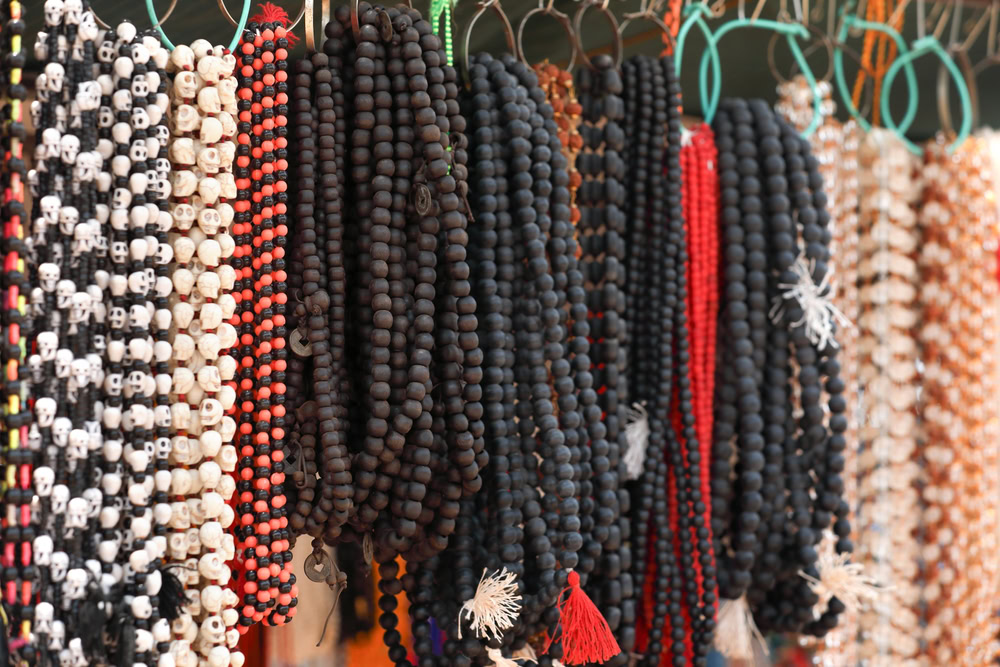
What Is the Ruling on Wearing Karungali as Jewelry Without Belief in Its Power?
Answered by Mawlana Ilyas Patel
Question
What is the ruling on wearing Karungali as jewelry without belief in its power, and what if it is worn believing it protects or brings benefit?
Answer
In the Name of Allah, the Most Merciful and Compassionate
I pray you are in good faith and health. Thank you for your question.
It is not permissible to wear Karungali, especially if purchased from a non-faith shop. Instead, buy ebony dhikr beads or misbaha locally or nationally from a Muslim shop or craftsman, choosing a slightly larger size for a necklace or a standard size for wristwear.
This qualifies as an unlawful imitation with a religious connotation linked to other faiths. It’s better to buy from religious-owned shops and artisans, as everything impacts us, from food to items we wear. Below are sample shops to give you an idea.
Ibn ‘Umar (Allah be pleased with him) reported: The Messenger of Allah (Allah bless him and give him peace) said, “Whoever imitates a people is one of them.” [Abu Dawud]
I would like you to go through the valuable answers and links below. In sha Allah, you will receive guidance and direction.
Related
- Karungali Malai
- Context for the Hadith: Whoever Imitates a People Is of Them
- How Can We Clearly Distinguish What Counts as Imitating
- Ebony wood misbahas
- Sindoor- History and Importance
Why not begin your search for knowledge by signing up for a course on SeekersAcademy (seekersguidance.org), like from the Islamic Studies Curriculum (seekersguidance.org), and build your way up, doing each course?
I pray this helps with your question.
Wassalam,
[Mawlana] Ilyas Patel
Checked and Approved by Shaykh Faraz Rabbani
Mawlana Ilyas Patel has received a traditional education in various countries. He started his schooling in the UK and completed his hifz of the Quran in India. After that, he joined an Islamic seminary in the UK, where he studied secular and Aalimiyya sciences. Later, he traveled to Karachi, Pakistan, and other Middle Eastern countries to further his education. Mawlana has served as an Imam in the Republic of Ireland for several years and taught the Quran and other Islamic sciences to both children and adults. He also worked as a teacher and librarian at a local Islamic seminary in the UK for 12 years. Presently, he lives in the UK with his wife and is interested in books and gardening.
